
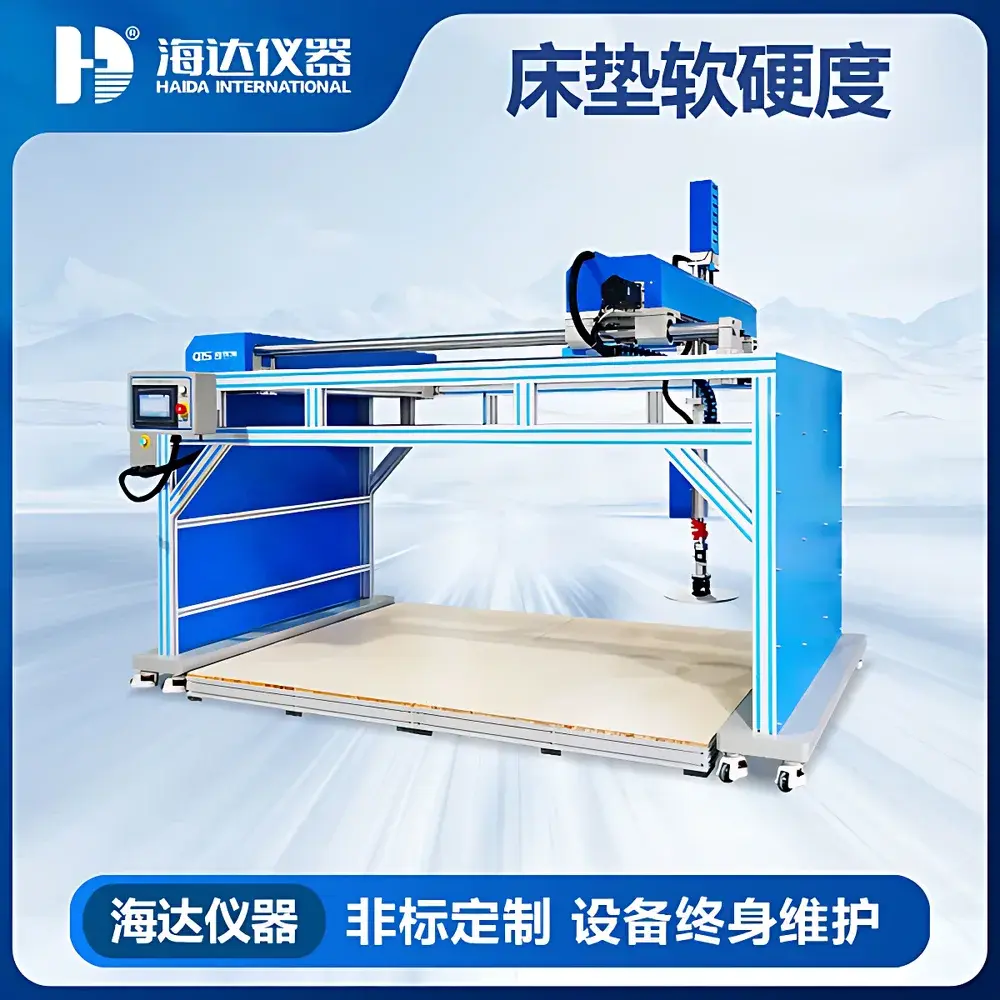
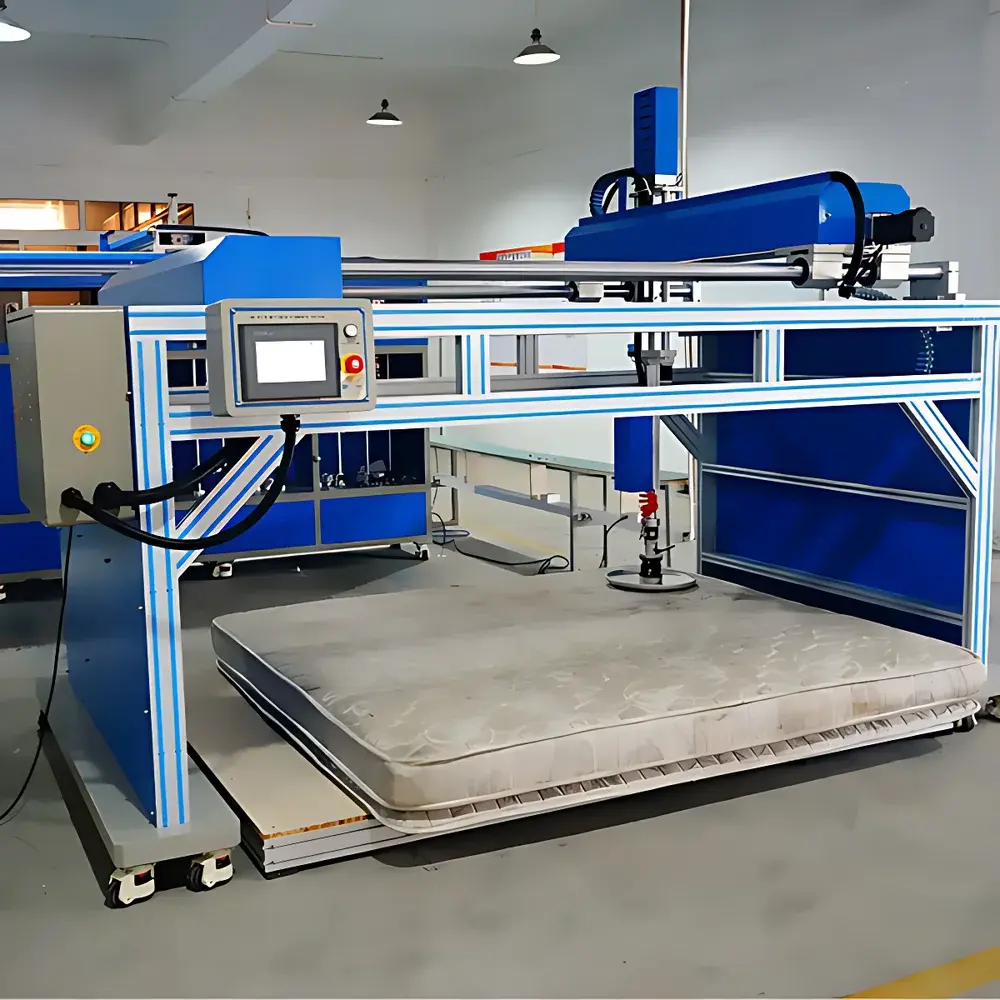
HAIDA HD-F779 Mattress Firmness and Compression Tester
| Brand | HAIDA INTERNATIONAL |
|---|---|
| Origin | Guangdong, China |
| Manufacturer Type | Direct Manufacturer |
| Product Category | Domestic (China-Made) |
| Model | HAIDA HD-F779 Mattress Firmness and Compression Tester |
| Pricing | Available Upon Request |
| Max Load Capacity | 2 kN |
| Force Range | 3–1400 N |
| Test Speed | 20–300 mm/min |
| Load Resolution | 1/250,000 |
| Vertical Stroke | 0–1800 mm (adjustable) |
| Horizontal Adjustment Range | 0–1150 mm (adjustable) |
| Electro-cylinder Travel | 350 mm |
| Compliance | EN 1957:2012, QB/T 1952.2–2011, ASTM F1566–22 |
| Sample Dimensions (Max) | 2200 × 2200 × 400 mm (L×W×H) |
| Overall Dimensions (Max) | 3050 × 2050 × 2300 mm (L×W×H) |
| Weight | ~950 kg |
| Power Supply | 1∮ AC 220 V |
| Power Consumption | ~750 W |
| Data Output | USB interface |
| Reporting | Automated test report generation |
Overview
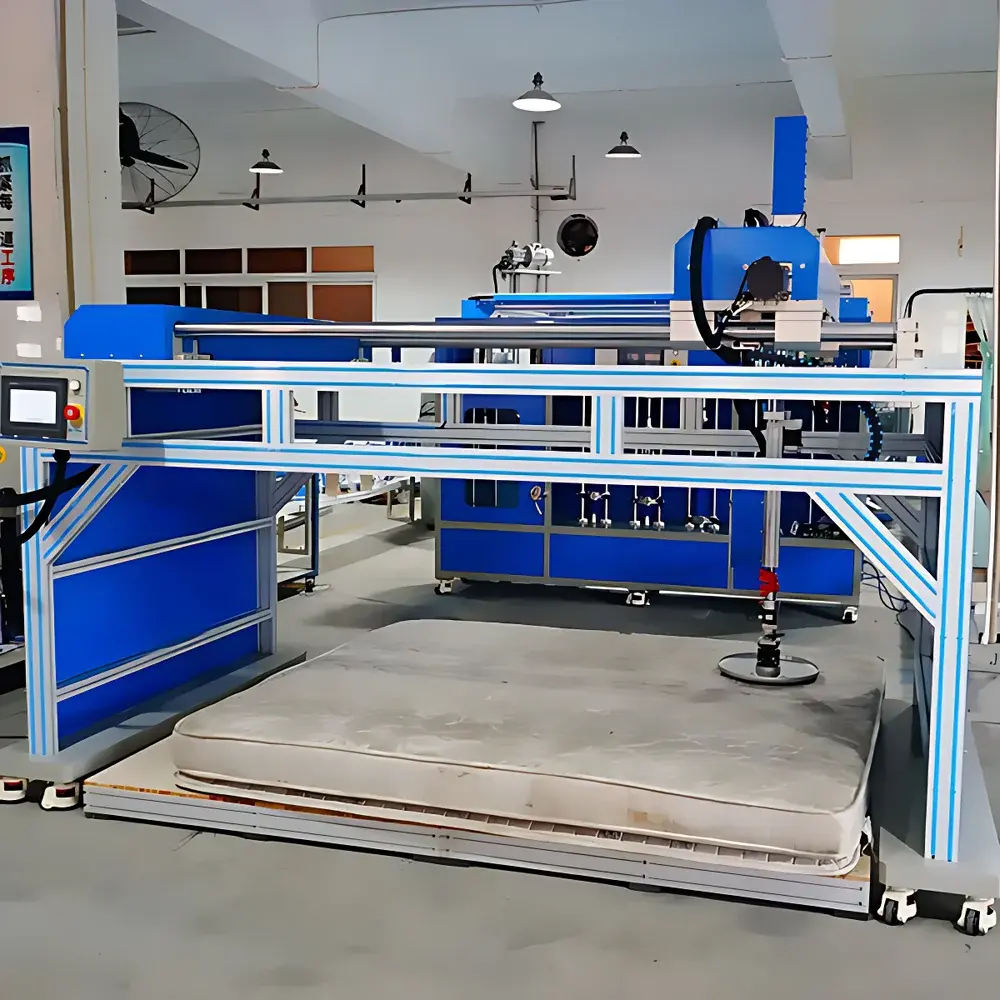
The HAIDA HD-F779 Mattress Firmness and Compression Tester is an engineered mechanical testing system designed for standardized evaluation of mattress structural response under controlled quasi-static compression. It operates on the principle of force-displacement transduction using high-accuracy load cells and precision electro-cylinders, enabling repeatable measurement of indentation resistance, height loss, and load-deflection behavior across multiple test points. The instrument implements defined loading protocols per internationally recognized standards—including EN 1957:2012 (Clause 7.3, 8.1, 8.2), ASTM F1566–22 (Section 6), and QB/T 1952.2–2011 (Annex A)—to quantify firmness classification, support consistency, and durability-related deformation metrics. Its architecture supports both single-point and multi-point spatial sampling (up to five locations for innerspring mattresses; two for foam or hybrid units), ensuring representative characterization of heterogeneous support layers.
Key Features
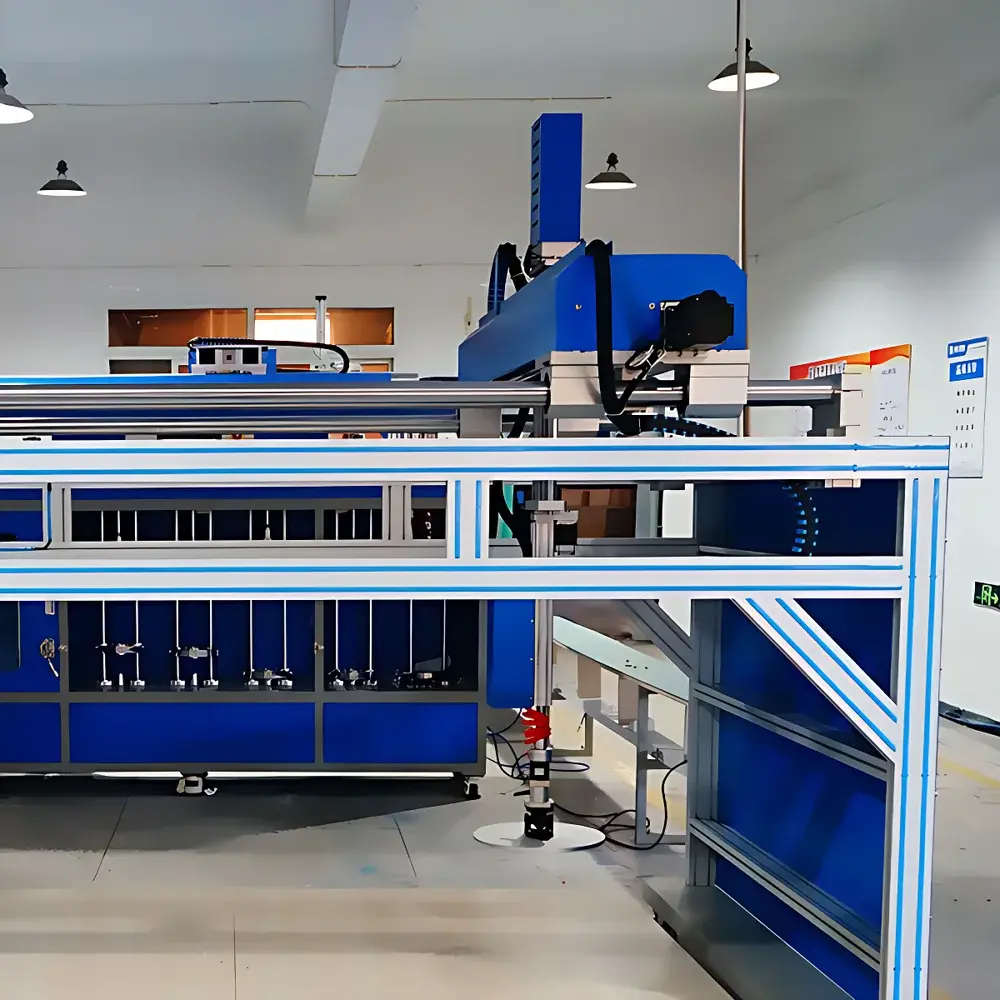
- Modular aluminum frame construction with corrosion-resistant surface treatment, offering structural rigidity and long-term dimensional stability under repeated 2 kN loading cycles.
- SMC high-precision electro-cylinder actuation system delivering smooth, backlash-free vertical motion with programmable speed control (20–300 mm/min) and positional repeatability ≤ ±0.1 mm.
- Dual-axis manual adjustment mechanism: vertical stroke range up to 1800 mm and horizontal positioning range up to 1150 mm—enabling precise alignment over large-format specimens (max 2200 × 2200 mm).
- German-sourced 2 kN load cell with 1/250,000 internal resolution and temperature-compensated output, calibrated traceable to national metrology standards.
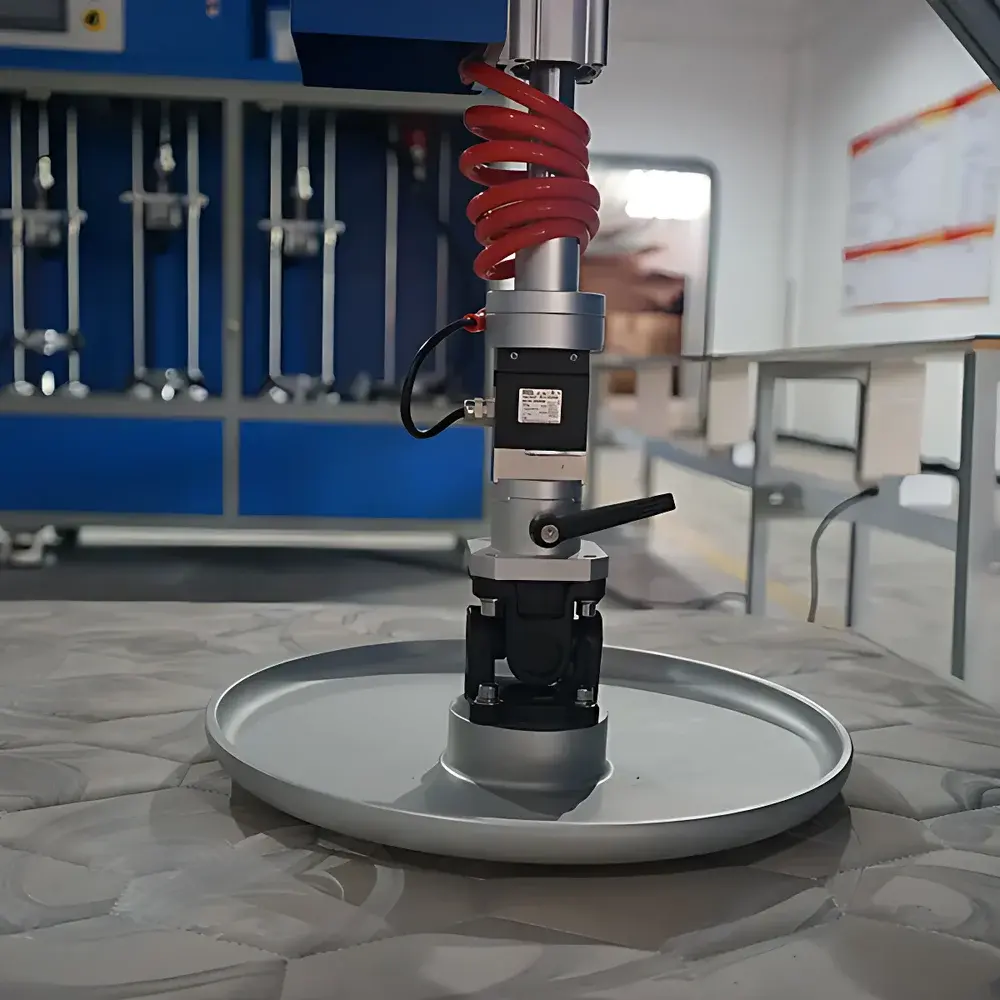
- Interchangeable indenter assemblies: standard 344 ± 5 mm aluminum circular platen (ASTM-compliant), optional 355 mm rigid cylinder (EN/QB-compliant), and 100 mm cylinder for height-loss reference measurements.
- Integrated touchscreen HMI with intuitive navigation, real-time force/displacement plotting, and on-device parameter configuration—including pre-load sequences, dwell times, and multi-step ramp profiles.
Sample Compatibility & Compliance
The HD-F779 accommodates full-size mattress formats up to 2200 mm × 2200 mm × 400 mm (L×W×H), including innerspring, memory foam, latex, hybrid, and airbed constructions. Its dual-test-point protocol satisfies QB/T 1952.2–2011 requirements for non-spring units, while the five-point grid mapping aligns with EN 1957’s spatial sampling mandate for coil-based systems. All test routines enforce strict adherence to standard-defined parameters: pre-compression at 250 mm/min to 778 ± 5 N (two cycles), 6 ± 1 minute recovery, zeroing at 4.4 N contact force, and final loading to 778 N at 50 ± 5 mm/min. Height loss is measured before and after 100-roll conditioning per EN 1957 Clause 8.1. Force-deflection curves are generated at discrete indentation depths (12.5, 25, 38, 50, 63, 76 mm) or discrete load points (210–340 N at 2 N intervals), supporting classification into ISO-defined firmness grades (e.g., soft, medium-firm, firm).
Software & Data Management
The proprietary HAIDA TestSuite v3.2 firmware provides full control over test sequencing, data acquisition, and post-processing. It supports GLP-aligned audit trails—including user login timestamps, parameter change logs, and calibration history—with exportable CSV and PDF reports compliant with internal QA documentation workflows. USB-based data transfer enables offline analysis in third-party platforms (e.g., MATLAB, Excel). Firmware includes built-in safety interlocks: emergency stop activation, over-travel limit detection, short-circuit protection, and power-fail resume functionality that preserves current test state upon unexpected shutdown. All test configurations are saved as reusable templates, reducing setup time across batch testing.
Applications
- Quality assurance of finished mattress units prior to packaging and distribution.
- R&D validation of new foam formulations, coil tension profiles, and layer stacking architectures.
- Comparative benchmarking against competitor products using standardized indentation metrics.
- Supporting regulatory submissions requiring EN 1957 or ASTM F1566 conformance evidence.
- Supplier qualification testing for raw material batches (e.g., polyurethane density variation, latex resilience deviation).
- Long-term durability assessment via repeated compression cycling combined with height-loss trending.
FAQ
What standards does the HD-F779 fully support out-of-the-box?
EN 1957:2012, ASTM F1566–22, and QB/T 1952.2–2011 are natively embedded in test templates, including correct pre-load counts, dwell durations, speed tolerances, and reporting fields.
Can the system perform automated multi-cycle fatigue testing?
No—the HD-F779 is optimized for static and quasi-static compression profiling. For cyclic endurance testing, HAIDA recommends the HD-F800 series fatigue platform.
Is calibration certification included with shipment?
Yes—a factory calibration certificate traceable to CNAS-accredited standards is supplied with each unit, along with a 12-month calibration validity statement.
What maintenance intervals are recommended?
Lubrication of linear guides every 6 months; annual verification of load cell linearity and electro-cylinder position encoder accuracy using HAIDA-certified service kits.
Does the software comply with FDA 21 CFR Part 11 requirements?
The base firmware does not include electronic signature or role-based access control modules; however, Part 11 compliance can be achieved through optional GxP add-on licensing and external LIMS integration.



