
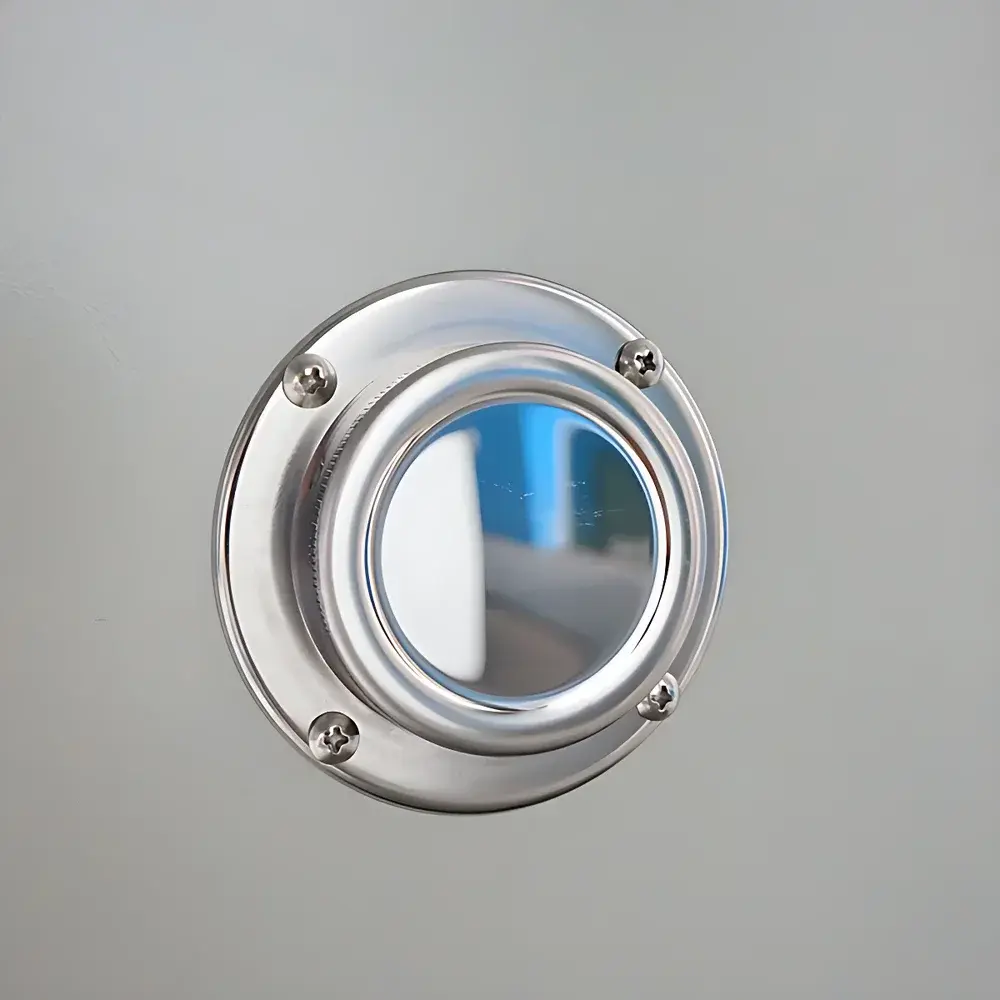
HAIDA HD-H203 Battery Explosion-Proof Test Chamber
| Brand | HAIDA INTERNATIONAL |
|---|---|
| Origin | Guangdong, China |
| Manufacturer Type | Direct Manufacturer |
| Origin Category | Domestic (China) |
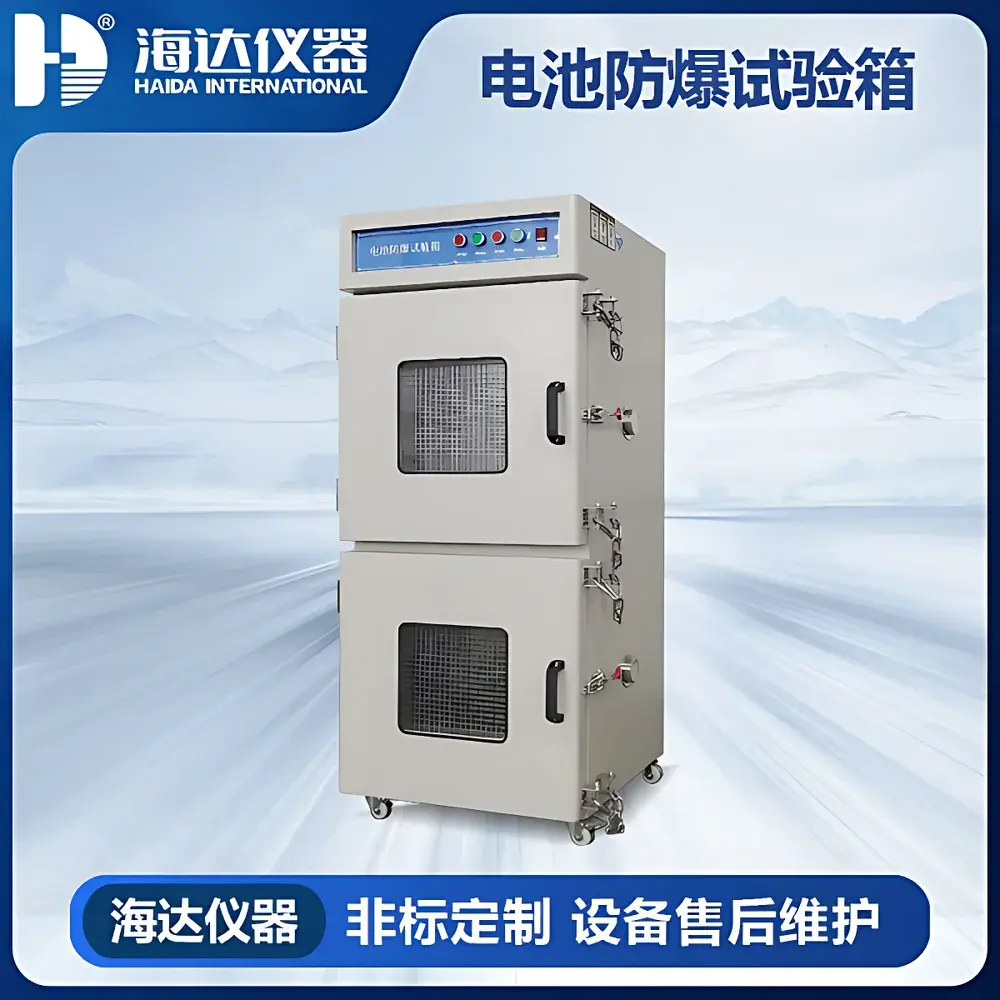
| Model | HD-H203 Battery Explosion-Proof Test Chamber |
| Quotation | Upon Request |
| Internal Dimensions | 500 × 500 × 500 mm (W × D × H) |
| External Dimensions | 680 × 750 × 1375 mm (W × D × H) |
| Inner Chamber Material | 1.2 mm thick SUS304 stainless steel with PTFE lining |
| Outer Enclosure Material | 1.5 mm cold-rolled steel with baked enamel finish |
| Observation Window | 250 × 250 mm dual-layer tempered glass with embedded stainless-steel mesh |
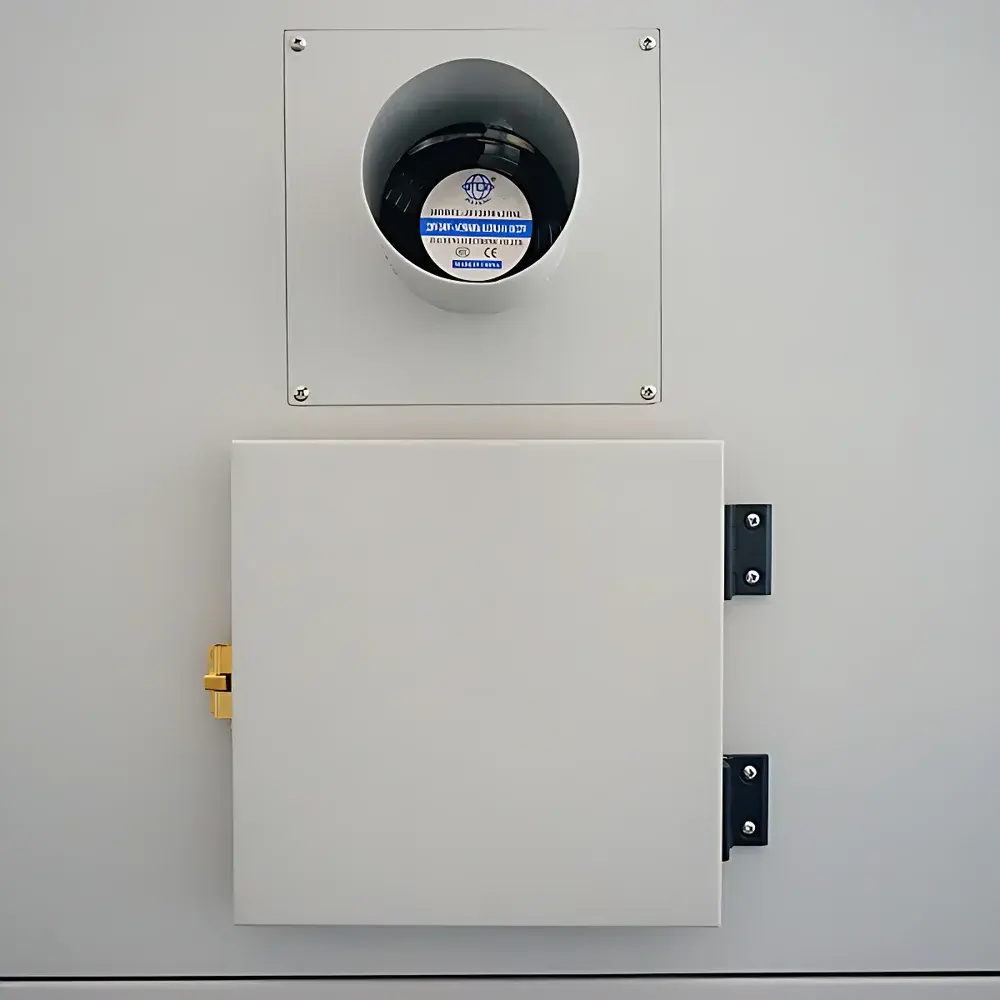
| Exhaust Port | Ø100 mm, rear-mounted |
| Pressure Relief Opening | 200 × 200 mm, rear-mounted, spring-actuated passive venting mechanism |
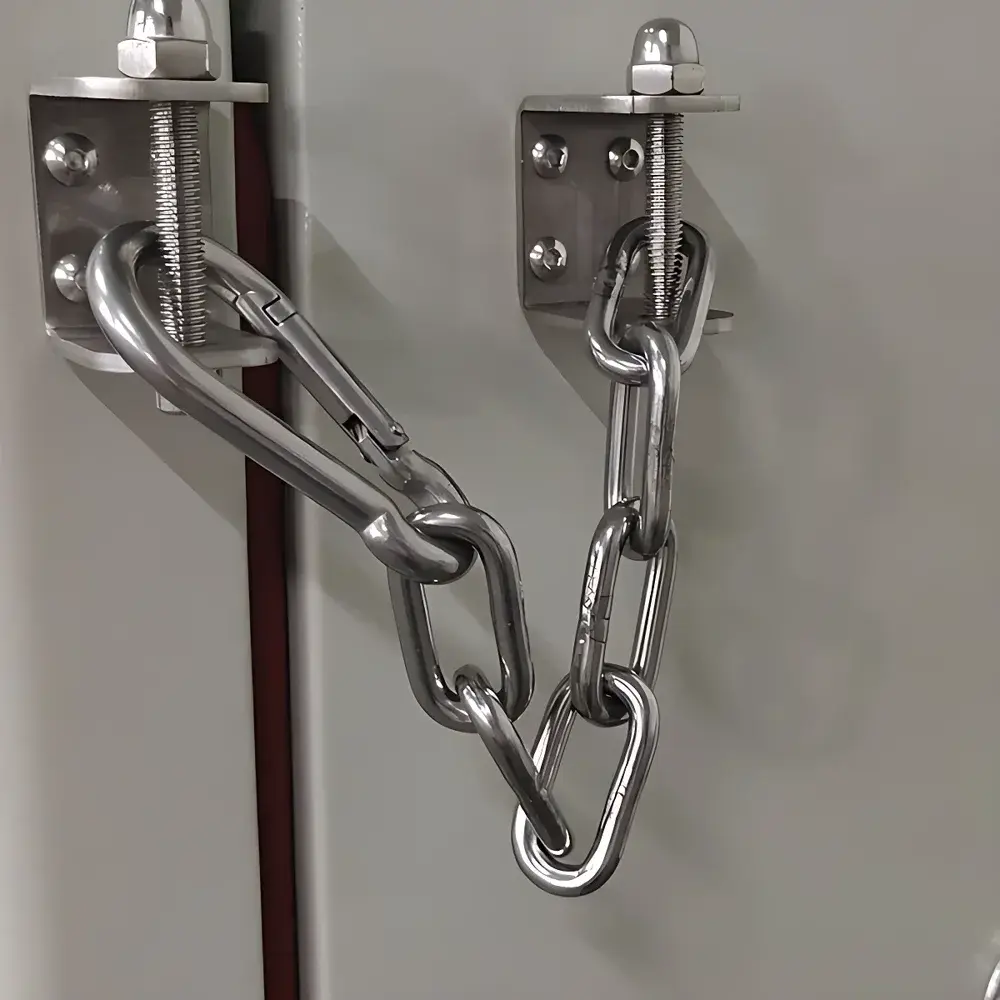
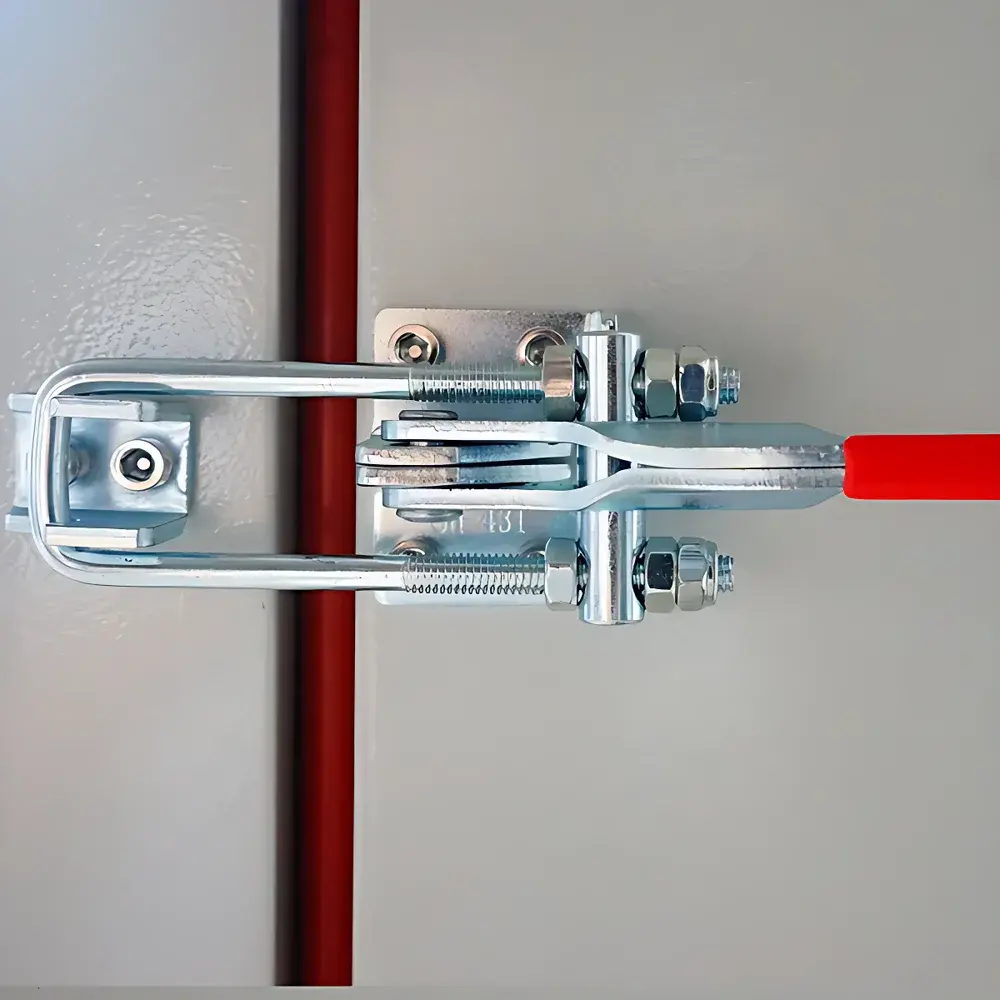
| Door Configuration | Single left-hinged door with explosion-resistant safety chain |
| Test Port | One Ø50 mm feedthrough on left side for thermocouples, voltage/current probes, and data cables |
| Mobility | Four swivel casters with locking brakes |
| Illumination | Integrated LED interior lighting |
| Control Interface | Push-button panel |
| Power Supply | AC 220 V, 200 W |
| Net Weight | 65 kg |
Overview
The HAIDA HD-H203 Battery Explosion-Proof Test Chamber is an engineered safety containment system designed specifically for high-risk electrochemical testing of lithium-ion and other advanced battery cells and modules under controlled hazardous conditions. It operates on the principle of passive pressure containment and rapid mechanical venting—leveraging a rigid, double-walled structural architecture to isolate thermal runaway events, internal combustion, or deflagration during overcharge, overdischarge, short-circuit, or forced thermal propagation tests. Unlike generic environmental chambers, the HD-H203 integrates certified mechanical safety features—including a calibrated pressure-relief vent, reinforced observation window assembly, and explosion-rated electrical feedthroughs—to comply with stringent physical safety requirements in battery development labs, quality assurance departments, and third-party certification facilities serving the hydrogen energy and electric mobility sectors.
Key Features
- Robust dual-layer chamber construction: 1.2 mm SUS304 stainless steel inner liner with PTFE surface coating for corrosion resistance and non-reactive sample exposure; outer shell fabricated from 1.5 mm cold-rolled steel with industrial-grade baked enamel finish.
- Passive pressure relief system: Rear-mounted 200 × 200 mm spring-loaded vent panel engineered to activate at defined overpressure thresholds—diverting explosive force away from operators and adjacent instrumentation without requiring external actuation or power.
- Optically safe observation interface: 250 × 250 mm dual-pane tempered glass viewport integrated with embedded stainless-steel wire mesh (mesh size ≤ 1 mm), providing real-time visual monitoring while maintaining structural integrity against shrapnel and flame ejection.
- Configurable test integration: Single Ø50 mm cable port on the left side, sealed with silicone grommet, supports simultaneous routing of thermocouple wires, voltage taps, current shunts, and digital sensor leads—enabling synchronized electrochemical and thermal data acquisition.
- Operator-centric ergonomics: Left-hinged access door fitted with redundant mechanical safety chain; four heavy-duty swivel casters with locking brakes for repositioning within ISO-classified lab spaces; integrated LED lighting with glare-reducing diffuser.
Sample Compatibility & Compliance
The HD-H203 accommodates prismatic, cylindrical, and pouch-format battery cells up to 500 mm in any dimension, supporting both single-cell and small-module (≤3S2P) configurations. Its design aligns with mechanical safety provisions outlined in key international standards including GB/T 31485–2015 (Electric Vehicle Traction Batteries), GB 31241–2014 (Portable Lithium Batteries), UN Manual of Tests and Criteria, Part III, subsection 38.3 (2012 edition), and IEC 62133–2012 (Secondary Cells and Batteries Containing Alkaline or Other Non-acid Electrolytes). While the chamber itself does not perform electrical testing, its containment performance is validated for use in conjunction with programmable battery cyclers, DC power supplies, and thermal imaging systems under GLP-compliant test protocols.
Software & Data Management
The HD-H203 is a hardware-only safety platform with no embedded firmware or proprietary software. All data acquisition, test sequencing, and safety interlocking must be managed externally via user-supplied instrumentation—such as Arbin, Bitrode, or Neware battery testers—configured to meet FDA 21 CFR Part 11 requirements where applicable. The chamber’s mechanical interfaces (e.g., feedthroughs, grounding lugs, and vent alignment marks) are dimensionally referenced to facilitate traceable integration into validated test workflows. Documentation includes a factory calibration certificate for structural integrity verification, ISO/IEC 17025-aligned manufacturing records, and full traceability of material certifications (e.g., SUS304 mill test reports).
Applications
- Safety validation of lithium-based chemistries (NMC, LFP, LCO, solid-state) during abuse testing per UL 1642, UL 2580, and ISO 12405 series standards.
- Thermal runaway propagation studies in multi-cell battery packs under controlled ambient conditions.
- Pre-certification screening for UN 38.3 transport compliance, particularly T.1 (altitude simulation), T.2 (thermal cycling), T.3 (vibration), and T.4 (shock).
- QC/QA verification in battery manufacturing lines where in-process safety containment is mandated by OEM technical specifications.
- Research-level investigation of vent gas composition, flame dynamics, and pressure transients using auxiliary mass spectrometry or FTIR gas analyzers connected via the Ø50 mm port.
FAQ
Does the HD-H203 include built-in data logging or remote monitoring capabilities?
No—the HD-H203 is a passive mechanical containment system without embedded sensors, controllers, or network interfaces. All measurement and control functions must be implemented externally.
Can the internal dimensions be customized beyond the standard 500 × 500 × 500 mm configuration?
Yes—HAIDA offers OEM engineering services for modified chamber volumes, alternate port layouts, and specialized material linings (e.g., Hastelloy or ceramic-coated variants) upon formal technical specification submission.
Is the pressure relief vent pre-calibrated, and can its activation threshold be adjusted?
The vent mechanism is factory-set to open at approximately 15–20 kPa gauge pressure (typical for Li-ion cell rupture scenarios); adjustment is not user-serviceable and requires recalibration by authorized HAIDA service personnel.
What grounding provisions are included for ESD-sensitive battery testing?
The chamber features a dedicated M6 brass grounding stud on the rear panel, rated for ≤1 Ω resistance to earth ground when installed per IEC 61340-5-1 guidelines.
Are replacement PTFE liners and tempered glass viewports available as spare parts?
Yes—original-specification consumables and wear components are stocked globally and supplied with material traceability documentation.





