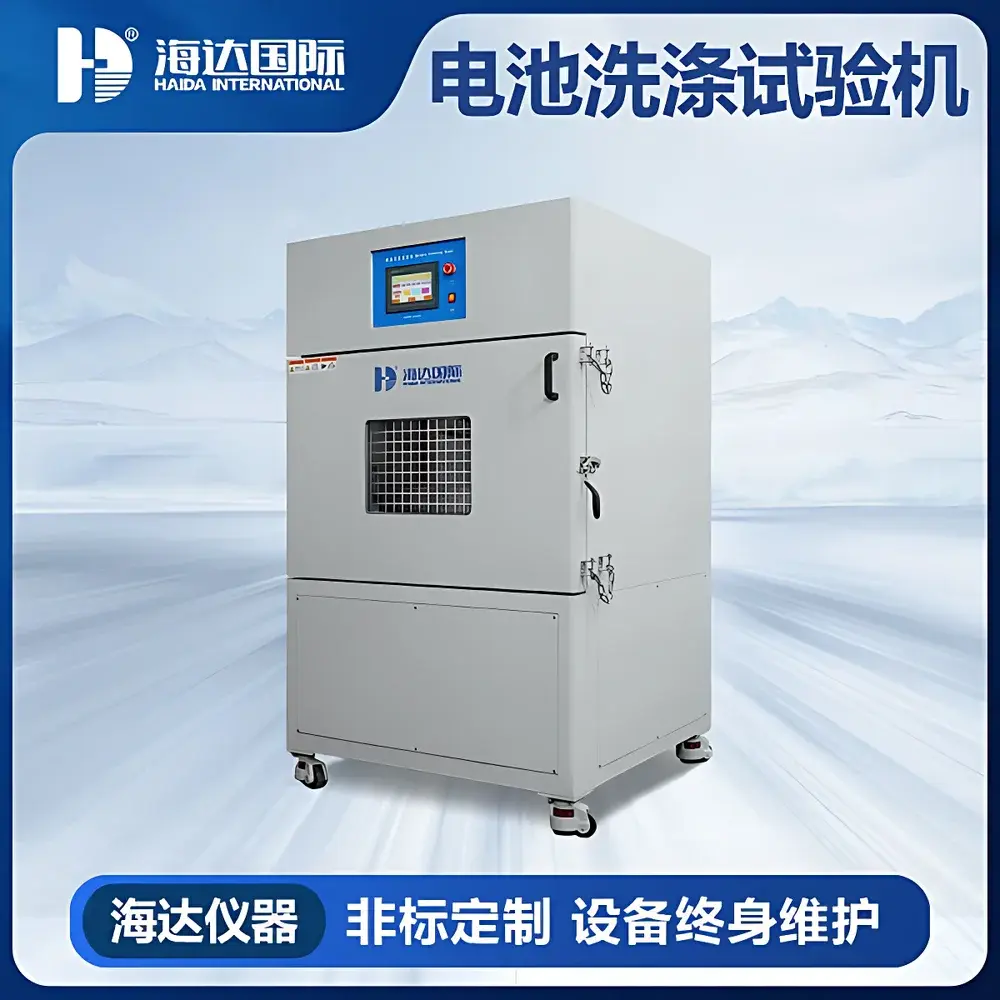
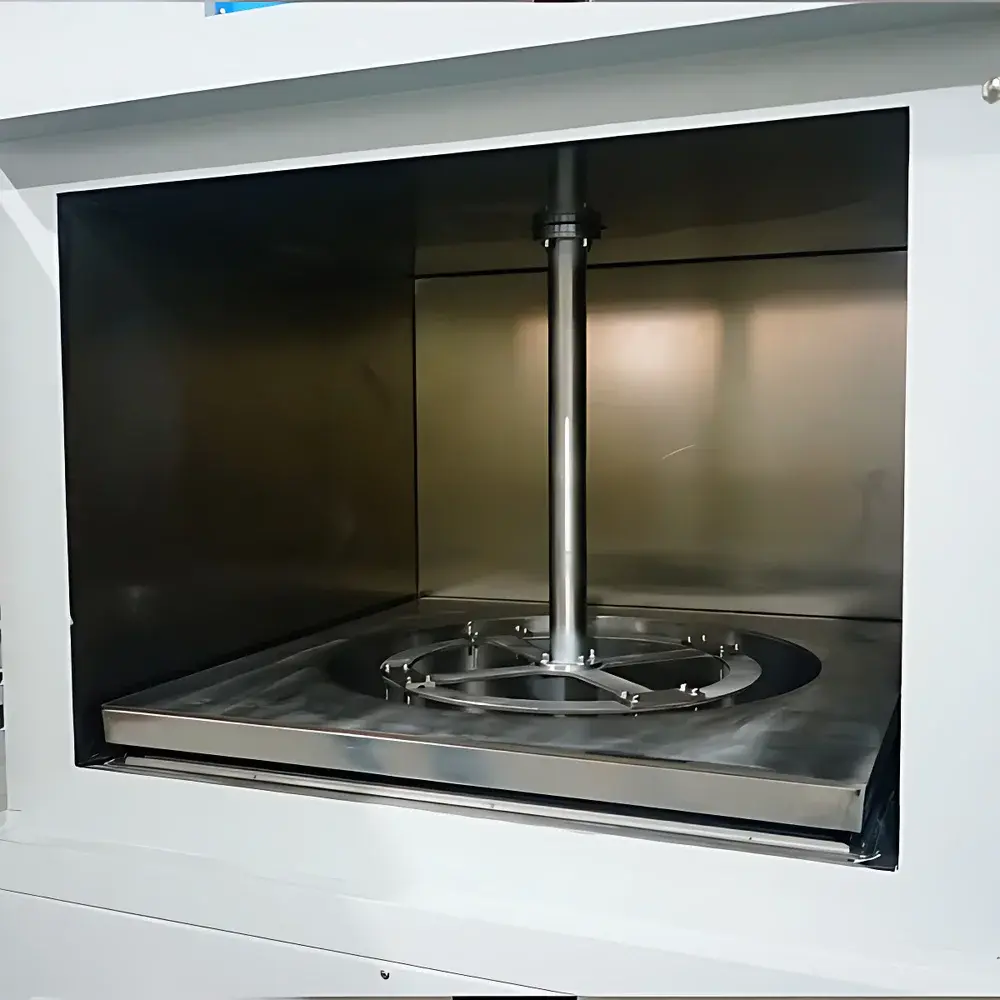
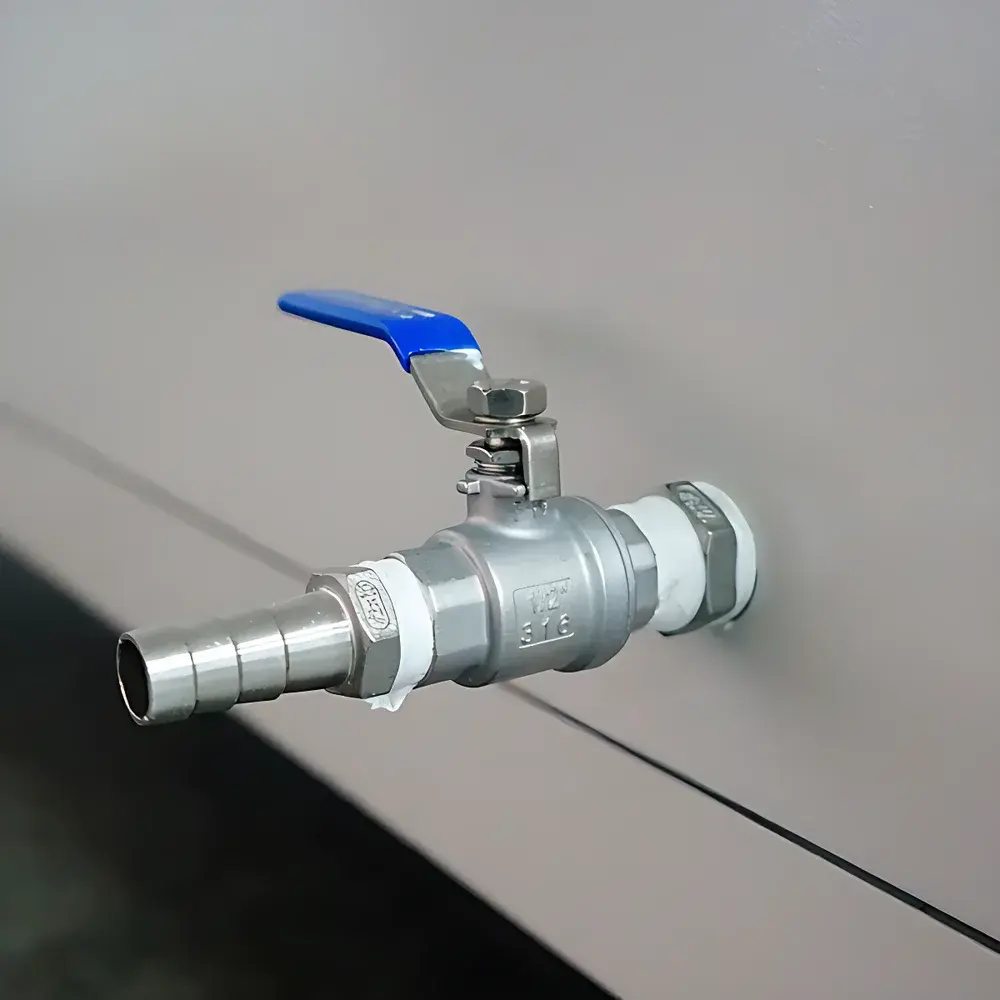
HAIDA HD-H211 Battery Washing Test Machine
| Brand | HAIDA INTERNATIONAL |
|---|---|
| Origin | Guangdong, China |
| Manufacturer Type | Manufacturer |
| Product Origin | Domestic (China) |
| Model | HD-H211 |
| Quotation | Upon Request |
| Control System | PLC + Touchscreen HMI |
| Drive Mechanism | Servo Motor |
| Solution Temperature Range | Ambient to 80 °C (adjustable) |
| Standard Test Temp | 45 ± 2 °C |
| Test Drum Outer Diameter | Ø500 ± 10 mm |
| Inner Tank Diameter | 650 mm |
| Inner Tank Depth | 600 mm |
| Rotational Speed | 1–999 rpm (adjustable) |
| Inner Chamber Material | SUS#304 Stainless Steel |
| Outer Casing Material | Cold-Rolled Steel with Powder Coating |
| Test Duration Range | 0–9999 h/min/sec (programmable) |
| Temperature Control Method | PID Algorithm |
| Test Solution | pH 11.0 ± 0.1 (e.g., 0.004 wt% NaOH), heated to 45 ± 2 °C |
| Sample Immersion Depth | Battery center positioned at 300 ± 10 mm below liquid surface |
| Inner Chamber Dimensions (W×D×H) | 900 × 900 × 645 mm |
| Overall Dimensions (W×D×H) | 1200 × 1150 × 1880 mm |
| Net Weight | 230 kg |
| Power Supply | AC 220 V, 50/60 Hz |
| Rated Power | 6 kW |
| Operating Environment | Ambient Temp. 0–35 °C |
Overview
The HAIDA HD-H211 Battery Washing Test Machine is a purpose-built environmental reliability testing system engineered for evaluating the structural integrity and sealing performance of lithium-ion batteries and battery packs under simulated laundry exposure conditions. Designed in strict alignment with GB 31241–2014 “Safety Requirements for Lithium-ion Batteries and Battery Packs for Portable Electronic Products”, this apparatus replicates the mechanical agitation, thermal stress, and alkaline chemical exposure encountered during accidental immersion in detergent solutions—particularly relevant for batteries integrated into wearable devices, pocket-carried electronics, and non-user-replaceable handheld products. The system operates on the principle of controlled rotational immersion: samples are rigidly mounted on a servo-driven rotating drum submerged in a temperature-regulated, high-pH aqueous solution, enabling reproducible simulation of mechanical shear forces and electrochemical corrosion pathways. Its robust architecture supports long-duration, unattended operation while maintaining traceable thermal and rotational parameters—critical for compliance-driven test protocols in R&D, quality assurance, and regulatory submission workflows.
Key Features
- PLC-based control system with intuitive touchscreen HMI for real-time monitoring, parameter programming, and test sequence execution
- Precision servo motor drive delivering stable, low-vibration rotation across full speed range (1–999 rpm), ensuring consistent mechanical loading
- High-accuracy PID temperature regulation (±2 °C tolerance at 45 °C) with independent heating elements and insulated stainless-steel tank
- Corrosion-resistant inner chamber constructed from SUS#304 stainless steel (thickness ≥1.5 mm), validated for prolonged exposure to alkaline solutions (pH 11.0 ± 0.1)
- Programmable test duration up to 9999 hours, minutes, or seconds—enabling extended durability assessment per customized test plans
- Integrated sample mounting fixture designed to maintain precise immersion depth (300 ± 10 mm from liquid surface to battery center), as mandated by GB 31241–2014 Clause 7.7
- Modular electrical architecture compliant with IEC 61000-6-3 (EMC) and IEC 61000-6-2 (immunity), with dedicated grounding provisions for safe operation in shared lab environments
Sample Compatibility & Compliance
The HD-H211 accommodates a broad spectrum of portable battery configurations, including prismatic, cylindrical, and pouch-type cells; single-cell modules; and multi-cell battery packs with integrated BMS—provided physical dimensions permit secure fixation on the rotating drum and full submersion within the 650 mm diameter × 600 mm depth tank. It is explicitly validated for use with lithium-ion chemistries employed in consumer electronics, medical wearables, and industrial IoT devices where end-user exposure to laundering conditions cannot be fully excluded. Regulatory alignment extends beyond GB 31241–2014 to support internal adoption of UL 2054 Annex M (washing simulation), IEC 62133-2:2017 Clause 7.7.2 (mechanical stress under wet conditions), and UN 38.3 Section 38.3.11 (optional supplementary evaluation). All operational parameters—including temperature logging, speed verification, and runtime tracking—are recorded with timestamped digital audit trails, facilitating GLP-compliant documentation and FDA 21 CFR Part 11–ready data archiving when integrated with validated third-party LIMS platforms.
Software & Data Management
The embedded control firmware supports dual-mode operation: standalone mode for basic test execution and PC-linked mode via RS485/Modbus RTU or optional Ethernet interface. Test logs—including setpoints, actual temperature profiles, rotational speed feedback, elapsed time, and system fault codes—are stored internally (≥10,000 record capacity) and exportable via USB flash drive in CSV format. Optional HAIDA TestSuite software (v3.2+) provides advanced features: automated report generation (PDF/Excel), comparative trend analysis across multiple test runs, alarm threshold configuration (e.g., temperature deviation > ±3 °C triggers immediate halt), and configurable electronic signature workflows for QA sign-off. Data integrity safeguards include write-protected memory partitions, cyclic redundancy checks (CRC-16) on all logged entries, and tamper-evident file naming conventions (e.g., “HDH211_20240522_142833_RUN087.csv”).
Applications
- Pre-certification validation of battery enclosures against washing-induced ingress (IPX7/IPX8 equivalent under dynamic agitation)
- Failure mode analysis of sealant adhesion, gasket compression set, and terminal insulation degradation under combined thermal–chemical–mechanical stress
- Comparative lifecycle assessment of alternative packaging materials (e.g., silicone vs. thermoplastic elastomer gaskets)
- Root cause investigation of field returns linked to moisture-related short circuits or electrolyte leakage
- Supporting Design Failure Mode and Effects Analysis (DFMEA) for next-generation battery-integrated wearables and smart apparel
- Internal conformance screening prior to third-party safety certification (e.g., CCC, CB Scheme, PSE)
FAQ
What standards does the HD-H211 specifically support?
The system is engineered to execute the washing test procedure defined in GB 31241–2014 Section 7.7, and its mechanical and thermal specifications align with requirements in UL 2054 Annex M and IEC 62133-2:2017 Clause 7.7.2.
Can the machine accommodate custom test solutions beyond pH 11.0?
Yes—the temperature and agitation parameters remain valid for other aqueous alkaline formulations; however, users must verify material compatibility of SUS#304 with alternative chemistries and document deviations per internal QA protocols.
Is remote monitoring or integration with factory MES systems possible?
Standard RS485/Modbus RTU enables integration with SCADA or MES platforms; optional Ethernet module (HD-ETH-01) supports TCP/IP communication and OPC UA server deployment.
What maintenance intervals are recommended for sustained accuracy?
Biannual calibration of temperature sensors (traceable to NIST-certified reference) and annual verification of rotational speed accuracy using optical tachometry are advised; full preventive maintenance occurs every 24 months or after 5,000 operating hours.
Does the system include test report templates compliant with ISO/IEC 17025?
Yes—preformatted Excel and PDF report templates are supplied, pre-populated with mandatory fields per CNAS-CL01:2018 and include space for analyst signature, equipment calibration status, and environmental condition logs.