
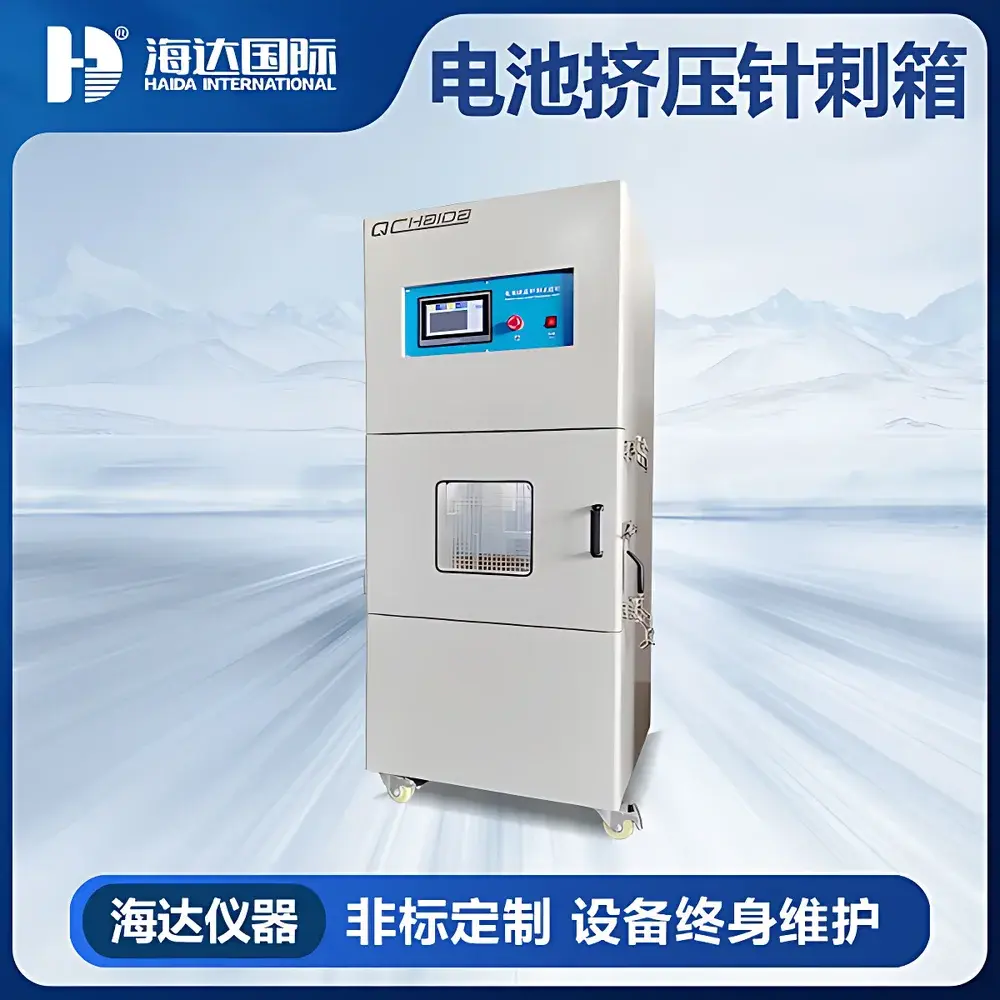
HAIDA HD-H212 Battery Crush & Nail Penetration Test Chamber
| Brand | HAIDA INTERNATIONAL |
|---|---|
| Origin | Guangdong, China |
| Manufacturer Type | Direct Manufacturer |
| Country of Origin | China |
| Model | HD-H212 |
| Quotation | Upon Request |
| Internal Chamber Dimensions (W×D×H) | 520 × 450 × 560 mm |
| External Dimensions (W×D×H) | 800 × 700 × 1730 mm |
| Internal Material | 1.2 mm thick SUS#304 stainless steel |
| External Material | 1.5 mm thick A3 steel with baked enamel finish |
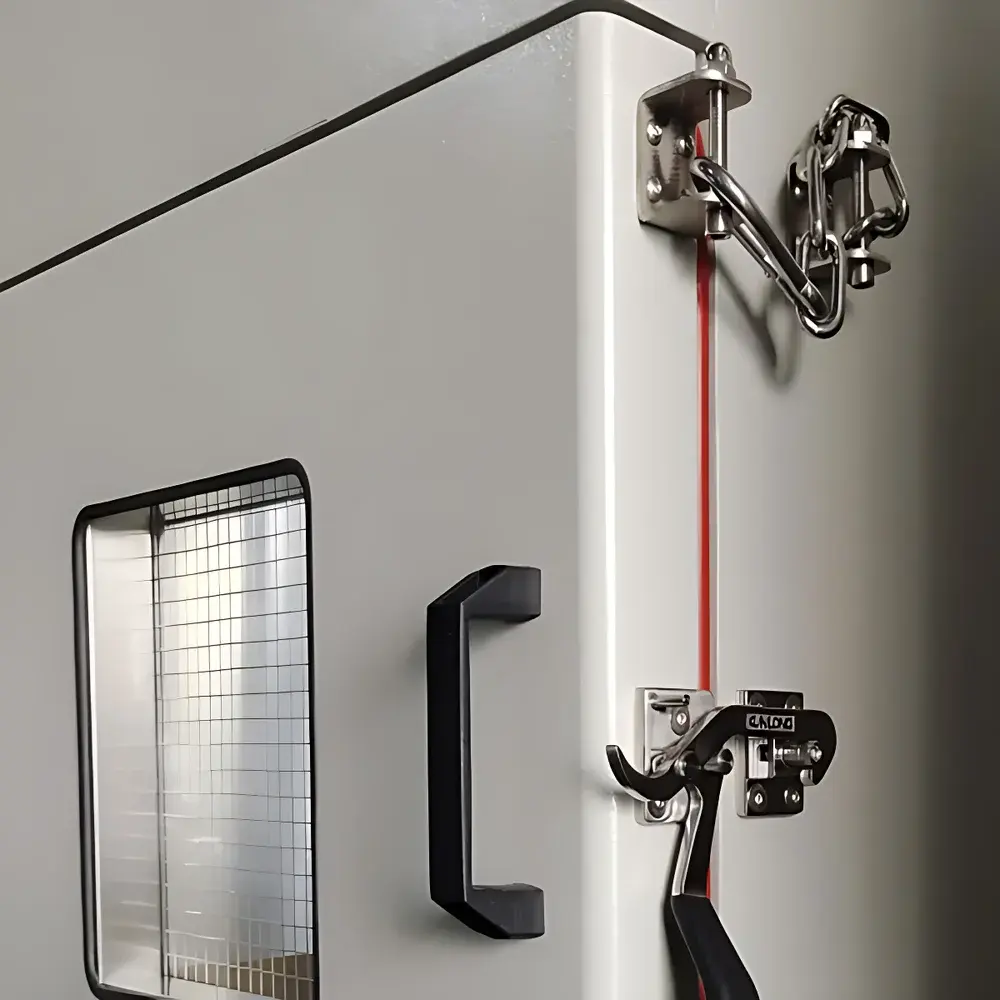
| Observation Window | 250 × 250 mm dual-layer tempered glass with embedded stainless-steel mesh |
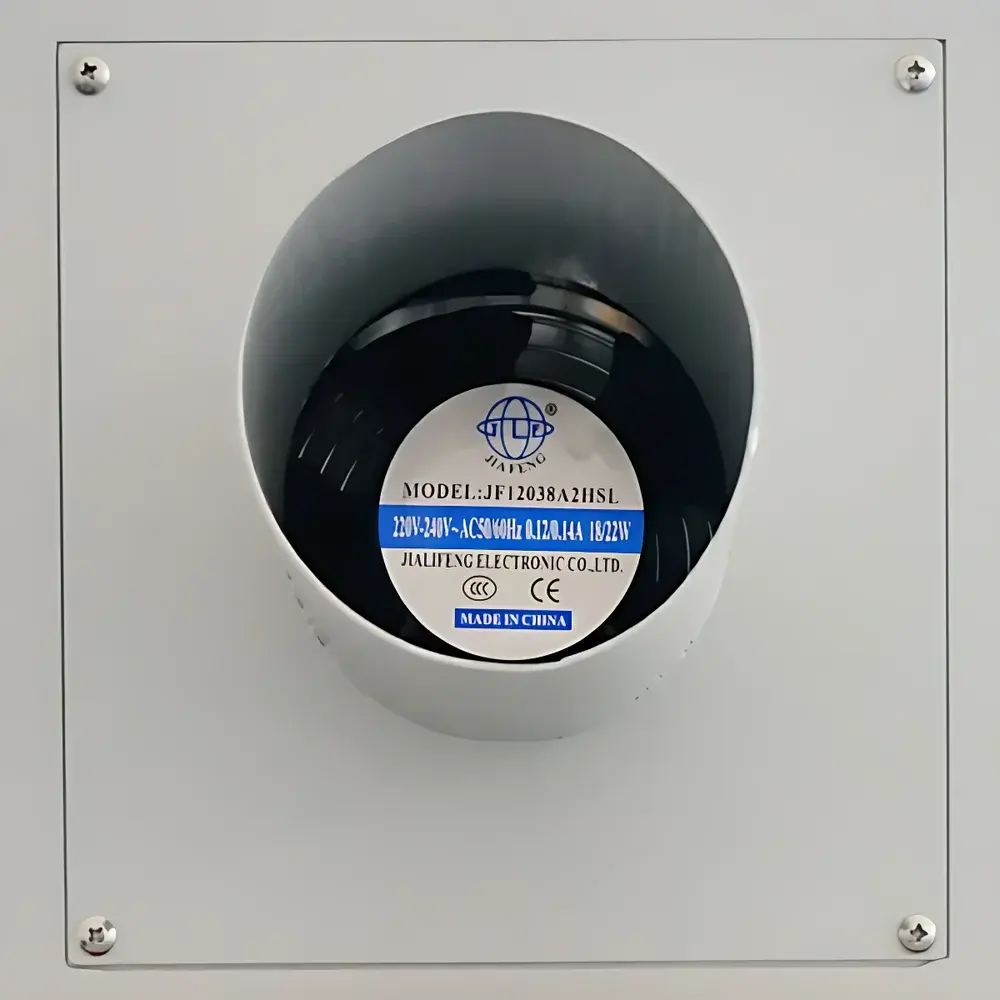
| Exhaust Port Diameter | 100 mm (rear-mounted) |
| Pressure Relief Port | 200 × 200 mm (rear-mounted, spring-loaded passive venting) |
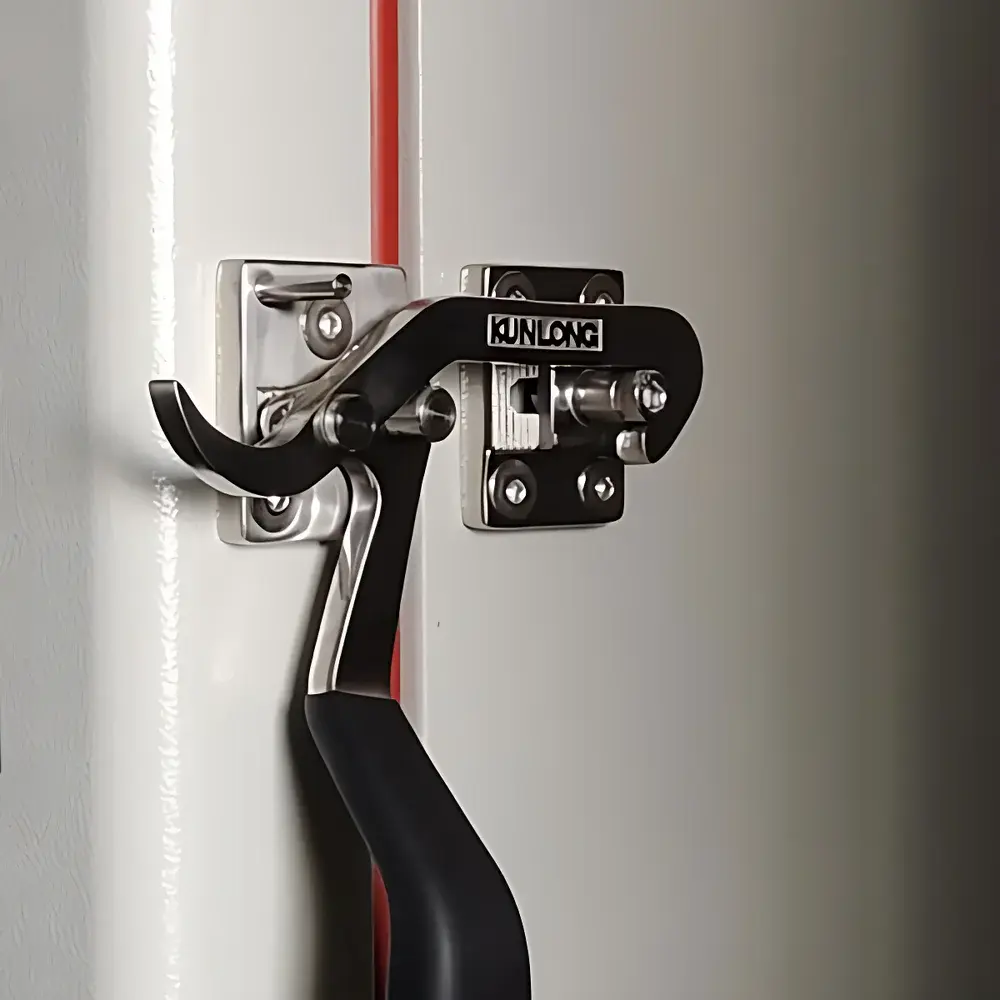
| Door Configuration | Single left-hinged door with safety interlock switch and side-mounted explosion-proof chain |
| Test Port | One Ø50 mm port on left side wall |
| Illumination | Integrated LED lighting for real-time visual monitoring |
| Actuation | Hydraulic drive system |
| Force Range | 1–20 kN |
| Force Resolution | 0.1 N |
| Crush Stroke | 250 mm |
| Force Display | 7-inch industrial touchscreen HMI |
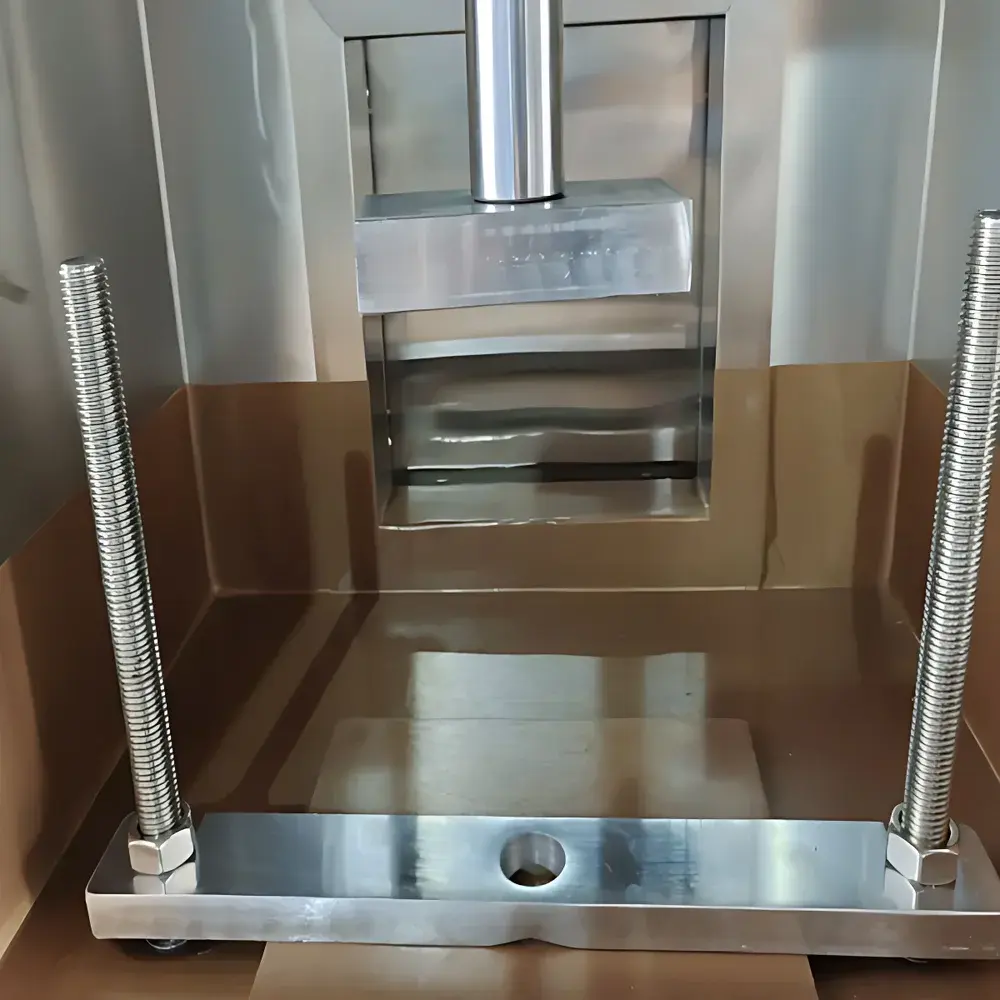
| Standard Crush Platen | Flat rigid plate ≥20 cm² contact area |
| Crush Load Target | 13.0 ± 0.2 kN, held for 60 s |
| Nail Specifications | Austenitic stainless steel (e.g., AISI 304), Ø2–8 mm, L = 100 mm (custom lengths available) |
| Penetration Speed | Adjustable 4–40 mm/s |
| Net Weight | 280 kg |
| Power Supply | AC 380 V, 3-phase, 50/60 Hz |
| Rated Power | 2 kW |
Overview
The HAIDA HD-H212 Battery Crush & Nail Penetration Test Chamber is an engineered safety validation platform designed specifically for thermal-mechanical abuse testing of electrochemical energy storage devices—including lithium-ion, lithium-metal, solid-state, and emerging hydrogen-compatible battery cells and modules. It operates on the principle of controlled mechanical intrusion to replicate worst-case physical abuse scenarios encountered during end-use, logistics, recycling, or accidental impact. The chamber integrates a high-fidelity hydraulic actuation system with synchronized force feedback, real-time environmental monitoring, and passive pressure mitigation architecture—enabling compliance-driven evaluation per internationally recognized safety standards for battery transport, integration, and disposal. Its design prioritizes operator protection, test repeatability, and traceable data acquisition under ambient conditions of 20 ± 5 °C, as mandated by GB/T 31485, UN 38.3, IEC 62133, and UL 1642.
Key Features
- Passive pressure relief system with calibrated 200 × 200 mm spring-actuated vent panel—designed to rapidly discharge overpressure during catastrophic cell failure while containing ejecta within the chamber volume.
- Dual-layer 250 × 250 mm observation window with embedded stainless-steel mesh (aperture ≤2 mm) ensures unobstructed visual assessment without compromising containment integrity.
- Hydraulic actuator delivering precise, programmable force application from 1 to 20 kN with 0.1 N resolution and closed-loop load control—critical for replicating standardized crush profiles such as the 13.0 ± 0.2 kN hold condition specified in GB/T 31485-2015.
- Modular nail penetration subsystem supporting interchangeable stainless-steel needles (Ø2–8 mm, L = 100 mm), each certified for high-temperature stability and corrosion resistance per ASTM F2129 requirements for metallic test probes.
- Integrated 7-inch industrial touchscreen HMI with intuitive parameter configuration, real-time force/displacement curves, and event-triggered logging—supporting pre-defined test sequences aligned with UN 38.3 Section 38.3.2.2 and IEC 62133 Clause 7.2.2.
- Full electrical isolation and grounding provisions compliant with IEC 61000-6-4 emissions and IEC 61000-6-2 immunity standards; CE-marked power distribution architecture with thermal overload and emergency stop circuitry.
Sample Compatibility & Compliance
The HD-H212 accommodates cylindrical (18650, 21700, 32135), prismatic (up to 500 mm length), and pouch-type cells up to 100 Ah nominal capacity. All internal surfaces are constructed from non-sparking, non-catalytic SUS#304 stainless steel to prevent unintended redox reactions during thermal runaway events. The system meets structural and functional requirements for ISO/IEC 17025-accredited laboratories conducting third-party certification testing. It supports full audit trails for GLP/GMP-aligned workflows when paired with optional external DAQ systems recording thermocouple (Type K), voltage, and current signals via the Ø50 mm feedthrough port. Test reports generated using the built-in HMI comply with documentation requirements under FDA 21 CFR Part 11 when integrated with validated time-stamped digital signature modules.
Software & Data Management
While the HD-H212 operates via embedded firmware without proprietary PC software, its touchscreen interface logs timestamped force, displacement, and duration data to internal flash memory (≥10,000 test records). Export is supported via USB 2.0 port in CSV format for post-processing in MATLAB, Python (Pandas), or LabVIEW environments. Optional RS-485 Modbus RTU interface enables integration into centralized MES or QMS platforms for automated test scheduling, electronic batch record generation, and statistical process control (SPC) charting of crush force deviation across production lots. All calibration certificates—including load cell verification per ISO 376 Class 0.5—are traceable to NIM (China National Institute of Metrology) or UKAS-accredited providers.
Applications
- Validation of cell-level mechanical robustness prior to module/pack integration in EV, e-bike, and stationary ESS applications.
- UN 38.3 transportation hazard classification testing for air, sea, and ground shipment approval.
- Root cause analysis of thermal runaway propagation mechanisms under localized mechanical stress.
- Development benchmarking of novel separator materials, electrolyte formulations, and mechanical reinforcement architectures.
- Quality assurance screening in high-volume cell manufacturing lines—particularly for automotive-grade AEC-Q200-compliant qualification.
- Research on hydrogen-enriched battery chemistries where gas evolution kinetics must be correlated with mechanical failure thresholds.
FAQ
What safety certifications does the HD-H212 chamber itself hold?
The chamber complies with IEC 61010-1 (Safety Requirements for Electrical Equipment for Measurement, Control, and Laboratory Use) and carries CE marking for EMC and Low Voltage Directive conformity. Structural containment performance is validated per UL 2595 Annex D and GB/T 31467.3-2015 Annex B.
Can the system perform simultaneous crush and nail penetration in one test sequence?
No—the HD-H212 executes either crush or nail penetration as discrete, user-selected test modes. Combined mechanical abuse protocols require sequential operation with manual reconfiguration of the platen/nail assembly.
Is remote monitoring or network connectivity supported?
Standard configuration includes only local HMI and USB export. Ethernet or Wi-Fi connectivity is available as a factory-installed option with TLS 1.2-secured API endpoints for RESTful command/control and JSON-formatted telemetry streaming.
Does HAIDA provide calibration services or accredited traceability documentation?
Yes—annual recalibration services include load cell verification, stroke encoder validation, and temperature uniformity mapping. Certificates reference CNAS-accredited calibration labs (ISO/IEC 17025) with uncertainty budgets reported per ISO/IEC 17025:2017 Clause 7.7.
What maintenance intervals are recommended for hydraulic system longevity?
Hydraulic oil replacement and filter servicing are required every 1,500 operating hours or biannually—whichever occurs first. Full preventive maintenance (including seal inspection, valve cleaning, and pressure transducer zero drift verification) is advised at 5,000-hour intervals.






