
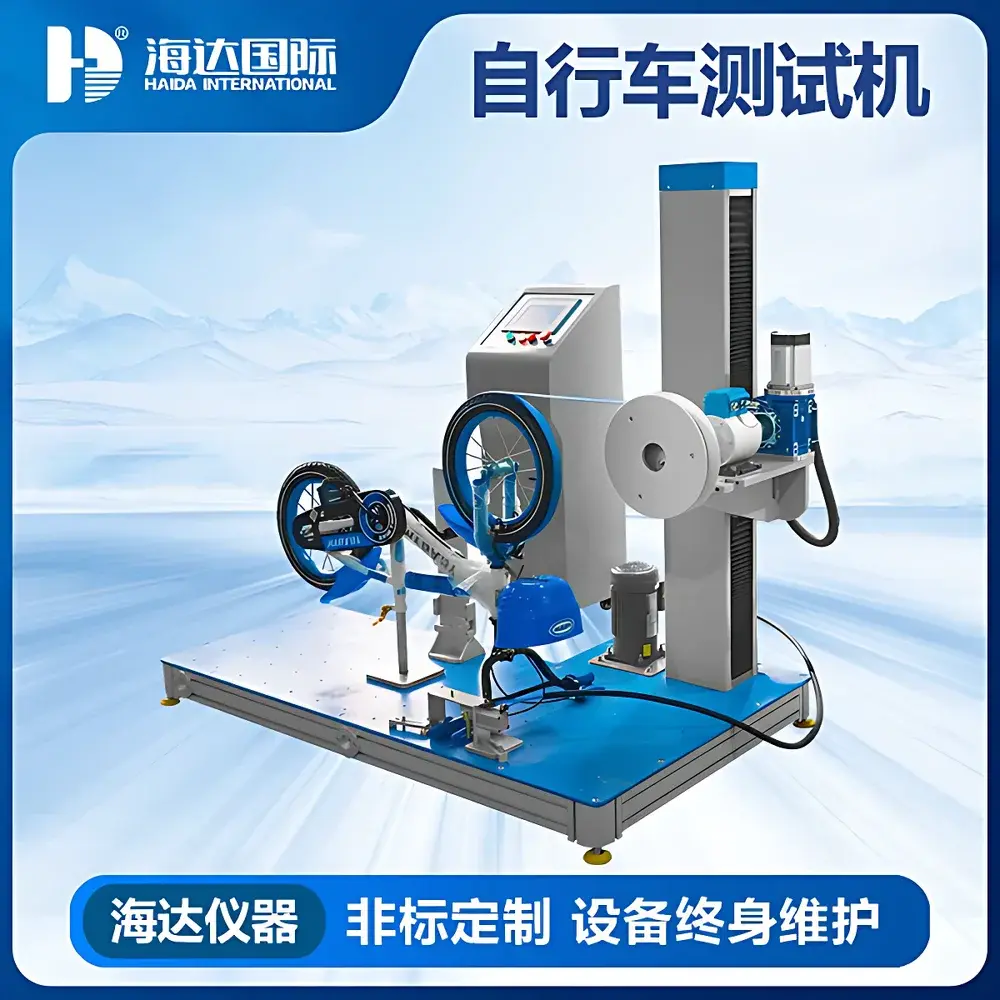
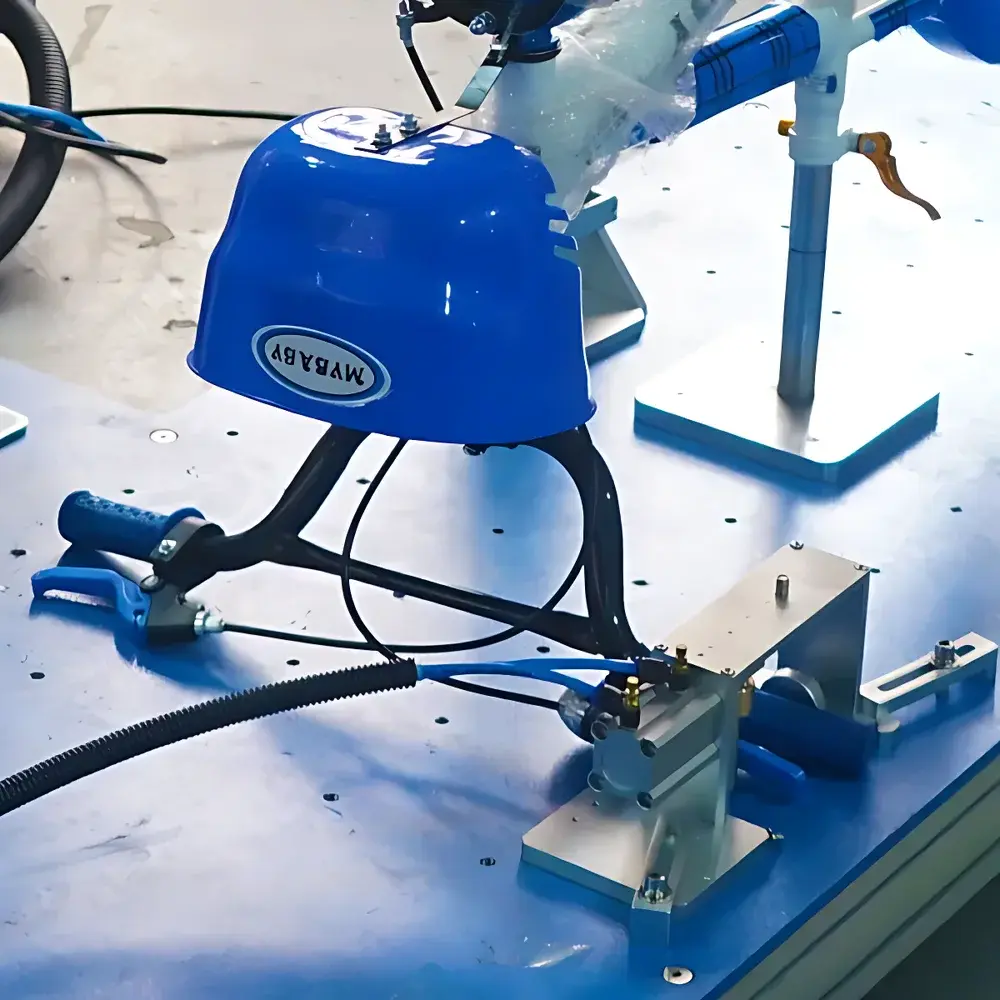
HAIDA HD-J234-1 Children’s Bicycle Brake Performance Tester
| Brand | HAIDA INTERNATIONAL |
|---|---|
| Origin | Guangdong, China |
| Manufacturer Type | Direct Manufacturer |
| Product Category | Domestic (China-made) |
| Model | HAIDA HD-J234-1 Children’s Bicycle Brake Performance Tester |
| Quotation | Upon Request |
| Control System | PLC-based touch-screen interface |
| Display | 7-inch industrial HMI touchscreen |
| Data Output | USB port for CSV report export |
| Actuation Stroke Range | 300–1100 mm (user-adjustable via touchscreen) |
| Load Cell | 20 kg capacity, resolution 1/10,000, accuracy ≤ ±1% FS |
| Torque Sensor | 30 N·m dynamic torque transducer |
| Brake Actuation | Pneumatic cylinder with proportional pressure control valve |
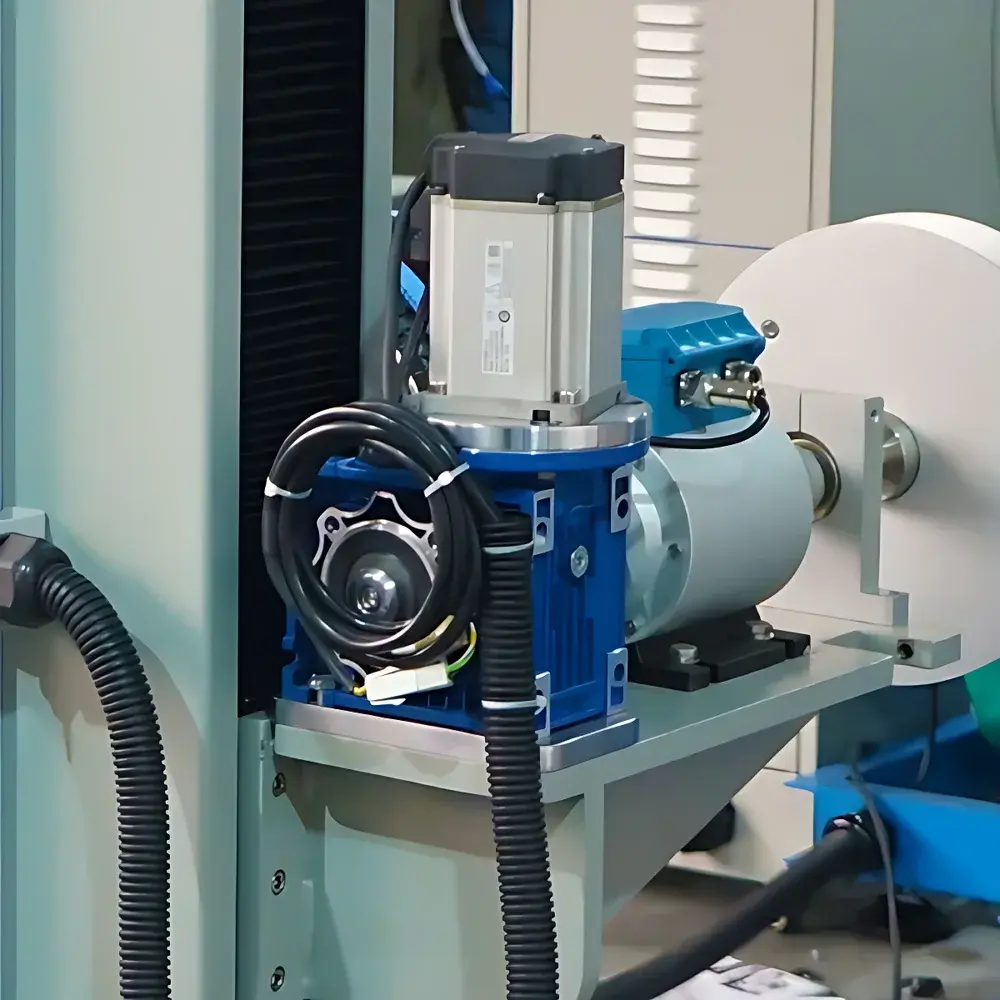
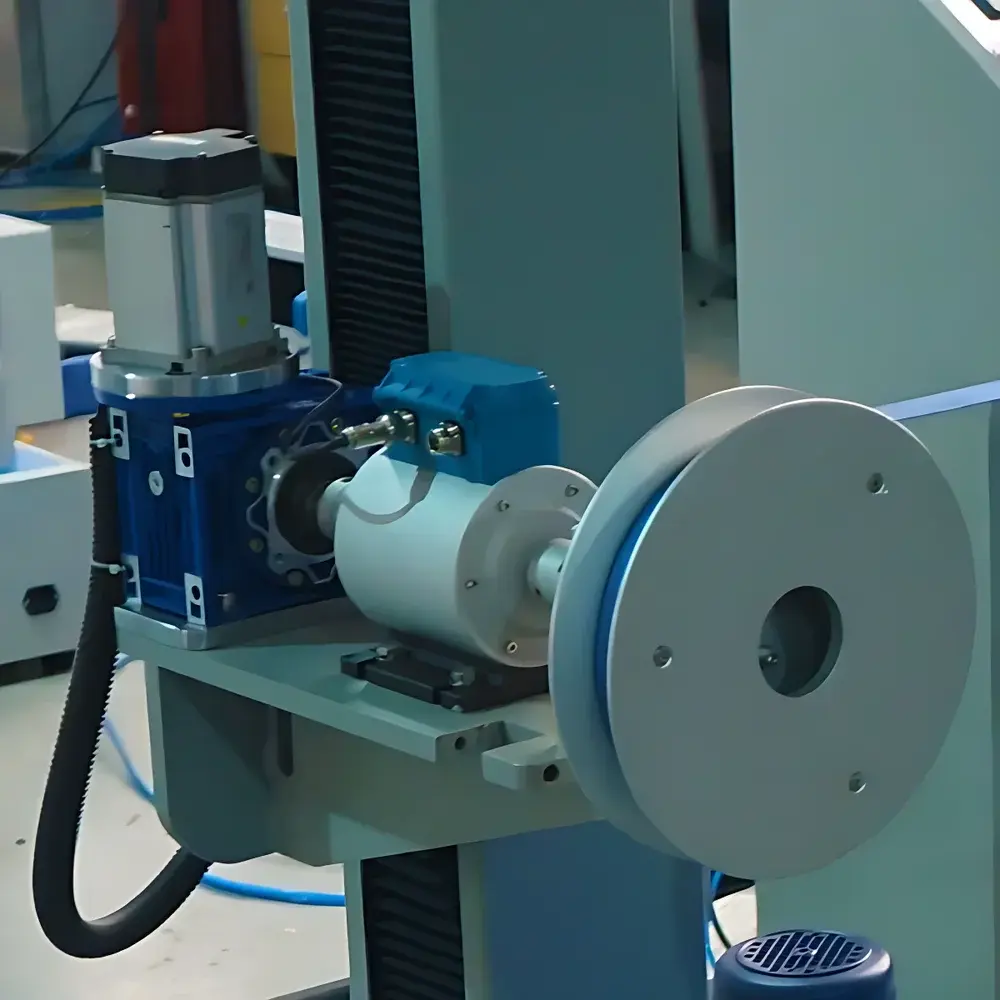
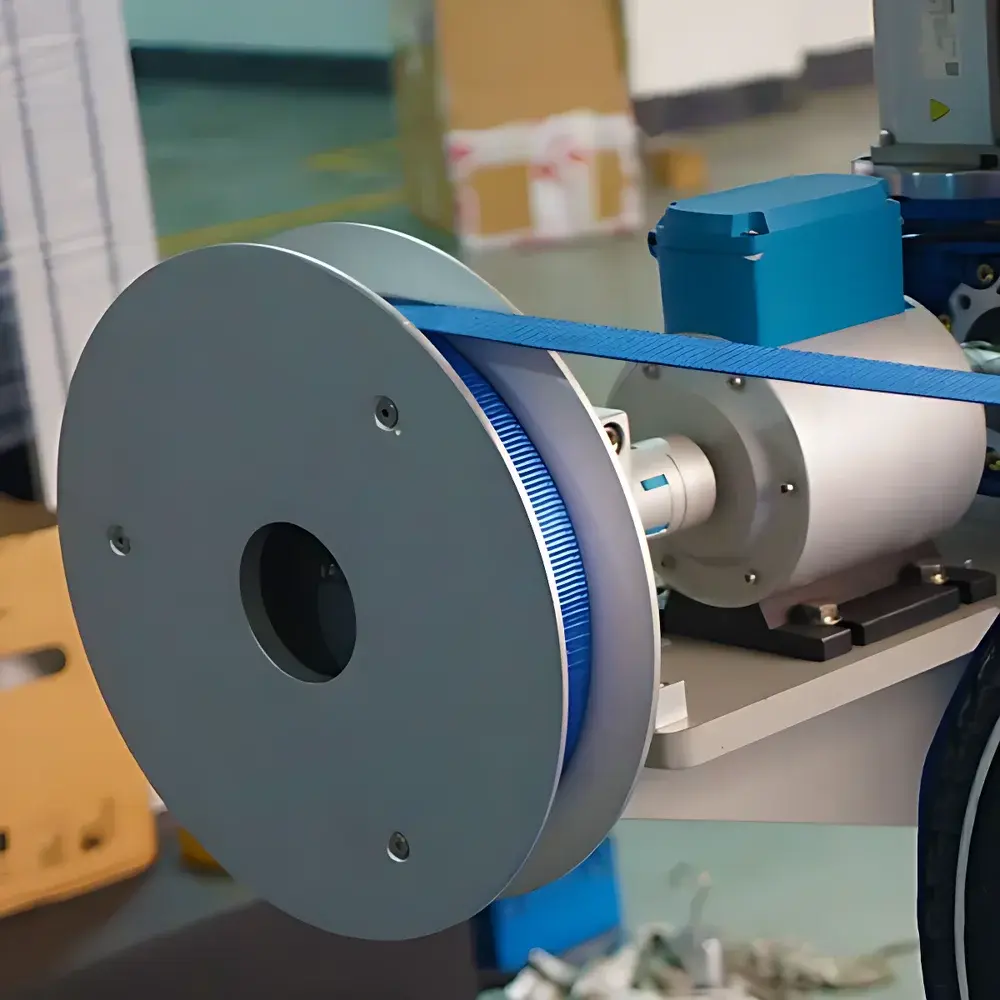
| Wheel Drive | Servo motor + high-tensile woven belt (≥3 wraps on both pulley and wheel rim) |
| Measured Parameters | Linear speed (0.3–3 m/s), applied braking force, time, brake displacement |
| Sample Compatibility | 12–20 inch children’s bicycles |
| Dimensions (L×W×H) | ≈1500 × 900 × 1450 mm |
| Weight | ≈600 kg |
| Air Supply Requirement | ≥0.6 MPa |
| Power Supply | 1-phase, 220 V / 50 Hz |
| Rated Power | ≈1200 W |
Overview
The HAIDA HD-J234-1 Children’s Bicycle Brake Performance Tester is an engineered test system designed to evaluate the structural integrity and functional efficacy of braking systems on juvenile bicycles in accordance with internationally recognized safety standards—primarily GB 14746–2006 “Safety Requirements for Children’s Bicycles”. The instrument implements a dual-actuation methodology: pneumatic actuation simulates human hand or foot input on brake levers, while a servo-driven belt system rotates the rear wheel under controlled kinematic conditions. Real-time force and torque data are acquired through calibrated load and dynamic torque sensors, enabling quantitative assessment of brake engagement force, stopping distance, deceleration profile, and mechanical resistance to lever deformation. Unlike manual or semi-automated testers, the HD-J234-1 integrates closed-loop pneumatic pressure regulation, programmable stroke positioning, and synchronized multi-parameter logging—ensuring repeatability, traceability, and compliance-ready documentation.
Key Features
- Robust mechanical architecture constructed from thick-gauge steel plates, precision-machined aluminum extrusions, and solid steel components—engineered to eliminate vibration-induced measurement drift during high-force brake actuation.
- Four-column guided vertical adjustment mechanism with preloaded ball screws ensures stable, backlash-free height positioning across the full 300–1100 mm stroke range—accommodating diverse frame geometries from 12″ to 20″ wheelbase configurations.
- Integrated proportional pneumatic control system with pressure feedback sensor and high-response solenoid valve delivers precise, repeatable brake lever actuation forces—eliminating variability associated with manual operation or fixed-pressure cylinders.
- Industrial-grade 7-inch HMI touchscreen with PLC-based logic enables intuitive test parameter setup (e.g., target actuation force, belt speed, dwell time), real-time waveform visualization, and one-touch report generation.
- Dual-sensor acquisition architecture: a 20 kg load cell (≤±1% FS accuracy, 0.01% resolution) measures lever input force; a 30 N·m dynamic torque sensor captures rotational resistance at the wheel axle—both sampled at ≥1 kHz for transient event capture.
- Comprehensive safety interlock suite—including emergency stop circuitry, pneumatic pressure monitoring, over-travel limit switches, and automatic fault logging—ensures GLP-compliant operational integrity.
Sample Compatibility & Compliance
The HD-J234-1 accepts all commercially available children’s bicycles with wheel diameters between 305 mm (12″) and 508 mm (20″), including models equipped with caliper, coaster, or linear-pull brakes. Test fixtures are fabricated from corrosion-resistant stainless steel and feature modular mounting holes for rapid reconfiguration. The system fully supports GB 14746–2006 Clause 5.4 (Braking Performance) and Clause 5.5 (Brake Strength), delivering test outputs directly traceable to specified pass/fail thresholds. While primarily aligned with Chinese national standards, its measurement methodology is functionally compatible with ASTM F963–17 Section 4.12 (Toy Safety) and EN 71–1:2014+A1:2018 Annex G (Mechanical and Physical Properties), facilitating cross-market validation. All sensor calibrations conform to ISO/IEC 17025 requirements when performed by accredited third-party laboratories.
Software & Data Management
Test execution and data handling are governed by an embedded PLC firmware platform with deterministic scan cycles (<10 ms). The HMI interface supports user-defined test profiles, password-protected parameter editing, and audit trail logging—including operator ID, timestamp, calibration status, and environmental metadata (if external sensors are integrated). Raw data (force, torque, displacement, time) is exported in CSV format via USB 2.0 port, preserving native sampling resolution for post-processing in MATLAB, Python, or industry-standard statistical software. Optional firmware upgrades enable 21 CFR Part 11-compliant electronic signatures, role-based access control, and encrypted data archiving—meeting QA/QC requirements for certified testing laboratories operating under ISO/IEC 17025 or CNAS accreditation frameworks.
Applications
- Pre-market compliance verification for OEMs and importers supplying children’s bicycles to the Chinese domestic market.
- Quality assurance screening in final assembly lines—detecting batch-level inconsistencies in cable tension, pad alignment, or lever pivot wear.
- R&D validation of new brake component designs (e.g., composite levers, low-friction cables, ceramic-coated rims) under standardized loading protocols.
- Third-party certification labs conducting accredited testing per GB 14746, CCC mark requirements, or voluntary safety certifications (e.g., CQC, SGS).
- Educational institutions performing mechanical engineering labs on friction dynamics, actuation mechanics, and sensor integration principles.
FAQ
Does the HD-J234-1 support simultaneous testing of front and rear brakes?
No. The system evaluates one brake circuit at a time—either hand-operated front/rear calipers or foot-actuated coaster brakes—to maintain compliance with GB 14746’s sequential test methodology.
Can test parameters be exported for regulatory submission?
Yes. All generated reports include test ID, operator name, calibration certificate numbers, raw data timestamps, and pass/fail determinations—formatted for direct inclusion in CCC or CNCA technical dossiers.
Is pneumatic supply included with the system?
No. A clean, oil-free compressed air source meeting ≥0.6 MPa minimum pressure and ISO 8573–1 Class 3 purity is required and must be supplied externally.
What maintenance intervals are recommended for long-term accuracy?
Load and torque sensors require annual recalibration by an ISO/IEC 17025-accredited laboratory; pneumatic valves and belts should be inspected quarterly for wear or leakage per the maintenance log provided in the user manual.
Is remote diagnostics supported?
Standard configuration includes RS-485 serial interface for local network integration; optional Ethernet module enables remote firmware updates and diagnostic telemetry under IT-managed infrastructure policies.



