
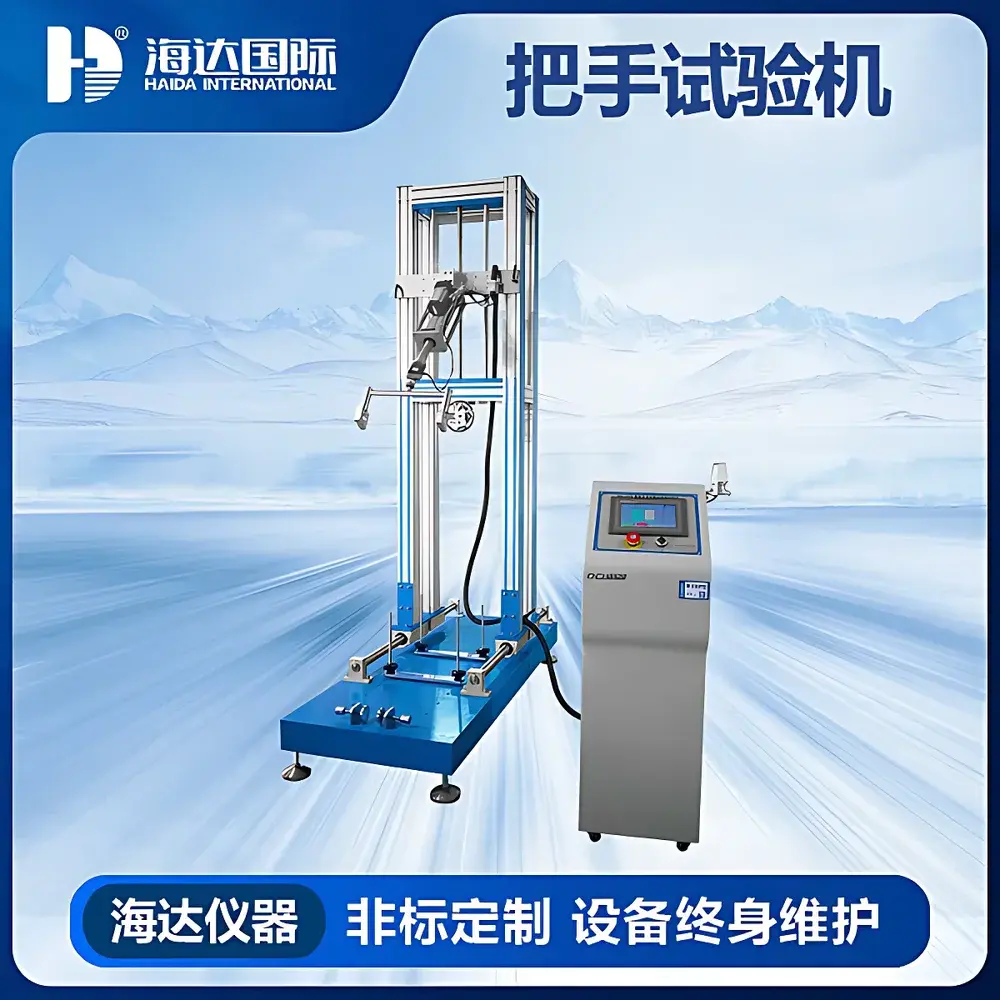
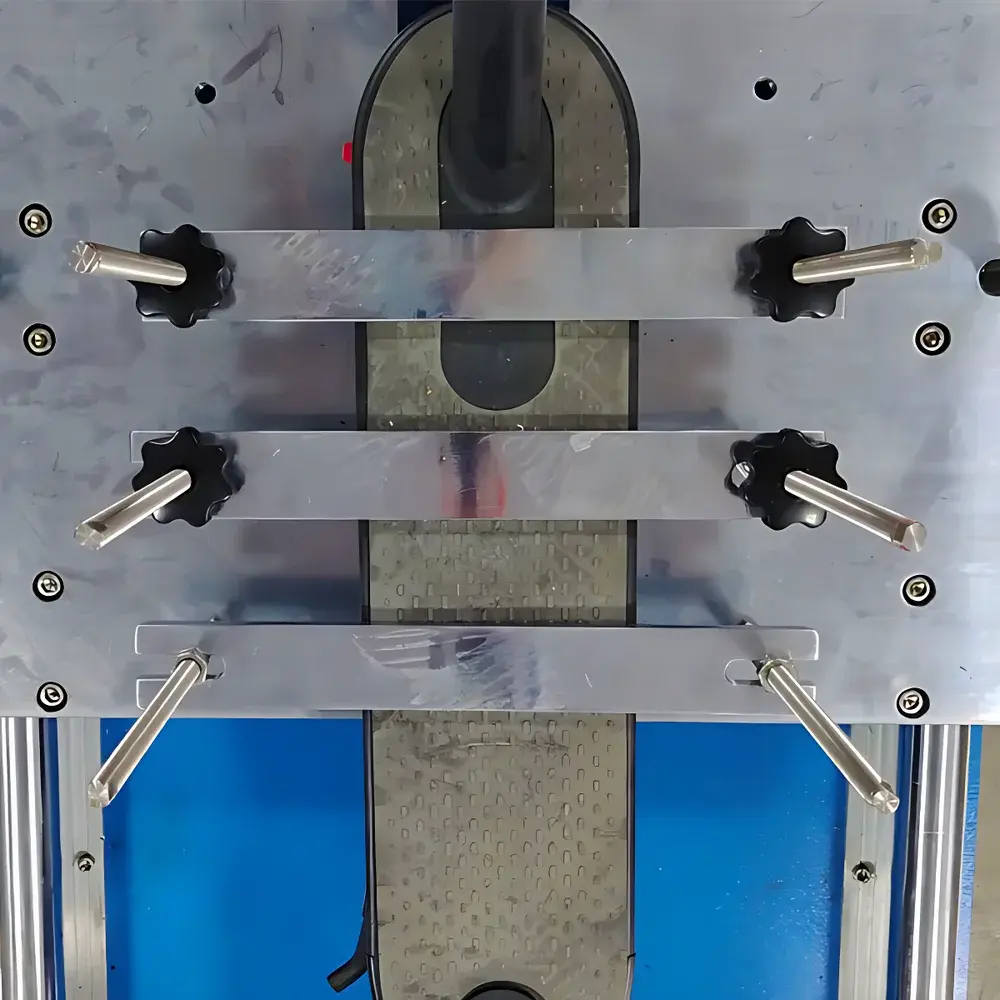
HAIDA HD-J247 Handlebar Fatigue Testing System for Scooters and Juvenile Vehicles
| Brand | HAIDA INTERNATIONAL |
|---|---|
| Origin | Guangdong, China |
| Manufacturer Type | Direct Manufacturer |
| Country of Origin | China |
| Model | HD-J247 |
| Control Interface | 7-inch HMI touchscreen with PLC-based logic |
| Load Sensor | S-type, 2 kN capacity |
| Test Frequency | 10 cycles/min (one push + one pull = 1 cycle) |
| Horizontal Load Capacity | 1000 N push / 1000 N pull (adjustable 0–1000 N) |
| Load Application Angles | 0° (horizontal) and 45° (upward/backward or downward/forward) |
| Maximum Test Cycles | 1,000,000 |
| Specimen Dimensions (L×W×H) | 500×500×500 mm to 1300×500×1400 mm |
| Machine Dimensions (L×W×H) | 1900×650×2800 mm |
| Power Supply | 220 V AC, 50/60 Hz |
| Rated Power | 600 W |
| Net Weight | 350 kg |
| Compliance Standard | ASTM F2264 |
Overview
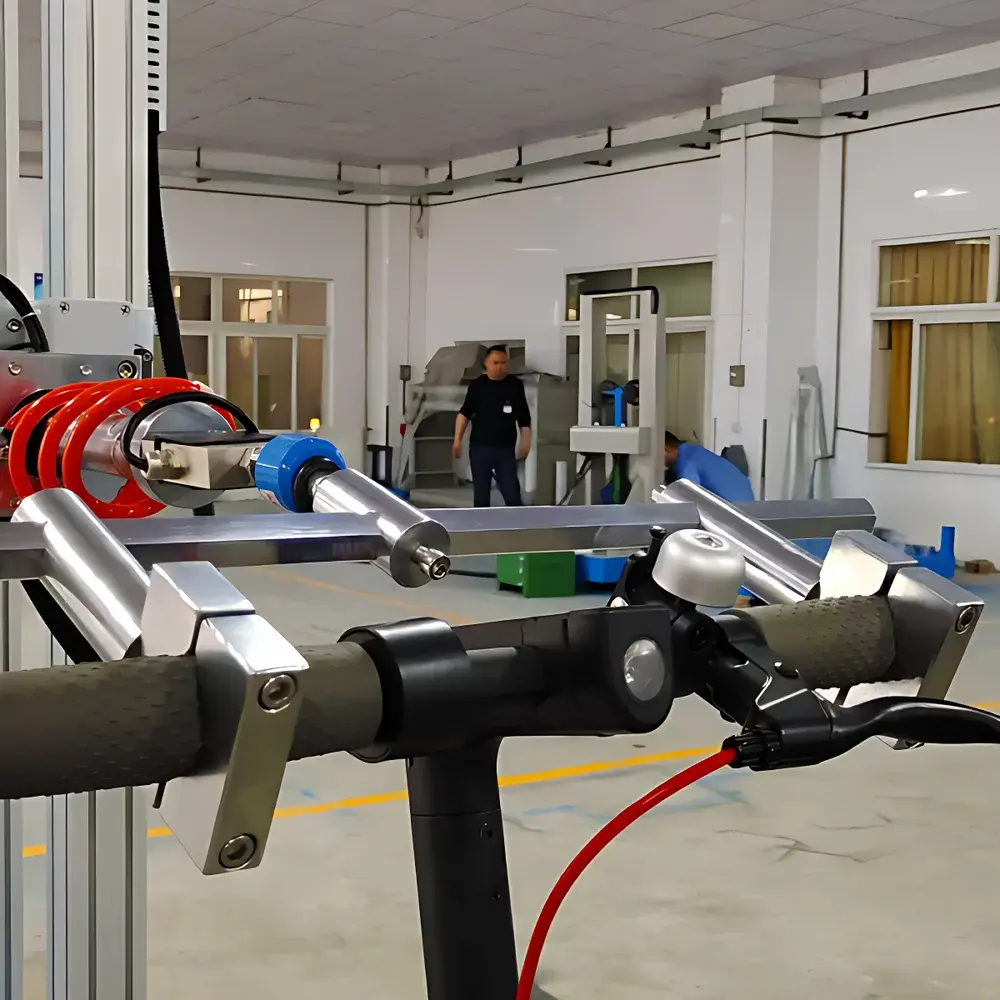
The HAIDA HD-J247 Handlebar Fatigue Testing System is an electromechanical servo-driven test instrument engineered for evaluating the structural durability and cyclic mechanical integrity of handlebars used on kick scooters, juvenile vehicles (e.g., strollers, ride-on toys), and light-duty wheeled carts. It operates on a controlled uniaxial push-pull fatigue principle—applying precisely timed, repeatable axial and angular forces to simulate real-world user interaction during dynamic operation. The system replicates the biomechanical loading profile defined in ASTM F2264: *Standard Specification for Scooters*, wherein a 267 N (60 lbf) force is applied at ±45° relative to vertical at two locations 25 mm from each end of the handlebar, alternating between tension and compression over up to 5,000 cycles at a rate not exceeding 3–5 Hz. Unlike static strength testers, the HD-J247 captures progressive degradation—including plastic deformation, joint loosening, weld fatigue, and material microcracking—under sustained cyclic stress, enabling predictive failure analysis and design validation prior to mass production.
Key Features
- Programmable dual-mode actuation: supports both horizontal (0°) and angled (±45°) push-pull loading sequences, configurable via intuitive HMI interface
- High-precision force control: integrated S-type 2 kN load cell with ≤±0.5% full-scale accuracy; real-time feedback enables closed-loop servo regulation
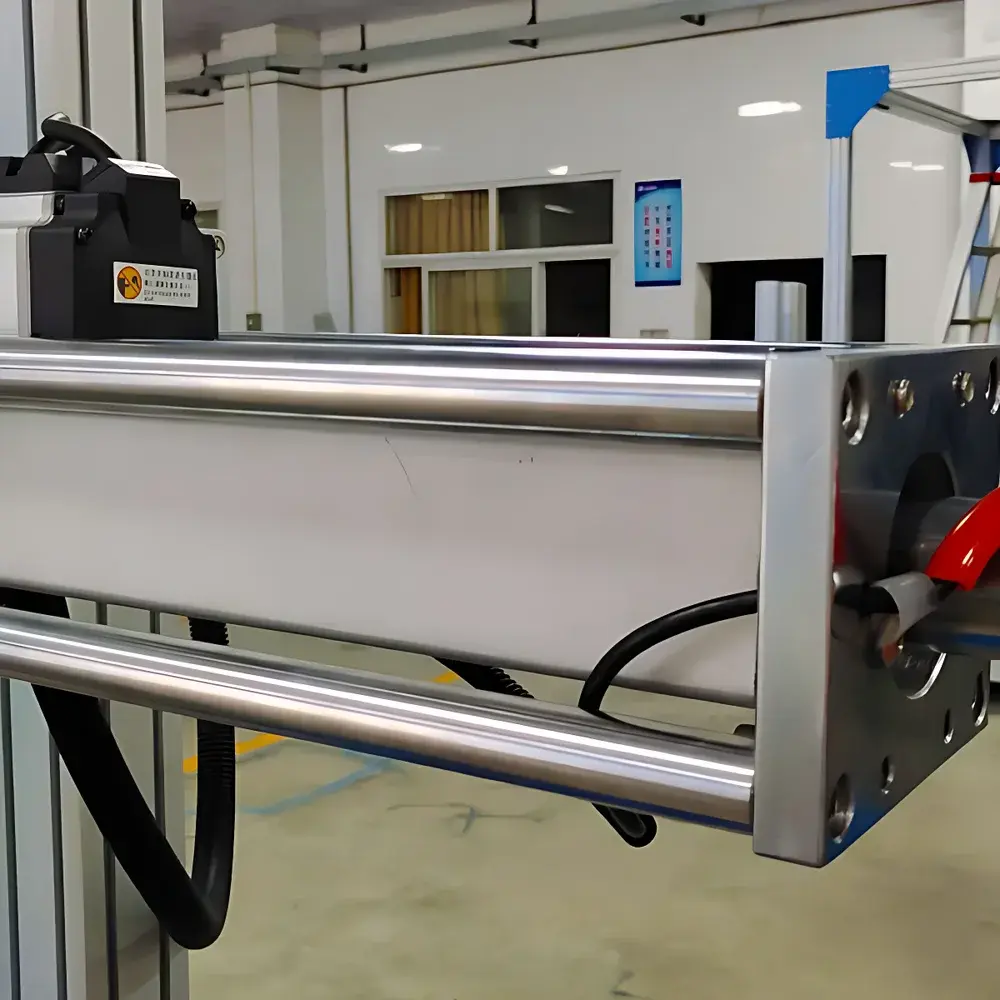
- Modular height-adjustable fixture system: quick-release fasteners and precision-ground ball screw assemblies allow rapid repositioning of the actuator arm to accommodate varying handlebar heights (500–1400 mm)
- Robust mechanical architecture: structural frame fabricated from anodized aluminum extrusions and stainless steel components; powder-coated enclosure ensures long-term corrosion resistance in laboratory environments
- Comprehensive safety interlocks: hardware-enforced overload cutoff (110% FS), mechanical limit switches, overvoltage protection, emergency stop circuitry, and automatic return-to-home upon power interruption
- PLC-based deterministic control: eliminates software latency; all motion profiles—including dwell time at peak load, ramp rates, and cycle count tracking—are executed with microsecond-level timing consistency
Sample Compatibility & Compliance
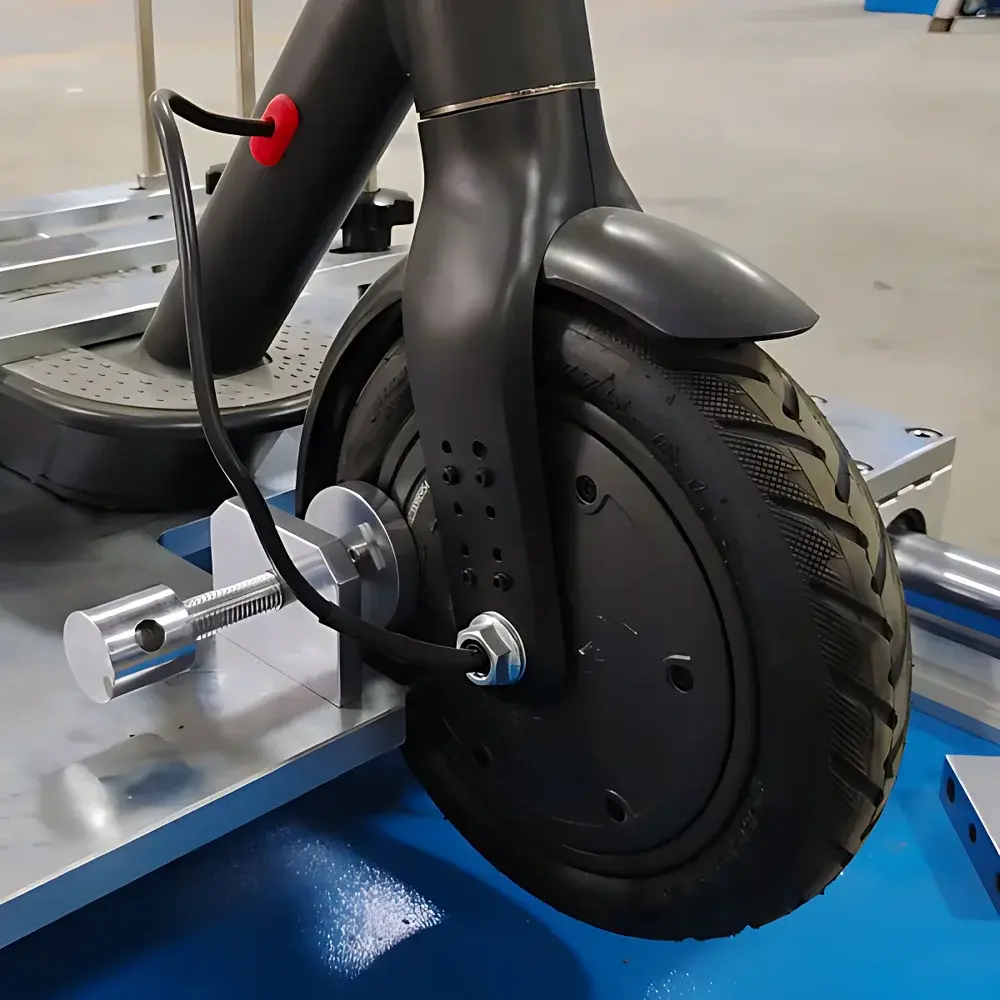
The HD-J247 accommodates a broad range of handlebar geometries across juvenile mobility products. Its adjustable platform accepts specimens from compact toddler scooters (min. 500×500×500 mm) to full-size adult kick scooters (max. 1300×500×1400 mm). Fixturing utilizes non-marring clamps with pneumatic-assisted locking to prevent slippage while preserving surface finish. The system is fully compliant with ASTM F2264 Section 7.3 (“Handlebar Fatigue Test”), including prescribed load magnitude (267 N), application angle (±45°), point-of-application (25 mm from ends), and minimum cycle count (5,000). While not certified to ISO/IEC 17025, its traceable sensor calibration path aligns with GLP principles for internal R&D and pre-compliance verification. Optional documentation packages support audit-ready test reports per ISO 17025-accredited laboratories.
Software & Data Management
The embedded 7-inch color HMI runs a deterministic ladder-logic program hosted on a ruggedized industrial PLC—not a Windows-based OS—ensuring immunity to background processes, driver conflicts, or OS updates. Users configure test parameters directly: total cycles, target force (0–1000 N), push/pull dwell duration (0.1–5.0 s), actuation angle (0° or 45°), and direction sequence (push-first or pull-first). All test data—including real-time force vs. time waveforms, cycle counter, elapsed time, and fault logs—are stored locally on non-volatile memory and exportable via USB to CSV. No cloud connectivity or remote access is implemented, preserving data sovereignty and simplifying 21 CFR Part 11 compliance for regulated manufacturers requiring audit trails and electronic signatures (achieved via external LIMS integration).
Applications
- Pre-production validation of aluminum alloy and composite handlebar assemblies for shared micro-mobility fleets
- Comparative fatigue life assessment between welded, riveted, and bolted stem-to-tube joints
- Material selection studies for polymer-reinforced grips subjected to repetitive torsional + axial loading
- Quality assurance screening of incoming handlebar batches in Tier-1 component suppliers
- Root cause analysis of field failures linked to resonance-induced fatigue at handlebar stem interfaces
- Supporting technical documentation for CE marking under EN 71-1 (Toy Safety) and ASTM F963 (Consumer Product Safety)
FAQ
What standards does the HD-J247 explicitly support?
ASTM F2264 is the primary referenced standard. The system’s mechanical layout, force resolution, and actuation kinematics are designed to meet the dimensional and procedural requirements outlined in Section 7.3.
Can the system perform simultaneous multi-axis loading?
No. The HD-J247 executes uniaxial push-pull fatigue only. It does not support torsional, lateral bending, or combined loading modes.
Is calibration certification included with shipment?
A factory calibration certificate traceable to national metrology institutes (e.g., CNAS) is provided with each unit. On-site recalibration services are available upon request.
What maintenance intervals are recommended?
Lubrication of ball screws and linear guides every 500 operational hours; annual verification of load cell linearity and zero offset using certified deadweight standards.
Does the system support custom test protocols beyond ASTM F2264?
Yes—users may define arbitrary cycle counts, force magnitudes, dwell times, and angle sequences via the HMI. However, such deviations require internal method validation and are not covered under standard compliance claims.



