
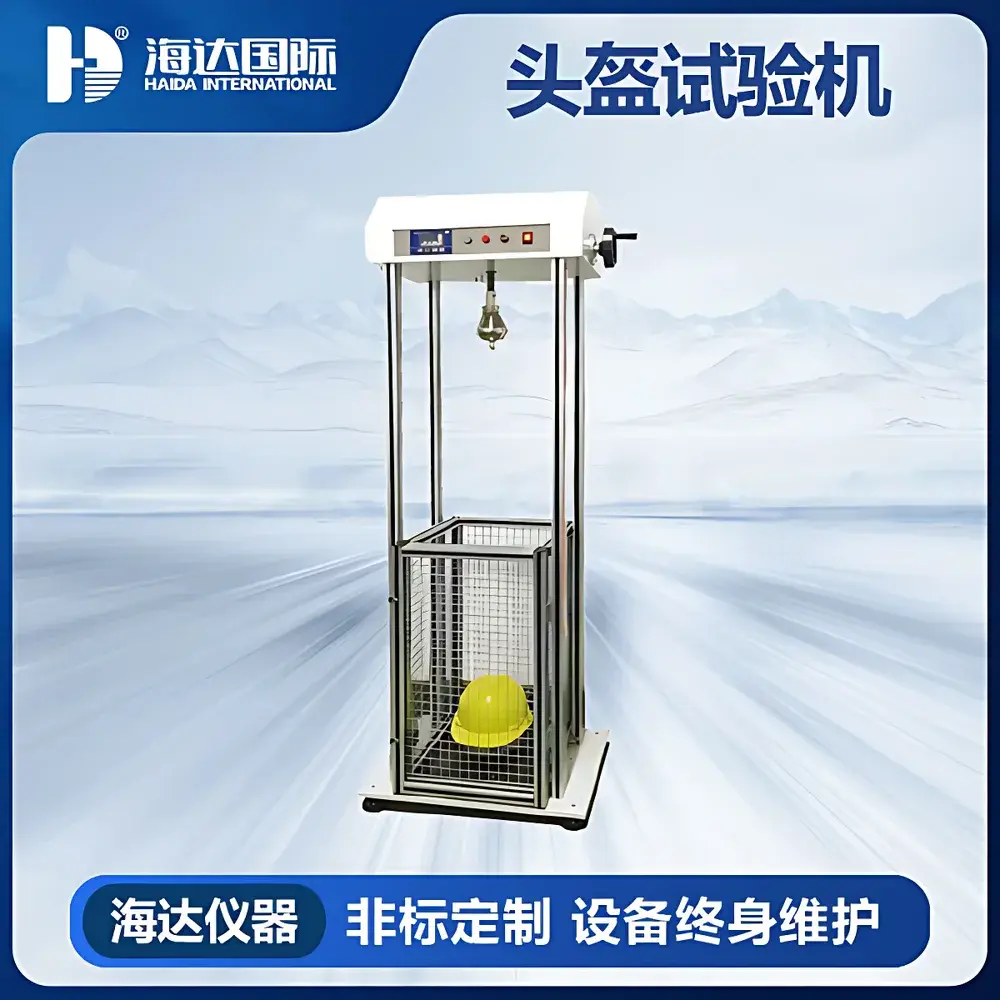
HAIDA HD-K501 Helmet Penetration Resistance Tester
| Brand | HAIDA INTERNATIONAL |
|---|---|
| Origin | Guangdong, China |
| Manufacturer Type | Original Equipment Manufacturer (OEM/ODM) |
| Product Category | Domestic (China-Made) |
| Model | HAIDA HD-K501 Helmet Penetration Resistance Tester |
| Pricing | Available Upon Request |
Overview
The HAIDA HD-K501 Helmet Penetration Resistance Tester is a precision-engineered mechanical impact testing system designed to evaluate the ability of protective headgear—such as industrial safety helmets, motorcycle helmets, and military-grade combat helmets—to resist penetration by sharp, rigid objects under standardized drop-weight conditions. It operates on the principle of controlled free-fall impact, where a calibrated striker (typically a conical or hemispherical steel probe) is released from a defined height onto the helmet shell surface. The test quantifies whether the striker makes contact with a simulated anthropometric headform positioned beneath the helmet, thereby determining compliance with internationally recognized performance thresholds for penetration resistance. This apparatus is engineered for repeatable, traceable, and operator-independent execution of tests specified in ISO 10256-1:2023, EN 397:2012+A1:2012, GB/T 2812–2006, ANSI/ISEA Z89.1–2014, and ASTM F1446–22. Its robust mechanical architecture ensures minimal energy loss during impact transmission, supporting high reproducibility across sequential trials.
Key Features
- Adjustable drop height mechanism with digital height encoder (range: 100–1000 mm ±0.5 mm resolution), enabling precise replication of standard test configurations.
- Interchangeable striker assemblies compliant with ISO, EN, and GB specifications—including 3 mm diameter conical tip (45° apex angle) and 6 mm hemispherical tip options.
- Integrated load cell and high-speed data acquisition module (sampling rate ≥10 kHz) for real-time force-time profile recording during impact event.
- Motorized release system with electromagnetic latch and fail-safe mechanical backup, eliminating manual trigger variability.
- Modular headform support platform accommodating standard 430 mm and 510 mm headforms (ISO 10256-compliant anthropometric dimensions).
- Stainless-steel frame with vibration-damped base and adjustable leveling feet for stable operation in laboratory or QC environments.
- Compliance-ready design featuring audit-trail logging, user access levels, and calibration certificate traceability to NIM (National Institute of Metrology, China) or equivalent national metrology institutes.
Sample Compatibility & Compliance
The HD-K501 accommodates helmets across multiple classes—including Type I (top-impact only) and Type II (top-and-lateral impact)—with shell materials ranging from thermoplastics (e.g., ABS, polycarbonate), thermosets (e.g., fiberglass-reinforced polyester), and composite laminates (e.g., aramid/epoxy, UHMWPE). It supports both full-helmet and shell-only testing configurations per ASTM F1446 Annex A3. All test procedures align with regulatory frameworks requiring documented evidence of conformity: ISO/IEC 17025:2017 accredited laboratories may utilize this instrument for routine type testing and production line verification. The system meets mechanical safety requirements per EN 61000-6-2 (immunity) and EN 61000-6-4 (emissions), and its structural integrity conforms to ISO 12100:2010 risk assessment principles.
Software & Data Management
The HD-K501 integrates with HAIDA’s proprietary TestMaster v4.2 software suite, a Windows-based application supporting automated test sequencing, real-time waveform visualization, and post-test analysis of peak force, time-to-peak, and energy absorption. Data export formats include CSV, PDF test reports (with embedded digital signatures), and XML for LIMS integration. Software features full 21 CFR Part 11 compliance—including electronic signature validation, audit trail generation (user actions, parameter changes, calibration events), and role-based permissions (Administrator, Technician, Reviewer). Calibration history, maintenance logs, and certificate expiry alerts are centrally managed within the database, facilitating GLP/GMP-aligned quality documentation workflows.
Applications
- Pre-market certification testing for CE marking (EN 397), CCC (GB/T 2812), and UL 2034 compliance.
- Production line quality assurance in helmet manufacturing facilities, including incoming raw material screening and final product batch verification.
- R&D evaluation of novel shell materials, liner foams, and hybrid composite architectures for improved penetration resistance without weight penalty.
- Third-party certification body testing per ILAC-MRA signatory requirements.
- Educational use in occupational safety engineering curricula for hands-on demonstration of biomechanical impact response and standard test methodology.
FAQ
What standards does the HD-K501 support out-of-the-box?
The system is pre-configured for ISO 10256-1, EN 397, GB/T 2812, ANSI/ISEA Z89.1, and ASTM F1446. Custom parameter sets can be added via software configuration for other regional or industry-specific standards.
Is calibration traceable to international standards?
Yes—each unit ships with a factory calibration certificate traceable to NIM (China) or UKAS-accredited providers upon request. On-site recalibration services are available globally through HAIDA’s authorized service network.
Can the HD-K501 be integrated into an existing LIMS or MES environment?
Yes—via OPC UA or RESTful API interfaces, enabling bidirectional data exchange with enterprise systems for automated result ingestion and nonconformance workflow triggering.
Does the system require external air supply or hydraulic power?
No—the HD-K501 is fully electromechanical and operates on standard 220 V AC / 50 Hz power; no compressed air, hydraulics, or auxiliary utilities are required.
What is the recommended maintenance schedule?
Daily visual inspection of striker tip wear and guide rod alignment; quarterly verification of drop height accuracy and force sensor linearity; annual full metrological recalibration per ISO/IEC 17025 requirements.
Related Products



