
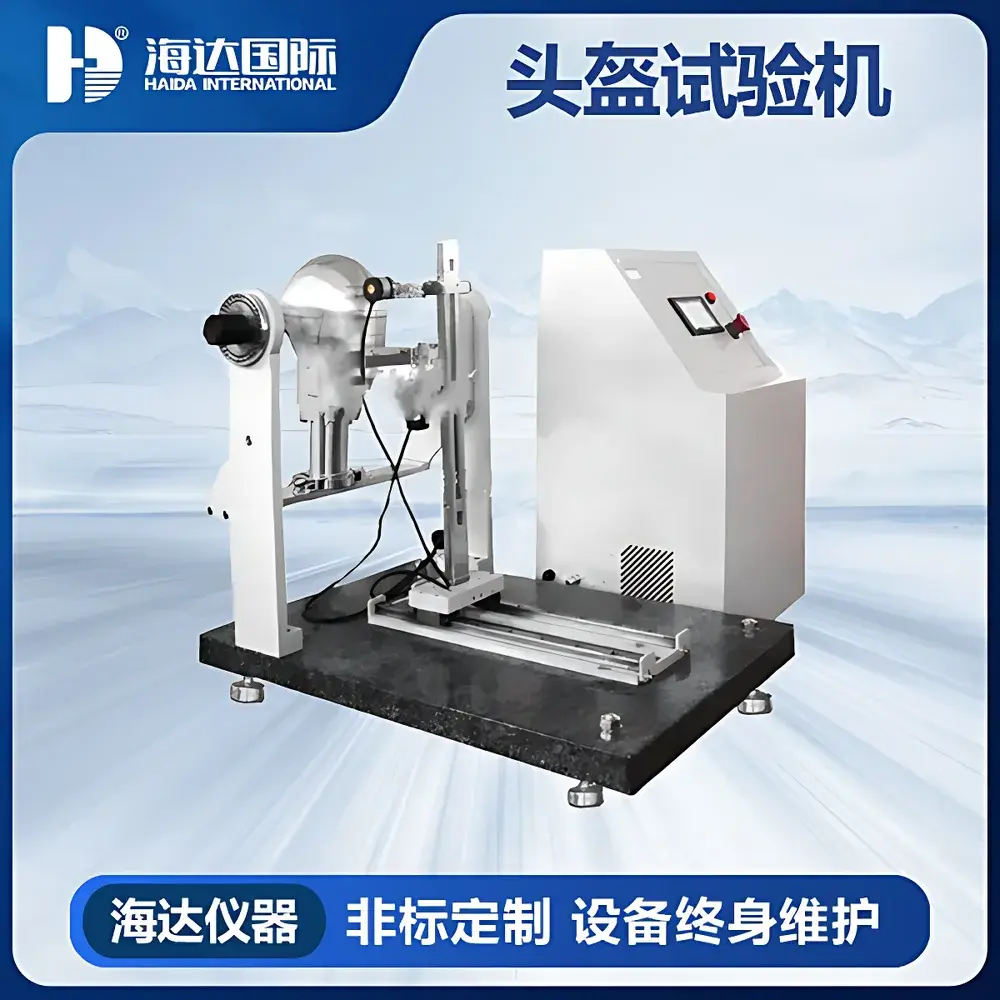
HAIDA HD-K504 Helmet Field-of-View Analyzer
| Brand | HAIDA INTERNATIONAL |
|---|---|
| Origin | Guangdong, China |
| Manufacturer Type | OEM/ODM Manufacturer |
| Country of Origin | China |
| Model | HAIDA HD-K504 Helmet Field-of-View Analyzer |
| Pricing | Available Upon Request |
Overview
The HAIDA HD-K504 Helmet Field-of-View Analyzer is a precision optical measurement system engineered for quantitative evaluation of the visual field envelope provided by protective helmets—primarily military, firefighting, industrial safety, and motorsport headgear. It operates on the principle of controlled angular projection and calibrated photometric detection: a fixed-position helmet is mounted on a motorized, multi-axis rotational stage, while a high-resolution digital imaging sensor (CCD/CMOS) captures real-time silhouette profiles against a uniformly illuminated background at predefined azimuthal and elevational angles. The system computes horizontal, vertical, and diagonal field-of-view (FOV) boundaries in accordance with standardized test geometries defined in ISO 16889:2022 (Protective helmets — Determination of field of vision), EN 397:2012+A1:2012 (Industrial safety helmets), and MIL-STD-662F (Ballistic and Non-Ballistic Helmet Testing). Unlike subjective visual assessment methods, the HD-K504 delivers objective, repeatable, traceable angular measurements with angular resolution better than ±0.5° across its full 360° azimuthal range and ±90° elevation sweep.
Key Features
- Motorized dual-axis (azimuth/elevation) positioning stage with programmable step resolution down to 0.25°, enabling automated FOV mapping per ISO-defined test points.
- Integrated high-dynamic-range (HDR) imaging module with synchronized LED backlighting, ensuring consistent contrast for accurate edge detection of helmet visor and shell contours.
- Optical calibration traceable to NIM (National Institute of Metrology, China) standards; includes built-in reference targets and auto-alignment verification routine.
- Modular mounting interface compatible with standard anthropomorphic headforms (e.g., ISO 10289 headform sizes M/L/XL) and adjustable chin strap tension simulation.
- Rugged aluminum alloy chassis with vibration-damped optical bench design, optimized for laboratory and accredited test facility environments.
- Compliance-ready firmware architecture supporting audit trails, user access levels, and electronic signature capability aligned with GLP and ISO/IEC 17025 requirements.
Sample Compatibility & Compliance
The HD-K504 accommodates helmets conforming to all major structural categories: full-face, modular, open-face, and bump caps—with or without integrated visors, goggles, or communication systems. It supports testing of both rigid (thermoset composites, polycarbonate shells) and semi-flexible (textile-reinforced thermoplastic) constructions. The system is validated for use in conformity assessment against ISO 16889, EN 397, EN 14052 (High-performance industrial helmets), ASTM F1163 (Equestrian helmets), and NFPA 1971 (Structural firefighting helmets). All measurement protocols include configurable pass/fail thresholds based on regulatory minimum FOV requirements (e.g., ≥105° horizontal FOV for EN 397 compliance). Calibration certificates are issued per ISO/IEC 17025:2017 and include uncertainty budgets compliant with GUM (Guide to the Expression of Uncertainty in Measurement).
Software & Data Management
The HD-K504 is operated via HAIDA VisionLink™ v3.2 software—a Windows-based application developed in accordance with IEC 62304 Class B medical device software principles. It provides guided workflow execution, real-time FOV boundary visualization, and automatic report generation in PDF/A-1b and Excel (.xlsx) formats. Raw image data, stage position logs, and metadata (operator ID, timestamp, calibration status) are stored in an encrypted SQLite database with SHA-256 hashing. Audit trail functionality records all user actions—including parameter changes, calibration events, and report exports—with immutable timestamps. Optional 21 CFR Part 11 compliance package available, including electronic signatures, role-based permissions, and secure e-signature validation logs.
Applications
- Pre-certification validation of helmet designs prior to third-party testing at notified bodies (e.g., SGS, TÜV Rheinland, UL).
- Root-cause analysis of FOV nonconformities during R&D—enabling iterative optimization of visor curvature, shell cutout geometry, and retention system positioning.
- Periodic in-house verification for quality assurance labs operating under ISO/IEC 17025 accreditation.
- Supporting technical documentation for EU Declaration of Conformity (DoC) and FDA 510(k) submissions where FOV performance is a critical safety parameter.
- Training and comparative benchmarking across helmet models in occupational health and safety departments.
FAQ
Does the HD-K504 comply with ISO/IEC 17025 requirements for accredited testing laboratories?
Yes—the system’s calibration traceability, measurement uncertainty reporting, and documented validation procedures meet Clause 6.5 and Annex A of ISO/IEC 17025:2017.
Can the analyzer accommodate custom headforms beyond ISO 10289 specifications?
Yes—modular adapter plates support user-supplied anthropometric headforms, provided dimensional drawings and mounting interface specifications are submitted for mechanical compatibility review.
Is remote software support and firmware updates available?
Yes—HAIDA provides secure remote diagnostics and over-the-air firmware updates via TLS 1.3–encrypted connection, subject to customer-configured firewall policies.
What is the recommended recalibration interval?
Annual recalibration is recommended; however, interval may be extended to 24 months under stable environmental conditions (±1°C temperature stability, <50% RH) with documented intermediate verification using included reference targets.
Does the system integrate with LIMS or MES platforms?
Yes—via configurable RESTful API endpoints supporting JSON payloads, enabling bidirectional data exchange with LabWare LIMS, Thermo Fisher SampleManager, and Siemens Opcenter Execution.



