
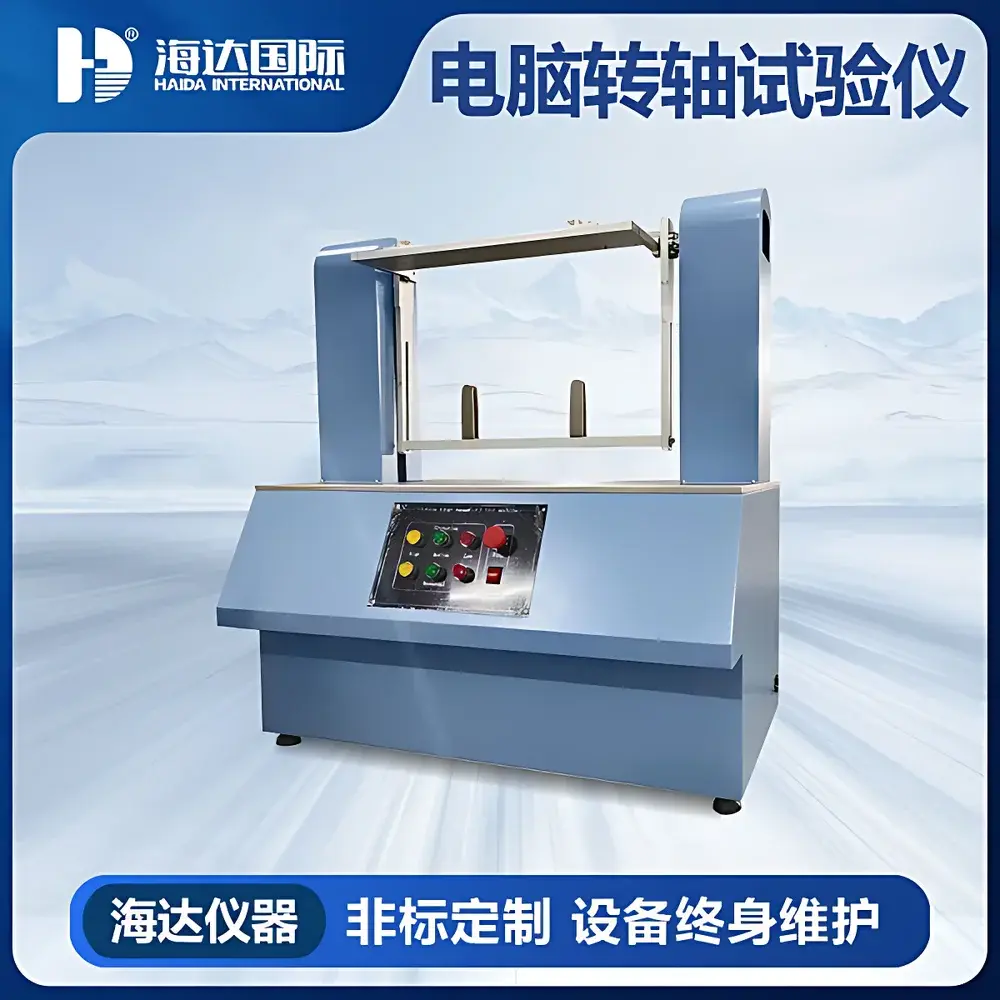
HAIDA HD-K811 Laptop Hinge Durability Tester
| Brand | HAIDA INTERNATIONAL |
|---|---|
| Origin | Guangdong, China |
| Manufacturer Type | Original Equipment Manufacturer (OEM/ODM) |
| Product Category | Domestic (China-Made) |
| Model | HAIDA HD-K811 Laptop Hinge Durability Tester |
| Pricing | Available Upon Request |
Overview
The HAIDA HD-K811 Laptop Hinge Durability Tester is an electromechanical fatigue testing system engineered for quantitative evaluation of mechanical endurance in laptop display hinges and related rotational coupling mechanisms. It operates on a programmable angular oscillation principle—applying controlled torque, defined opening/closing angles, and repeatable cycle counts to simulate real-world usage conditions over extended service life. Designed for QC laboratories, R&D centers, and third-party certification bodies, the HD-K811 supports standardized hinge performance assessment per ISO 9221 (Ergonomics of Human-System Interaction – Mechanical Requirements for Hinges), IEC 60950-1 Annex Q (Hinge Endurance), and relevant clauses of GB/T 22794–2018 (General Technical Requirements for Portable Computers). Its modular architecture integrates precision stepper motor actuation, high-resolution rotary encoder feedback, and load-cell-based torque monitoring to ensure measurement repeatability and traceable test execution.
Key Features
- Programmable angular range: adjustable between ±15° and ±180° with 0.1° resolution, enabling simulation of both shallow-lid and full-flip hinge motions.
- Cycle count capability up to 100,000 cycles with automatic stop-on-failure detection via torque deviation thresholding or positional drift monitoring.
- Real-time torque acquisition using calibrated strain-gauge load cells (±0.5% FS accuracy), synchronized with angular position data for torque-angle hysteresis loop analysis.
- Dual-mode operation: manual jog mode for setup and calibration; automated test mode with configurable dwell time, speed ramping, and acceleration/deceleration profiles.
- Robust clamping fixture system compatible with standard laptop chassis mounting points (M2.5–M4 threaded inserts), supporting devices from 11” to 17” form factors without retooling.
- Integrated safety interlocks including emergency stop button, lid-open sensor, and motor thermal cutoff—compliant with EN 60204-1 (Electrical Equipment of Machines).
Sample Compatibility & Compliance
The HD-K811 accommodates rigid-body hinge assemblies found in clamshell-style laptops, 2-in-1 convertibles, and detachable tablet hybrids. Fixture adaptability extends to single-axis, dual-axis, and free-pivot hinge configurations, provided mechanical interface geometry permits secure clamping. Test protocols align with internationally recognized durability benchmarks—including ASTM F2899 (Standard Practice for Testing Laptop Hinge Life), ISO/IEC 17025-accredited test method development support, and GLP-compliant documentation workflows. All firmware and mechanical calibrations are traceable to NIM (National Institute of Metrology, China) reference standards. The instrument meets CE marking requirements under the Machinery Directive 2006/42/EC and electromagnetic compatibility (EMC) per EN 61326-1.
Software & Data Management
The HD-K811 is operated via HAIDA’s proprietary HingeTest Suite v3.2—a Windows-based application delivering full test sequence definition, live parameter visualization (torque vs. angle, cycle count vs. time), and post-test analytics. Software features include audit-trail logging compliant with FDA 21 CFR Part 11 (electronic signatures, user access levels, change history), CSV/PDF report export with embedded metadata (operator ID, calibration certificate ID, environmental conditions), and customizable pass/fail criteria based on torque decay rate, positional overshoot, or cycle-to-failure. Raw data files are stored in HDF5 format for interoperability with MATLAB, Python (pandas/h5py), or LabVIEW environments. Firmware updates are delivered via encrypted USB key with SHA-256 signature verification.
Applications
- Validation of hinge design robustness during pre-production prototyping phases.
- Comparative benchmarking of hinge materials (stainless steel, aluminum alloys, reinforced polymers) under accelerated aging conditions.
- Root-cause analysis of hinge failure modes—including torsional spring fatigue, bushing wear, gear tooth degradation, and lubricant migration.
- Supporting regulatory submissions for CE, CCC, and BIS certifications where hinge durability forms part of mechanical safety compliance.
- Contract testing services offered by accredited labs performing ISTA 3A, MIL-STD-810H Section 516.8 (vibration-induced hinge stress), and custom OEM specification testing.
FAQ
Does the HD-K811 support variable-speed cycling to replicate user-dependent opening dynamics?
Yes—speed profiles can be defined per segment (e.g., slow initial engagement, constant mid-range velocity, decelerated closure), with acceleration limits configurable up to 500°/s².
Can test data be exported directly into LIMS or ERP systems?
Yes—via RESTful API integration (available as optional module) or scheduled CSV dumps with timestamped filenames adhering to ISO 8601 formatting.
Is periodic recalibration required, and what documentation is provided?
Annual calibration is recommended; each unit ships with a NIM-traceable calibration certificate covering torque (0–5 N·m range) and angular position (±0.25° uncertainty), valid for 12 months under normal operating conditions.
What environmental conditions must be maintained during testing?
Ambient temperature: 23 ± 2°C; relative humidity: 40–60% RH; non-condensing; vibration-isolated bench surface (ISO 2372 Class A).
Are custom fixtures available for non-standard hinge geometries?
Yes—HAIDA offers engineering consultation and CNC-machined fixture design services, with lead time typically 10–15 working days after dimensional specifications submission.



