
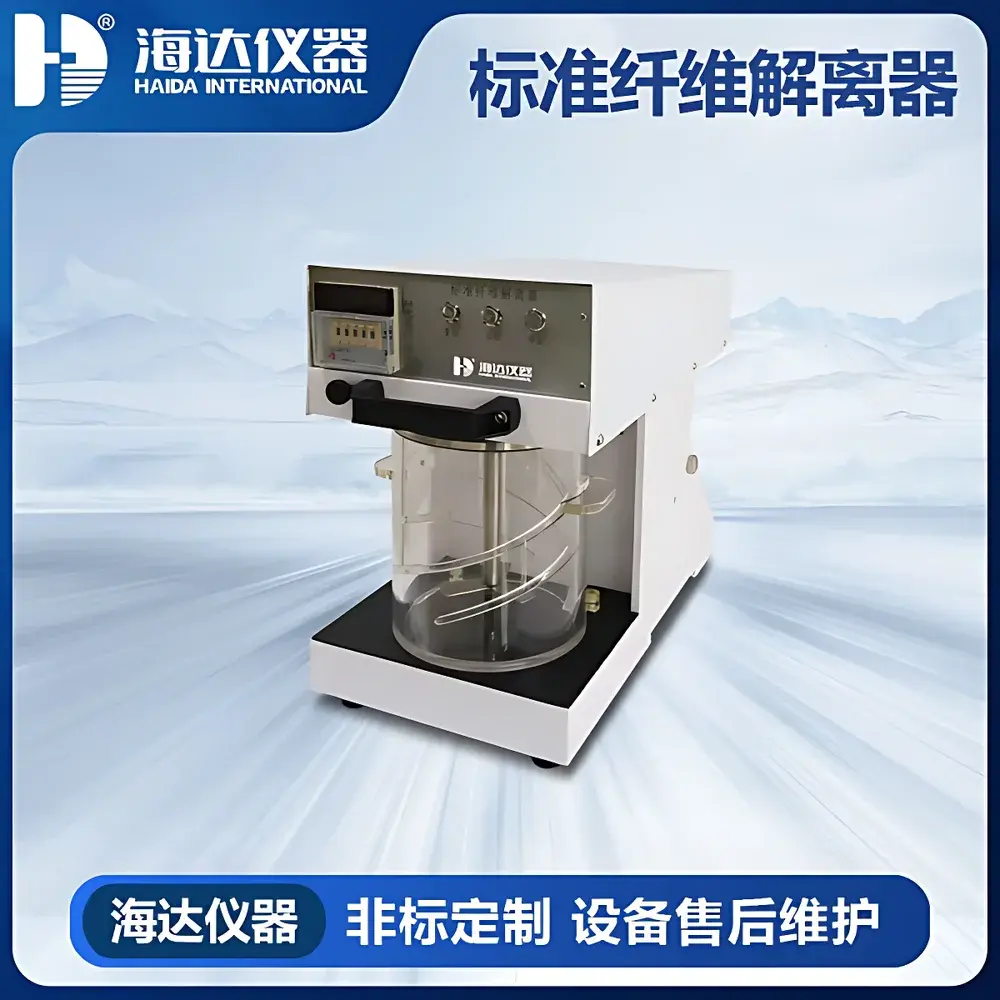
HAIDA HD-P003 Standard Fiber Disintegrator
| Brand | HAIDA INTERNATIONAL |
|---|---|
| Origin | Guangdong, China |
| Manufacturer Type | Direct Manufacturer |
| Product Origin | Domestic (China) |
| Model | HAIDA HD-P003 Standard Fiber Disintegrator |
| Pricing | Upon Request |
| Vessel Dimensions | Ø152 × 191 mm |
| Internal Helical Rib Geometry | 6.5 × 6.5 mm, 4-fold symmetric |
| Counting Mechanism | Digital preset counter with auto-stop function |
| Blade Rotational Frequency | 48.3 ± 1.66 Hz (2950+ rpm) |
| Overall Dimensions | 520 × 270 × 360 mm |
| Stainless Steel Vessel Capacity | ≥2 L |
| Power Supply | 220 V, 50 Hz, 400 W |
| Net Weight | ~45 kg |
| Operating Environment | 10–40 °C, ≤75% RH |
| Impeller | Φ90 mm, 3-blade stainless steel |
| Packaging Dimensions | 32 × 59 × 41 cm |
| Compliance | GB/T 24327–2009, ISO 5263, QB/T 1462–1992 |
Overview
The HAIDA HD-P003 Standard Fiber Disintegrator is a precision-engineered laboratory instrument designed for controlled wet disintegration of pulp suspensions in accordance with internationally recognized standard methods. It operates on the principle of mechanical shear dispersion—utilizing a high-speed rotating impeller within a standardized stainless-steel vessel to subject fiber networks to reproducible hydrodynamic forces. This process effectively separates entangled fibers while preserving intrinsic morphological and structural integrity—including fiber length distribution, coarseness, and fines content—ensuring measurement fidelity across analytical workflows such as Canadian Standard Freeness (CSF), Schopper-Riegler (SR), or optical fiber characterization. The device meets the strict geometric, rotational, and timing specifications defined in GB/T 24327–2009, ISO 5263, and QB/T 1462–1992, making it suitable for accredited quality control laboratories, pulp & paper R&D centers, and regulatory testing facilities requiring traceable, inter-laboratory comparable results.
Key Features
- Stainless-steel (AISI 304 or higher) disintegration vessel (≥2 L capacity) with precisely machined internal helical ribs (6.5 × 6.5 mm, four-fold symmetry) to ensure uniform flow field generation and consistent fiber liberation.
- Digital preset counter with real-time rotation display and automatic shutdown upon reaching user-defined revolutions—eliminating operator-dependent timing errors and enhancing method compliance.
- High-efficiency low-voltage motor (400 W, 220 V / 50 Hz) delivering stable rotational speed >2950 rpm with minimal thermal drift and long-term torque consistency.
- Soft-coupling drive system mounted on a rigid cast-iron base—reducing vibration transmission and enabling silent, steady operation even during extended duty cycles.
- Top-mounted electrical enclosure isolating all wiring and controls from potential moisture exposure—improving safety, corrosion resistance, and service longevity in humid lab environments.
- Integrated dual-safety system: emergency stop button and anti-misoperation interlock switch preventing unintended startup during lid handling or maintenance.
Sample Compatibility & Compliance
The HD-P003 accommodates standard pulp slurries at concentrations of 0.5–1.5% w/w, including chemical, mechanical, semi-chemical, and recycled pulps. Its geometry and rotational dynamics are validated for use with handsheets, laboratory sheets, and repulped paper samples per TAPPI T205, ISO 5263, and ASTM D1995. All mechanical dimensions—including vessel diameter (Ø152 mm), height (191 mm), impeller diameter (Ø90 mm), and rib pitch—conform strictly to referenced standards to guarantee method equivalence across global laboratories. The unit supports GLP-compliant documentation when integrated with external logging systems, and its design facilitates routine verification per ISO/IEC 17025 calibration protocols.
Software & Data Management
While the HD-P003 operates as a stand-alone electromechanical instrument, its digital counter provides non-volatile storage of up to 99 preset run counts and cumulative operational history. For regulated environments, the device can be interfaced via RS-232 or optional USB-to-serial adapter to laboratory information management systems (LIMS) or electronic lab notebooks (ELN). Audit trail functionality—including timestamped start/stop events, operator ID input, and cycle count validation—is achievable through third-party middleware compliant with FDA 21 CFR Part 11 requirements. Firmware updates (where applicable) follow version-controlled release procedures aligned with IEC 62304 software lifecycle standards.
Applications
- Standardized pulp disintegration prior to freeness testing (TAPPI T227, ISO 5267-1).
- Preparation of homogeneous fiber suspensions for microscopic analysis, fiber length distribution (e.g., Kajaani or FiberLab systems), and fines quantification.
- Quality assurance of recycled fiber processing efficiency and deinking performance.
- Method development and validation studies in pulp chemistry, refining optimization, and nanocellulose dispersion protocols.
- Accredited testing under ISO/IEC 17025 for certification bodies issuing test reports for ISO 9001 or FSC Chain-of-Custody audits.
FAQ
What standards does the HD-P003 comply with?
It fully conforms to GB/T 24327–2009, ISO 5263, and QB/T 1462–1992 for geometry, rotational frequency, and timing accuracy.
Can the vessel be autoclaved or chemically sterilized?
The AISI 304 stainless-steel vessel is compatible with standard alkaline cleaning agents and steam sterilization up to 121 °C; however, prolonged exposure to chlorine-based disinfectants is not recommended.
Is calibration required before first use?
Yes—initial verification of rotational speed (±1.66 Hz tolerance), counter accuracy, and vessel dimensional conformity must be performed using NIST-traceable tachometry and metrology tools per ISO/IEC 17025 Annex A.
Does the unit support variable speed control?
No—the HD-P003 operates at a fixed, standardized rotational frequency optimized for method compliance; variable-speed variants are not offered under this model designation.
What maintenance intervals are recommended?
Lubrication of the drive shaft bearing every 500 operating hours and annual inspection of impeller balance and rib integrity are advised to maintain long-term repeatability.



