
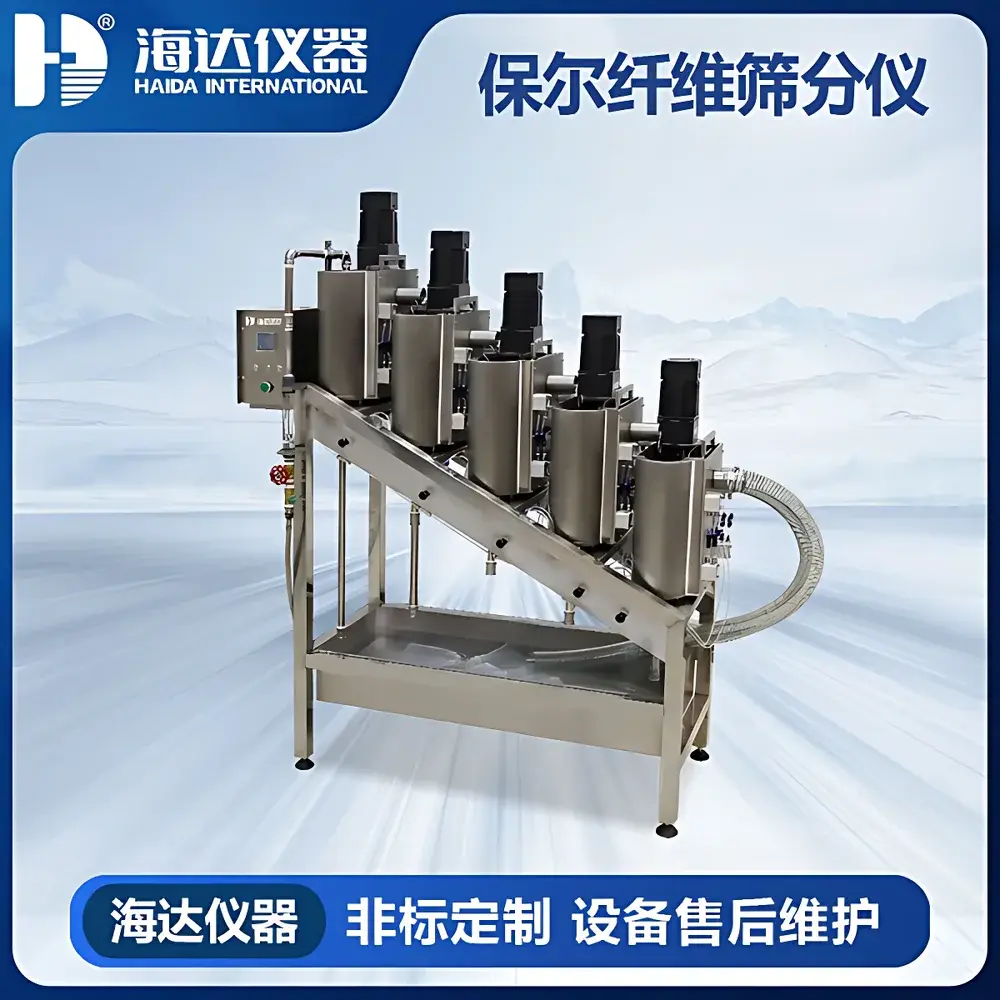
HAIDA HD-P010 Bauer Fiber Fractionator
| Brand | HAIDA INTERNATIONAL |
|---|---|
| Origin | Guangdong, China |
| Manufacturer Type | Direct Manufacturer |
| Product Origin | Domestic (China) |
| Model | HAIDA HD-P010 Bauer Fiber Fractionator |
| Quotation | Upon Request |
| Sieve Stages | 5 |
| Fractionator Capacity | 10 L per chamber |
| Agitator Speed | (580 ± 1) rpm |
| Standard Tyler Sieve Sizes (Factory-Installed) | 14, 28, 48, 100 mesh |
| Water Flow Rate Range | 0–20 L/min (adjustable |
| display accuracy | ±0.5% of reading) |
| Sieving Duration | 0–9999 min (programmable) |
| Construction Material | AISI 304 stainless steel |
| Net Weight | 135 kg |
| Water Supply | Continuous municipal or lab-grade supply required |
| Power Supply | 240 W, 380 V AC |
| Compliant Standards | GB/T 2678.1–1993, TAPPI T233 cm–95, SCAN M6 (10 g sample, 15 min duration, 10 L/min flow rate) |
Overview
The HAIDA HD-P010 Bauer Fiber Fractionator is a precision-engineered laboratory instrument designed for the quantitative separation and classification of wood pulp fibers by length using the classical Bauer-type wet-sieving principle. It operates on the fundamental hydrodynamic principle that fiber suspension flowing under controlled laminar water flow through a cascade of progressively finer sieves retains fibers longer than the aperture size of each sieve—enabling gravimetric determination of fiber length distribution. This method delivers the weight-average fiber length (often reported as weighted mean length or “Lw”) and provides critical insights into fiber morphology relevant to paper strength, formation, drainage, and refining response. The HD-P010 is not a particle-size analyzer but a dedicated fiber fractionation system conforming to internationally recognized pulp testing protocols.
Key Features
- Five-stage modular fractionation chamber assembly with individual 10 L stainless-steel vessels arranged in descending sieve order—ensuring consistent hydraulic residence time and minimizing fiber re-entrainment.
- Precision agitator system delivering stable (580 ± 1) rpm rotation to maintain homogeneous fiber suspension during sieving—critical for reproducible fiber liberation and transport behavior.
- Full-range adjustable water flow control (0–20 L/min) with high-fidelity flowmeter calibrated to ±0.5% of reading—supporting method-specific flow requirements across GB/T, TAPPI, and SCAN standards.
- Programmable sieving duration from 1 second to 9999 minutes—enabling strict adherence to standardized test durations (e.g., 15 min per SCAN M6 or variable durations per TAPPI T233).
- Corrosion-resistant AISI 304 stainless-steel construction throughout fluid-contact surfaces—including chambers, sieve supports, and piping—to ensure long-term dimensional stability and compliance with GLP handling of aqueous pulp suspensions.
- Interchangeable Tyler-standard sieve sets pre-configured for long, medium-length, or short fiber analysis—facilitating rapid method switching without recalibration.
Sample Compatibility & Compliance
The HD-P010 is validated for use with mechanical, chemical, chemi-mechanical, and recycled pulp suspensions at standard consistency (typically 0.1–0.3% w/w). It accommodates both handsheet-dispersed and laboratory-refiner-prepared samples. All operational parameters align with regulatory and industry-standard test methods: GB/T 2678.1–1993 (Chinese national standard for fiber length distribution), TAPPI T233 cm–95 (standard test method for fiber length distribution by Bauer-McNett), and SCAN M6 (Nordic standard for fiber fractionation under defined flow and time conditions). The system’s mechanical repeatability and flow stability support audit-ready documentation for ISO/IEC 17025-accredited laboratories and GMP-aligned pulp R&D environments.
Software & Data Management
The HD-P010 operates as a hardware-controlled benchtop instrument without embedded software or touchscreen interface—intentionally designed to eliminate firmware validation overhead in regulated settings. All operational parameters (flow rate, agitation speed, duration) are set via analog dials and digital timers with physical locking mechanisms to prevent accidental deviation. Test logs—including date, operator ID, sample ID, sieve configuration, flow setting, duration, and ambient temperature—are recorded manually in bound laboratory notebooks or integrated into LIMS via structured CSV export from optional external data acquisition modules (e.g., USB-connected flow meter loggers compliant with FDA 21 CFR Part 11 when paired with validated software). Audit trails for calibration certificates, sieve certification reports (per ASTM E11), and preventive maintenance records are maintained separately per GLP requirements.
Applications
- Determination of weight-average fiber length (Lw) and distribution breadth (e.g., ratio of >1 mm to <0.2 mm fractions) for pulp quality benchmarking.
- Monitoring fiber shortening during refining—correlating energy input with changes in coarse/fine fraction ratios.
- Comparative evaluation of fiber sources (e.g., hardwood vs. softwood, virgin vs. deinked pulp) in product development.
- Supporting TAPPI T233-based QC release testing for market-grade kraft, bleached sulfite, and mechanical pulps.
- Method transfer and inter-laboratory comparison studies under ISO 5725-2 precision guidelines.
FAQ
What standards does the HD-P010 comply with?
It meets the mechanical and procedural requirements of GB/T 2678.1–1993, TAPPI T233 cm–95, and SCAN M6—including specified flow rates, sieve geometry, sample mass, and timing protocols.
Can I use non-Tyler sieve meshes?
Only certified Tyler-standard sieves are recommended; deviations compromise comparability with published reference data and invalidate conformance to cited standards.
Is calibration traceable to national standards?
Yes—flow meters are supplied with NIST-traceable calibration certificates; sieve meshes are certified per ISO 3310-1 and ASTM E11 with documented aperture verification reports.
Does the unit require compressed air or vacuum?
No—it operates solely on gravity-fed or pumped potable water supply at stable pressure (2–6 bar); no auxiliary utilities are needed.
How often must sieves be replaced?
Sieves should be inspected before each test series; replacement is required if aperture deformation exceeds ±2% of nominal size or after 500 cumulative operating hours—documented in maintenance logs.



