
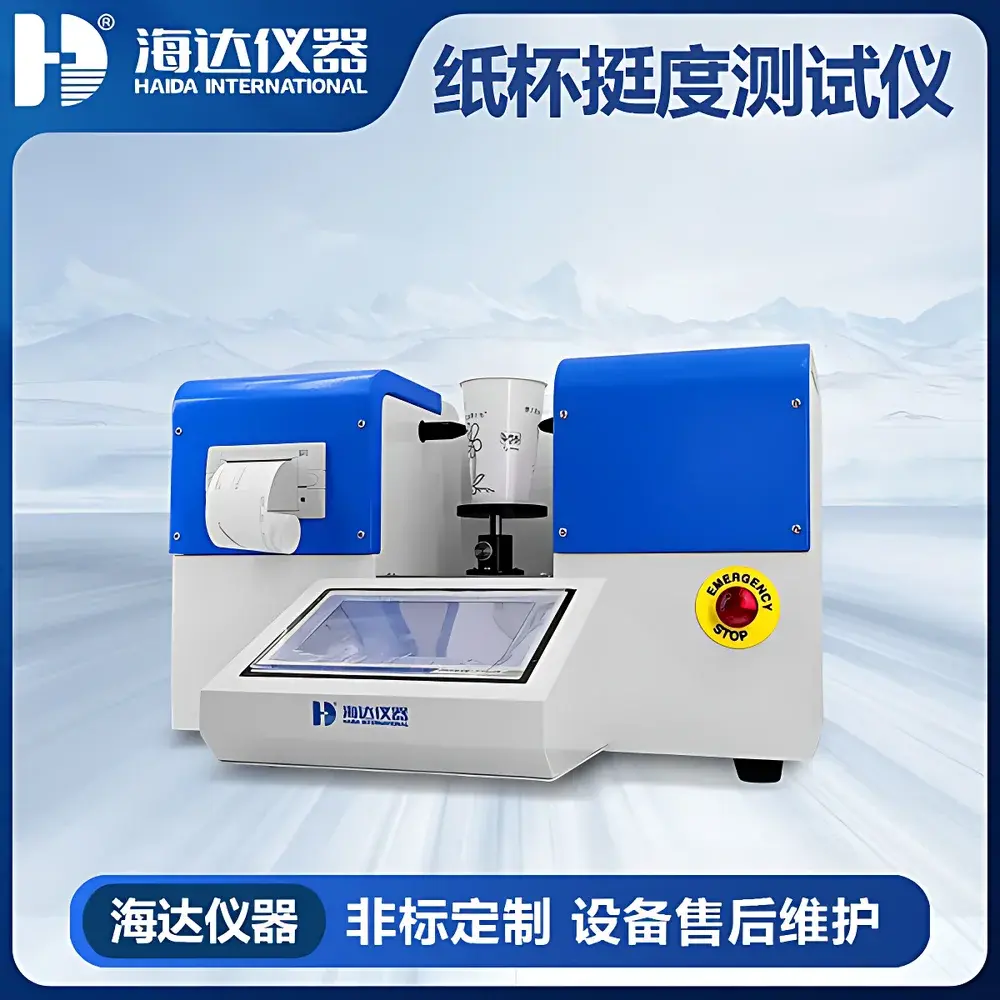
HAIDA HD-P012 Paper Cup Stiffness Tester
| Brand | HAIDA INTERNATIONAL |
|---|---|
| Origin | Guangdong, China |
| Manufacturer Type | Direct Manufacturer |
| Country of Origin | China |
| Model | HAIDA HD-P012 Paper Cup Stiffness Tester |
| Measurement Range | 0–30 N (optional ranges: 5/10/20/50 N) |
| Resolution | 0.01 N |
| Accuracy | ±1% FS |
| Test Speed | 50 ± 0.1 mm/min (adjustable 1–200 mm/min) |
| Probe Displacement | 9.5 ± 0.1 mm (adjustable 1–80 mm) |
| Probe Alignment Tolerance | ≤ 0.2 mm |
| Initial Probe Spacing | 40–120 mm |
| Data Output | Thermal Printer |
| Storage Capacity | 99 test records |
| Dimensions | 500 × 270 × 330 mm |
| Weight | ~18 kg |
Overview
The HAIDA HD-P012 Paper Cup Stiffness Tester is a dedicated mechanical testing instrument engineered for quantitative evaluation of cup wall rigidity — a critical physical property governing structural integrity, stackability, and user-handling performance in single-use paper cups. It operates on the principle of controlled axial compression between two parallel, rigid probes, applying a defined displacement at a regulated rate while measuring the resulting reaction force. This method aligns with standardized bending resistance assessment under constrained boundary conditions, as codified in GB/T 27590–2011 and QB/T 2294. The system adheres to the metrological requirements specified in JJG 157 for non-metallic tensile, compressive, and universal testing machines, ensuring traceable force measurement and repeatable kinematic control. Designed for compliance-driven environments, the HD-P012 supports routine quality verification in production lines and method development in R&D laboratories where mechanical stability under load must be objectively quantified.
Key Features
- High-accuracy force measurement enabled by precision load cell technology and signal conditioning circuitry incorporating imported U.S.-sourced microcontroller units for low-drift analog-to-digital conversion.
- Repeatable probe motion achieved via precision-ground lead screw actuation, delivering stable test speed (1–200 mm/min) and displacement resolution (0.01 mm), minimizing inter-test variability.
- Adjustable initial probe spacing (40–120 mm) and programmable displacement range (1–80 mm) accommodate diverse cup geometries and enable comparative stiffness profiling across product variants.
- 7-inch capacitive touchscreen interface with bilingual (English/Chinese) firmware, supporting fully automated test execution, real-time force–displacement curve visualization, and on-screen statistical summary (mean, SD, CV%).
- Integrated thermal printer provides immediate hard-copy output of test results including peak force, displacement at peak, and timestamped metadata — essential for audit-ready documentation in GLP-compliant workflows.
Sample Compatibility & Compliance
The HD-P012 is optimized for cylindrical or tapered paper-based cups with wall thicknesses ranging from 0.15 mm to 0.6 mm and diameters between 50 mm and 100 mm. Its probe geometry and alignment tolerance (≤0.2 mm) ensure consistent contact pressure distribution across the cup sidewall without localized buckling artifacts. The instrument satisfies mandatory verification criteria under JJG 157 and meets the functional specifications outlined in GB/T 27590–2011 (Section 6.4: “Cup Body Stiffness”) and QB/T 2294 (Clause 5.3). While not certified to ISO/IEC 17025, its design incorporates features required for laboratory accreditation readiness — including calibrated force transduction, documented uncertainty budgets, and unambiguous test parameter logging.
Software & Data Management
Firmware supports local storage of up to 99 complete test records, each containing raw force–displacement arrays, calculated metrics (e.g., maximum compressive force, stiffness slope over linear region), and operator-defined batch IDs. All data fields are immutable post-test; no editing capability exists to preserve data integrity. Timestamps are synchronized to internal RTC with battery backup. Export functionality is limited to printed reports; however, the system architecture allows future firmware upgrades to support USB-host data dump or RS-232 serial transmission for integration into centralized LIMS platforms. Audit trails — including calibration date, operator ID, and test initiation time — are embedded in every printed report, satisfying baseline FDA 21 CFR Part 11 documentation expectations for non-networked instruments.
Applications
- Production line release testing of paper cups against GB/T 27590–2011 stiffness thresholds (≥1.5 N for standard 9 oz cups).
- Raw material qualification: evaluating pulp fiber composition, coating weight, and calendering effects on cup wall resistance to radial deformation.
- Package design validation: correlating cup geometry (height/diameter ratio, rib depth) with measured stiffness to optimize material usage without compromising performance.
- Accelerated aging studies: monitoring stiffness degradation after exposure to humidity (RH ≥85%) or elevated temperature (40°C/72 h) per ASTM D685 protocols.
- Supplier qualification audits: generating reproducible benchmark datasets for third-party manufacturing sites operating under ISO 9001 quality management systems.
FAQ
What standards does the HD-P012 directly support?
GB/T 27590–2011, QB/T 2294, and JJG 157 — covering test method definition, performance verification, and metrological traceability.
Can the instrument measure stiffness beyond 30 N?
Yes — optional load cell variants (5 N, 10 N, 20 N, 50 N) are available to match expected force ranges for specialty cups (e.g., double-walled or insulated designs).
Is calibration certificate included with shipment?
A factory calibration report traceable to NIM (National Institute of Metrology, China) is supplied; users must perform periodic verification per JJG 157 intervals (typically annually).
Does the system comply with FDA 21 CFR Part 11?
As a standalone, non-networked device with immutable printed output and no electronic signature capability, it meets foundational data integrity requirements but lacks full Part 11 feature sets such as audit trail export or role-based access control.
How is probe alignment verified during maintenance?
Alignment is assessed using gauge blocks and dial indicators per manufacturer’s service manual; deviation >0.2 mm triggers recalibration of the probe carriage assembly.



