
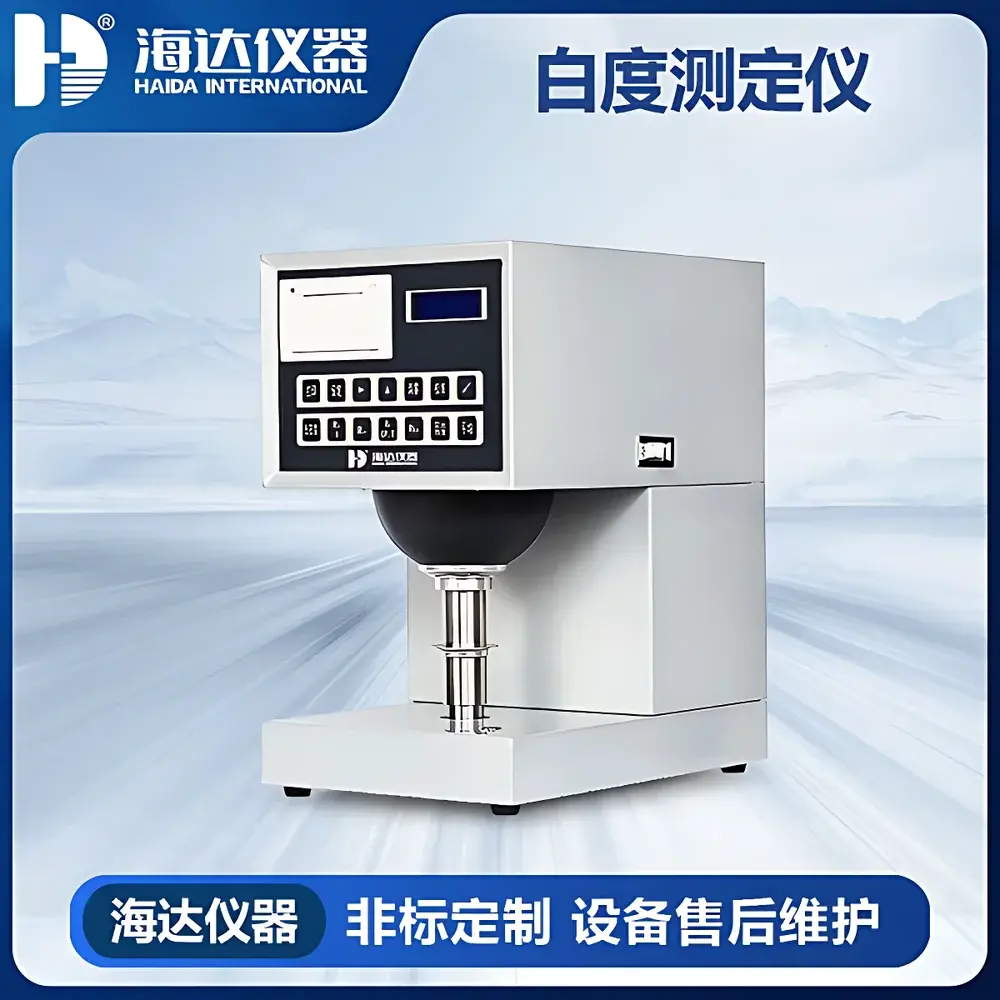
HAIDA HD-T002 Whiteness Tester
| Brand | HAIDA INTERNATIONAL |
|---|---|
| Origin | Guangdong, China |
| Manufacturer Type | Direct Manufacturer |
| Origin Category | Domestic (China) |
| Model | HD-T002 |
| Price | Upon Request |
| Light Source | Simulated D65 Illuminant |
| Integrating Sphere Diameter | 150 mm |
| Sample Port Diameter | ≥ φ30 mm |
| Max Sample Thickness | 40 mm |
| Zero Drift | ≤ 0.1 |
| Indication Error | ≤ 0.5 |
| Repeatability Error | ≤ 0.1 |
| Specular Reflection Error | ≤ 0.1 |
| Display | 128×32 Dot-Matrix LCD |
| Power Supply | AC (100–240) V, (50/60) Hz, 50 W |
| Operating Environment | (10–35) °C, RH ≤ 85% |
| Dimensions (W×D×H) | 370 × 260 × 425 mm |
| Net Weight | ~11 kg |
| Compliance Standards | GB/T 7973, GB/T 7974, GB/T 2679, GB/T 1543, GB/T 10339, GB/T 12911, GB/T 2913, GB/T 13025.2, GB/T 22427.6, ISO 2469, ISO 2470, ISO 2471, ISO 9416 |
| Optional Accessories | Constant-Pressure Sampler (YT-QY), Fiber Sampler |
Overview
The HAIDA HD-T002 Whiteness Tester is a precision optical instrument engineered for the quantitative determination of whiteness, brightness, and related optical properties of planar and powdered materials under standardized illuminants—primarily simulated D65 daylight. It operates on the principle of diffuse reflectance photometry using a 150 mm integrating sphere, ensuring high spatial uniformity and minimal angular dependency in measurements. The instrument conforms to internationally recognized test methodologies including ISO 2470 (paper brightness), ISO 2469 (paper whiteness), ISO 2471 (opacity), and corresponding Chinese national standards (e.g., GB/T 7974, GB/T 1543). Its core measurement capability includes R457 blue-light reflectance (commonly referred to as “brightness”), fluorescent whiteness correction for samples containing optical brightening agents (OBAs), and optional derivable parameters such as opacity (OP), scattering coefficient (S), absorption coefficient (A), and green-light reflectance factor (Ry10). Designed for laboratory and quality control environments, the HD-T002 delivers traceable, reproducible results suitable for routine compliance testing and inter-laboratory comparison.
Key Features
- 150 mm high-precision integrating sphere with spectrally neutral coating for stable diffuse illumination and collection geometry
- Simulated D65 illuminant compliant with CIE standard illuminant requirements for daylight evaluation
- Integrated zero-point stabilization circuitry with automatic drift compensation (≤ 0.1 unit over 30 min)
- Non-volatile memory preserving calibration coefficients and user settings after power interruption
- 128×32 dot-matrix LCD display with real-time parameter readout and status indicators
- Modular accessory support: constant-pressure sampler (YT-QY) for uniform paper sheet compression; fiber sampler for heterogeneous pulp or textile specimens
- RS232 serial interface (optional) enabling bidirectional communication with external PCs for automated data logging and report generation
- Robust mechanical architecture with vibration-damped base and thermal-stabilized optical path for operation across ambient temperatures from 10–35 °C
Sample Compatibility & Compliance
The HD-T002 accommodates a broad range of industrial substrates: paper and board (including coated, uncoated, and recycled grades), plastic films, salt crystals (industrial and food-grade NaCl), starch powders, calcium carbonate, talc, titanium dioxide pigments, and other opaque or semi-opaque particulates. Sample geometry must meet minimum planar dimensions (≥ φ30 mm) and thickness constraints (≤ 40 mm); powdered samples are measured in standardized sample cups with defined packing density. All reported values adhere strictly to metrological definitions outlined in ISO 2470 (brightness as R457), ISO 2469 (CIE whiteness index), and GB/T 7973 (instrumental white degree). The system supports GLP-aligned workflows through audit-ready calibration logs and operator identification fields when paired with compatible PC software (sold separately). It satisfies regulatory expectations for method validation per ISO/IEC 17025 and supports documentation required for FDA 21 CFR Part 11–compliant environments when used with validated software extensions.
Software & Data Management
When connected via RS232 (optional interface), the HD-T002 interfaces with HAIDA’s proprietary Windows-based data acquisition suite—designed for batch testing, statistical process control (SPC), and customizable reporting. The software enables storage of up to 10,000 measurement records with timestamp, operator ID, sample ID, and environmental metadata (temperature/humidity if externally logged). Export formats include CSV, Excel (.xlsx), and PDF reports compliant with internal QA templates. Audit trails record all calibration events, parameter modifications, and user logins. Raw spectral reflectance data is not captured (as the HD-T002 is a filtered broadband photometer, not a spectrophotometer); however, derived indices—including fluorescent-corrected whiteness, opacity, and Y10 tristimulus value—are fully traceable to NIM (National Institute of Metrology, China)–certified reference standards.
Applications
- Quality assurance of paper brightness and whiteness in pulp & paper mills per ISO 2470 and GB/T 7974
- Optical evaluation of OBA-treated textiles and nonwovens to quantify fluorescence contribution
- Batch release testing of industrial salts and food-grade sodium chloride for visual consistency
- R&D screening of pigment dispersion efficiency in coatings and plastics
- Raw material verification of fillers (CaCO3, TiO2, talc) in polymer compounding lines
- Regulatory compliance testing for pharmaceutical excipients requiring whiteness specifications (e.g., USP <905> referenced methods)
- Supplier qualification audits where whiteness deviation directly correlates with processing performance
FAQ
Does the HD-T002 measure full-spectrum reflectance or is it a fixed-wavelength photometer?
The HD-T002 is a broadband photometer equipped with a blue-filtered detector centered at 457 nm (R457) and calibrated for D65-weighted total reflectance—it does not acquire spectral data.
Can the instrument be recalibrated using user-provided standards?
Yes; calibration follows a two-point procedure using certified white and black tiles traceable to NIM or equivalent national metrology institutes. Full calibration routines are accessible via front-panel menu.
Is the RS232 interface included by default?
No—the RS232 port is an optional hardware module. Units shipped without it require factory retrofitting for serial communication capability.
What is the recommended calibration frequency for GMP-regulated environments?
Daily zeroing with black trap and weekly verification against white standard are advised; formal recalibration every six months is recommended under ISO/IEC 17025 accreditation requirements.
Does the HD-T002 support measurement of transparent or translucent films?
Not natively—the design assumes opaque or diffusely scattering samples. Transparency or haze assessment requires dedicated instruments (e.g., hazemeters or spectrophotometers with transmission mode).



