
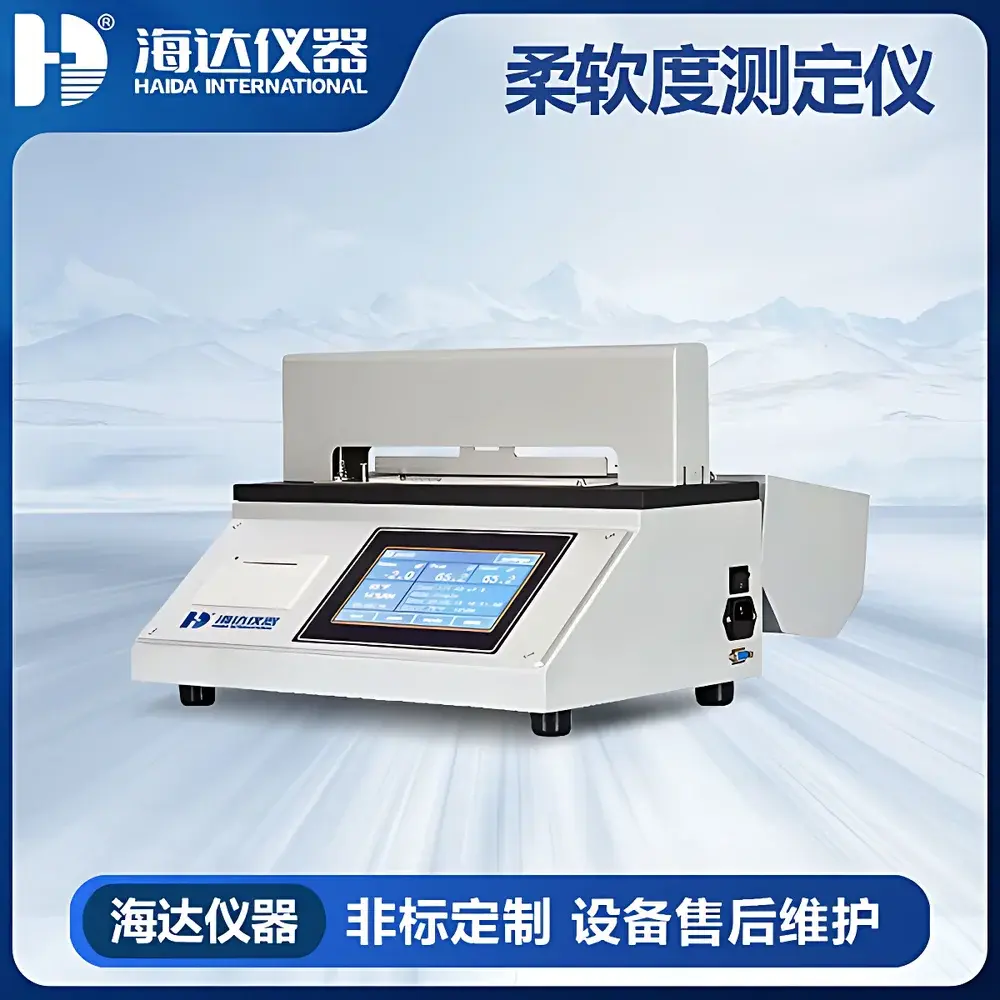
HAIDA HD-T004 Softness Tester
| Brand | HAIDA INTERNATIONAL |
|---|---|
| Origin | Guangdong, China |
| Manufacturer Type | Direct Manufacturer |
| Country of Origin | China |
| Model | HAIDA HD-T004 Softness Tester |
| Price | Upon Request |
| Power Supply | AC (100–240) V, (50/60) Hz, 50 W |
| Operating Temperature | (10–35) °C, Relative Humidity ≤85% |
| Display | 7-inch IPS capacitive touchscreen, 1024×600 resolution |
| Measurement Range | (10–1000) mN |
| Resolution | 0.1 mN |
| Accuracy | ±1% FS (at 5–100% of full scale) |
| Probe Total Stroke | (12±0.5) mm (adjustable approach distance) |
| Probe Penetration Depth | 8 mm |
| Test Speed | 72±0.72 mm/min (adjustable from 1–250 mm/min) |
| Sample Clamp Gap Options | 5 / 6.35 / 10 / 20 mm (4-position selectable) |
| Gap Parallelism Error | ≤0.05 mm |
| Probe Centering Error | ≤0.05 mm |
| Data Storage Capacity | 50 test records |
| Data Export | USB flash drive |
| Built-in Thermal Printer | Yes |
| Communication Interfaces | USB 2.0, Wi-Fi (2.4 GHz IEEE 802.11b/g/n) |
| Dimensions (W×D×H) | 425×290×305 mm |
| Net Weight | ~20 kg |
Overview
The HAIDA HD-T004 Softness Tester is a microprocessor-controlled mechanical testing instrument engineered for objective, repeatable quantification of softness in flexible sheet materials. It operates on the principle of controlled-force indentation—applying a standardized probe at a defined speed and depth to measure the resistance force (in millinewtons) required to compress a specimen within a fixed gap. This method aligns with established mechanical deformation paradigms used in tactile property evaluation, where softness correlates inversely with peak force and energy absorption characteristics under quasi-static loading. Designed specifically for quality control laboratories in pulp & paper, nonwovens, tobacco processing, and textile R&D, the HD-T004 delivers traceable, operator-independent measurements compliant with core national standards including GB/T 8942 (tissue paper softness) and QB/T 1060 (softness testing of cigarette paper and similar thin sheets).
Key Features
- Embedded Cotex-M4 ARM processor ensures deterministic real-time data acquisition, low-latency response, and high computational integrity during dynamic force profiling.
- 7-inch high-resolution IPS capacitive touchscreen interface supports intuitive navigation, live pressure–displacement curve visualization, and on-device parameter configuration without external software dependency.
- Intelligent power-loss recovery: All active test data—including raw force-time traces and calculated metrics—are automatically preserved in non-volatile memory upon unexpected shutdown; resumed testing retains pre-interruption state.
- Dual over-range protection: Hardware-level current limiting and firmware-based sensor saturation detection prevent transducer overload across all operating ranges.
- Modular communication architecture: Native USB 2.0 host/device mode and IEEE 802.11 b/g/n Wi-Fi (2.4 GHz band) enable flexible integration with local networks or standalone PC-based analysis tools.
- Field-upgradable firmware and UI: System software and display logic can be updated via USB flash drive or over-the-air (OTA) through secure Wi-Fi connection—no hardware modification required.
Sample Compatibility & Compliance
The HD-T004 accommodates a broad spectrum of planar, flexible substrates requiring standardized softness assessment. Compatible specimens include—but are not limited to—tissue paper (facial, bath, kitchen), cigarette paper and reconstituted tobacco sheet (RTS), spunbond/meltblown nonwovens, woven and knitted textiles, synthetic films (e.g., PE, PET), and laminated composites. Four precision-machined clamp gap settings (5 mm, 6.35 mm, 10 mm, 20 mm) allow adaptation to varying thicknesses and structural compliance. Mechanical tolerances—including ≤0.05 mm parallelism error across the sample aperture and ≤0.05 mm probe concentricity deviation—ensure consistent contact geometry and minimize edge-effect artifacts. The instrument conforms to metrological requirements specified in GB/T 8942 and QB/T 1060, and its measurement uncertainty budget supports GLP-aligned validation protocols when deployed in regulated environments.
Software & Data Management
Local data handling includes storage of up to 50 complete test sequences—each comprising time-stamped force vs. displacement curves, peak load, average load, and integrated area (energy). All datasets export directly to FAT32-formatted USB drives in CSV format for downstream statistical analysis (e.g., Minitab, JMP, Python/Pandas). Optional cloud connectivity enables encrypted upload to HAIDA’s QMS Paper Quality Management System (sold separately), supporting centralized audit trails, multi-site benchmarking, and SPC chart generation. When paired with licensed PC-based companion software (available as add-on module), the HD-T004 supports advanced post-processing: derivative-based stiffness calculation, hysteresis loop analysis, and batch reporting per ISO/IEC 17025 documentation templates. All digital interactions comply with ALCOA+ principles (Attributable, Legible, Contemporaneous, Original, Accurate, Complete, Consistent, Enduring, Available) for regulated QA/QC workflows.
Applications
- Quality assurance of tissue products across tensile strength–softness trade-off optimization.
- Process validation of creping, embossing, and calendering parameters in paper machine operations.
- Raw material screening for fluff pulp, bamboo fiber, and recycled content impact on tactile performance.
- Regulatory submission support for FDA-listed medical packaging (e.g., sterile barrier systems) where drape and conformability influence usability.
- Research into structure–property relationships in bio-based films and nanocellulose composites.
- Supplier qualification against contractual softness specifications (e.g., ≤350 mN at 8 mm penetration, 72 mm/min).
FAQ
Does the HD-T004 meet international softness testing standards beyond Chinese national standards?
Yes—it implements physical test methodologies fully compatible with ASTM D5266 (Standard Practice for Measuring Tactile Properties of Paper and Paperboard), though formal ASTM certification requires lab-specific validation per Section 8.2 of the standard.
Can test parameters such as speed or penetration depth be customized beyond factory defaults?
The test speed is continuously adjustable from 1 to 250 mm/min; penetration depth is fixed at 8 mm per GB/T 8942, but total stroke (12 mm) allows user-defined approach limits via firmware configuration.
Is the built-in thermal printer capable of generating GLP-compliant reports?
It prints timestamped summary reports with operator ID, sample ID, date/time, and key metrics—but full GLP compliance (e.g., electronic signatures, audit trail) requires use of the optional PC software with 21 CFR Part 11–enabled modules.
What calibration intervals are recommended for routine operation?
Annual verification using NIST-traceable deadweight force standards is advised; internal zero-point and span checks should be performed before each shift using certified reference loads.
How is sensor linearity verified across the full 10–1000 mN range?
Linearity is validated per ISO 376 Annex B using at least five equally spaced points (10, 250, 500, 750, 1000 mN); certificate of conformance with ±1% FS error tolerance is supplied with each unit.
Related Products



