
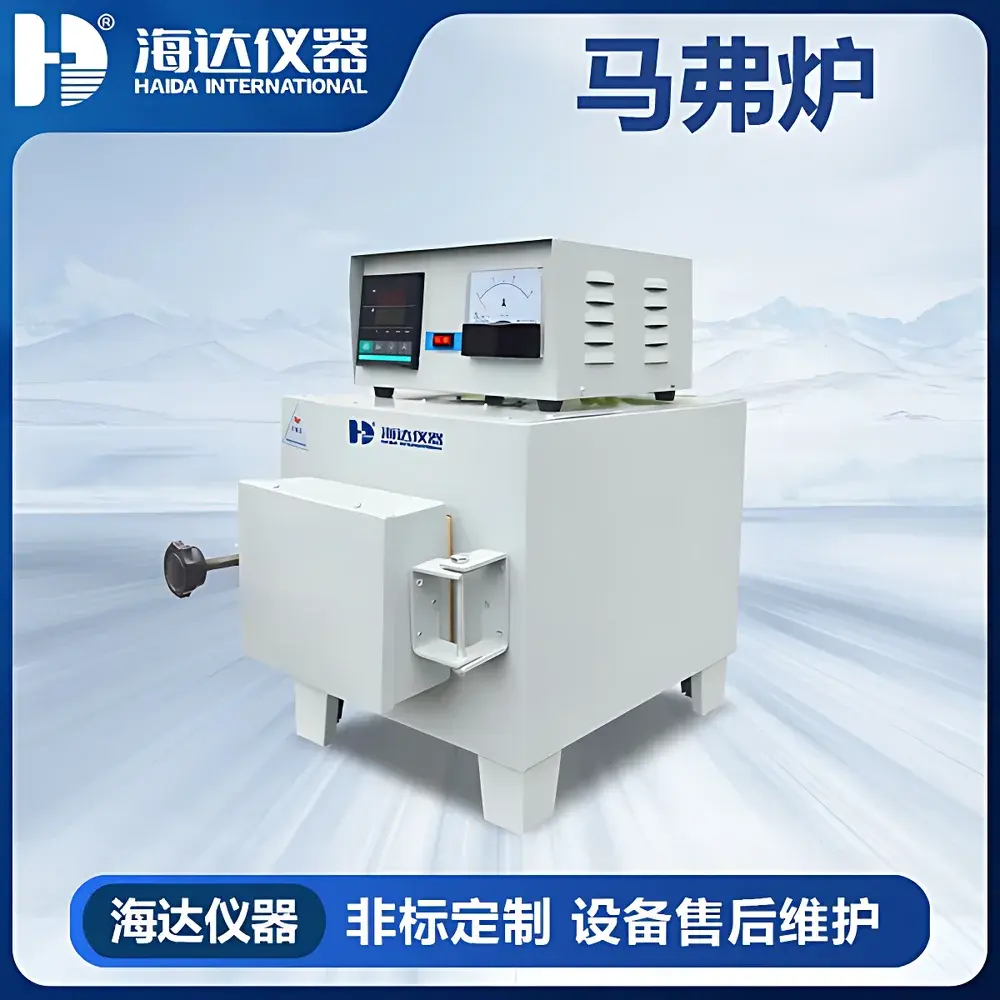
Haida International HD-E805 Muffle Furnace / Ashing Furnace
| Brand | Haida International |
|---|---|
| Origin | Guangdong, China |
| Manufacturer Type | Direct Manufacturer |
| Country of Origin | China |
| Model | HD-E805 Muffle Furnace / Ashing Furnace |
| Power | 2.5 kW (HD-E805), up to 12 kW (HD-E805-5) |
| Max Temperature | 1000 °C (standard), 1200 °C (high-temp variants) |
| Internal Chamber Dimensions (H×W×D) | 80×120×200 mm (HD-E805), up to 200×300×500 mm (HD-E805-5) |
| Voltage | 220 V or 380 V AC, 50/60 Hz |
| Controller Options | C6, C6D, or S27 programmable process controllers |
| Construction | Stainless steel outer casing with ceramic fiber insulation (vacuum-formed modules), refractory lining, rear ventilation ports for optional catalytic exhaust or forced-air cooling |
| Safety | Ground-fault circuit interrupter (GFCI) integrated, viewing window in door |
Overview
The Haida International HD-E805 series is a line of benchtop and floor-standing muffle furnaces engineered for precise, repeatable thermal processing in analytical, quality control, and research laboratories. Operating on resistive heating principles with Kanthal A1 or similar high-stability alloy heating elements embedded within a double-layered thermal barrier, the HD-E805 achieves uniform temperature distribution across its insulated chamber via optimized airflow geometry and low-thermal-mass ceramic fiber modules. As a true muffle furnace, it isolates samples from combustion byproducts and heating element emissions—making it suitable for gravimetric ash content determination (e.g., ASTM D3174, ISO 1171), loss-on-ignition (LOI) analysis, residue quantification in polymers and pharmaceuticals (USP <281>), and pre-treatment of catalyst supports or ceramic precursors. Its design complies with general safety requirements for Class II laboratory ovens per IEC 61010-1 and incorporates thermal runaway mitigation through redundant overtemperature protection circuits.
Key Features
- Robust stainless steel exterior with reinforced hinge mechanism and heat-resistant tempered glass viewing window for real-time sample observation without opening the chamber
- Vacuum-formed ceramic fiber insulation (density ≥128 kg/m³) providing low thermal conductivity (<0.09 W/m·K at 1000 °C) and minimal energy consumption during extended dwell cycles
- Modular rear ventilation interface compatible with external catalytic converters or low-noise centrifugal blowers for controlled off-gas management during organic matrix ashing
- Three controller options: C6 (single-setpoint timer), C6D (dual-stage ramp-soak programming), and S27 (16-segment PID programmable logic with RS485 Modbus RTU output)
- Integrated ground-fault circuit interrupter (GFCI) meeting IEC 61008-1 requirements, ensuring personnel protection under fault conditions
- Calibration-ready architecture with accessible thermocouple terminals (Type K input standard) and optional NIST-traceable calibration certificate support
Sample Compatibility & Compliance
The HD-E805 accommodates crucibles (alumina, platinum, quartz), porcelain boats, and silica dishes—compatible with standard ASTM E1529 and ISO 5660-1 specimen holders. It supports ashing of diverse matrices including polymeric films (ASTM D5630), rubber compounds (ISO 247), foodstuffs (AOAC 942.05), coal and coke (ASTM D3174), and pharmaceutical excipients (EP 2.2.24). All variants are CE-marked for EMC Directive 2014/30/EU and Low Voltage Directive 2014/35/EU. When equipped with S27 controller and audit trail-enabled firmware, the system supports GLP-compliant data integrity per FDA 21 CFR Part 11 Annex 11 requirements for electronic records and signatures.
Software & Data Management
While the base HD-E805 operates as a standalone instrument, the S27 controller enables seamless integration into laboratory informatics environments. It provides ASCII-formatted serial output (Modbus RTU) for direct ingestion into LIMS or SCADA platforms. Optional HaidaLink™ PC software (Windows 10/11) offers real-time graphing, alarm logging, user-access-level configuration (admin/operator), and CSV export of time-stamped temperature profiles with ±0.5 °C repeatability across 10–100% of full scale. All data files include embedded metadata: operator ID, batch number, furnace ID, and calibration status flag.
Applications
- Gravimetric ash analysis in plastics, textiles, and composites per ISO 3451-1 and ASTM D5630
- Residue-on-ignition testing for cementitious materials (ASTM C114) and fly ash characterization (ASTM C618)
- Preparation of inorganic standards for ICP-OES/MS analysis following EPA Method 3050B
- Thermal cleaning of metallographic specimens prior to microstructural evaluation
- Heat treatment of small-dimension tool steels and sintered ceramics under inert or air atmosphere
- Validation of sterilization cycle parameters for reusable surgical instruments (ISO 17664)
FAQ
What temperature uniformity can be expected across the working chamber?
At 1000 °C, typical radial uniformity is ±5 °C within the central 70% volume; at 1200 °C (HD-E805-1/-3/-4 variants), uniformity degrades to ±8 °C due to increased radiant asymmetry—verified per ASTM E220 calibration protocol.
Is the furnace suitable for chlorine-containing polymer ashing?
Yes, when used with an externally mounted catalytic scrubber (e.g., Haida CatEx-1000) connected via the rear ventilation port; this configuration meets ISO 14040 requirements for halogen emission control.
Can the HD-E805 be validated for GMP environments?
With S27 controller, IQ/OQ documentation package, and third-party calibration (NIST-traceable PtRh10-Pt thermocouples), it satisfies equipment qualification per EU GMP Annex 15 and USP <1058>.
What maintenance intervals are recommended for ceramic fiber insulation?
No scheduled replacement is required under normal operation; however, visual inspection for cracking or delamination is advised every 500 operating hours or annually—whichever occurs first.
Does the unit support nitrogen purging?
Not natively; but the rear ventilation port may be adapted with a custom flange kit (Haida PN: F-VP-N2-Kit) for low-flow (<5 L/min) inert gas introduction, maintaining positive pressure and oxygen displacement.



