
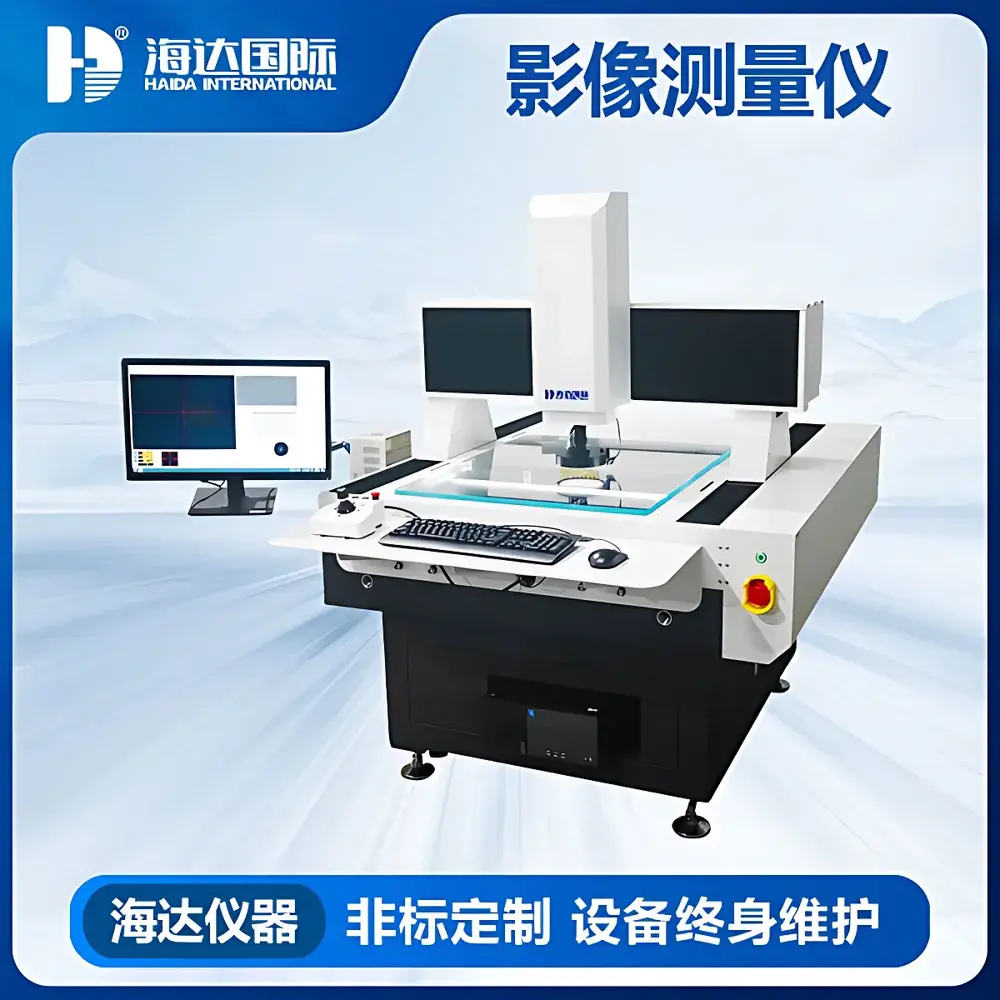
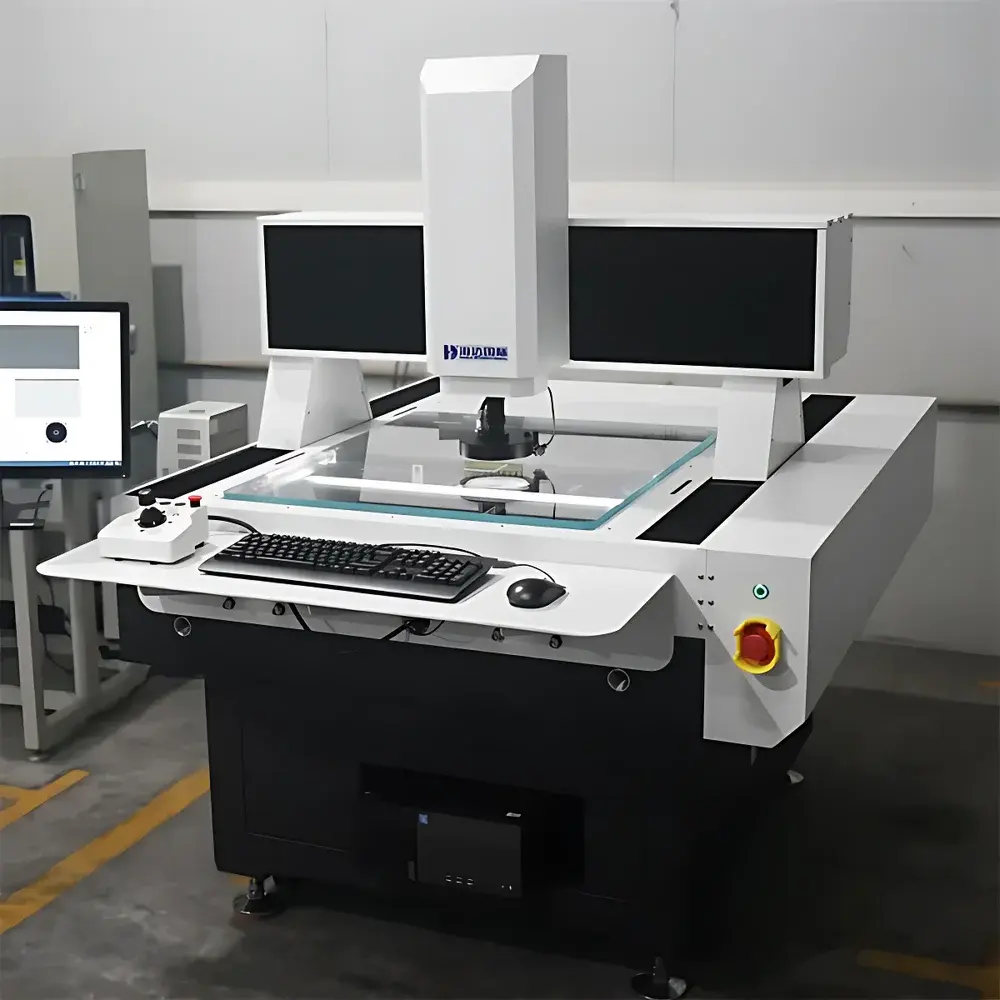
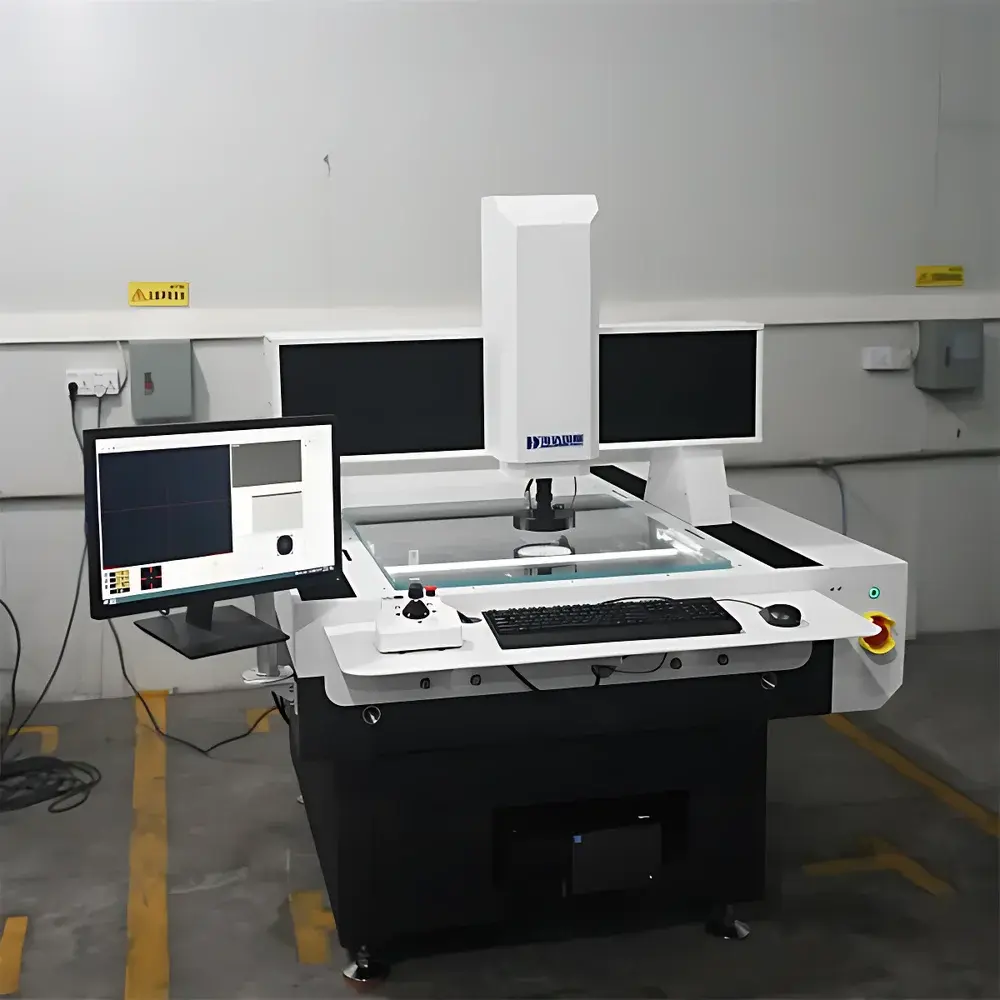
HAIDA INTERNATIONAL HD-U801 Bridge-Type Automated 2.5D Vision Measuring System
| Brand | HAIDA INTERNATIONAL |
|---|---|
| Origin | Guangdong, China |
| Manufacturer Type | Direct Manufacturer |
| Product Origin | Domestic (China) |
| Model | HD-U801 Bridge-Type Automated 2.5D Vision Measuring System |
| Pricing | Upon Request |
Overview
The HAIDA INTERNATIONAL HD-U801 is a precision-engineered bridge-type automated vision measuring system designed for high-accuracy dimensional metrology of complex 2.5D parts. Operating on the principle of optical coordinate measurement—combining high-resolution digital imaging with motorized XYZ-axis motion control—the HD-U801 captures calibrated magnified images of workpieces under telecentric or zoom optics, then computes geometric features (e.g., distances, angles, radii, profiles, positions, and form tolerances) via sub-pixel edge detection algorithms. Unlike purely 2D systems, the HD-U801 supports Z-axis probing (via optional tactile or non-contact height sensors), enabling simultaneous measurement of planar geometry and surface elevation—thus qualifying as a true 2.5D platform compliant with ISO 10360-7 (coordinate measuring machines – acceptance and reverification tests) and aligned with GD&T practices per ASME Y14.5 and ISO 1101. Its rigid granite bridge structure, air-bearing guided linear stages, and thermally stable optical path ensure long-term repeatability (<1.5 µm EMPE at 100 mm) and resistance to mechanical drift in production-floor environments.
Key Features
- Bridge architecture with reinforced granite base and column—optimized for vibration damping and thermal mass stability
- Motorized XYZ translation stages with closed-loop servo control and resolution down to 0.1 µm
- High-magnification zoom lens (e.g., 0.7×–4.5×) with auto-focus capability and integrated LED coaxial & ring lighting
- Programmable multi-lighting modes (backlight, front light, diffuse, structured illumination) for enhanced edge contrast across reflective, transparent, or textured surfaces
- Optional Z-axis sensor integration: non-contact chromatic confocal probe or precision touch-trigger probe for height, step, and surface profile acquisition
- Real-time image processing engine supporting sub-pixel edge detection (1/10-pixel interpolation), pattern matching, and auto-feature recognition
- Integrated environmental compensation module (temperature, air pressure, humidity) for traceable measurement uncertainty management
Sample Compatibility & Compliance
The HD-U801 accommodates parts ranging from micro-components (e.g., watch gears, SMT connectors, MEMS elements) up to 400 × 300 × 200 mm (X × Y × Z), with weight capacity up to 20 kg. It is routinely deployed in regulated manufacturing settings—including medical device component suppliers, automotive Tier-1 suppliers, and electronics contract manufacturers—where measurement data must satisfy internal quality standards and external audit requirements. The system supports calibration traceability to NIST-traceable artifacts and complies with ISO/IEC 17025 documentation protocols. Measurement reports include full audit trails, operator ID, timestamp, environmental conditions, and instrument calibration status—enabling compliance with FDA 21 CFR Part 11 (electronic records/signatures) when paired with validated software configurations. Routine verification follows ISO 10360-7 procedures using gauge blocks, ball bars, and step gauges.
Software & Data Management
The HD-U801 operates with HAIDA’s proprietary MetroPro™ 2.5D metrology software suite, built on a modular architecture compatible with Windows 10/11 LTSB. The software provides full GD&T evaluation (position, concentricity, flatness, perpendicularity, etc.), statistical process control (SPC) charting, CPK/PPK analysis, and automated report generation in PDF, Excel, or XML formats. All measurement programs are version-controlled, password-protected, and support role-based access (operator, programmer, administrator). Raw image archives, coordinate data logs, and parameter histories are stored in an encrypted local database with configurable backup intervals. For enterprise integration, the system offers OPC UA and RESTful API interfaces to feed metrology data directly into MES (e.g., Siemens Opcenter, PTC ThingWorx) or PLM platforms without manual export.
Applications
The HD-U801 serves critical metrology functions across diverse industrial sectors: In precision machining and mold-making, it verifies cavity dimensions, electrode geometry, and EDM finish uniformity; in electronics manufacturing, it measures PCB fiducials, solder paste deposit height, connector pin pitch, and flex circuit trace width; in watchmaking and jewelry, it quantifies gear tooth profiles, jewel hole roundness, and clasp engagement depth; in automotive micro-components, it validates fuel injector nozzle orifice geometry and sensor housing concentricity. Its ability to merge optical imaging with limited Z-probing makes it especially suitable for thin-sheet metal stampings, injection-molded plastic housings, and ceramic substrates where tactile CMM contact may risk part deformation or surface damage.
FAQ
What does “2.5D” mean in this context?
It indicates the system’s capability to measure X–Y planar geometry with pixel-level accuracy while also acquiring discrete Z-height data at user-defined points or along scanned profiles—without full 3D surface reconstruction.
Is the HD-U801 compliant with ISO 17025 for accredited labs?
Yes—when operated with documented calibration procedures, environmental monitoring, and trained personnel, the HD-U801 meets the technical requirements for inclusion in ISO/IEC 17025 scope of accreditation.
Can measurement programs be exported and shared across multiple HD-U801 units?
Yes—MetroPro™ uses standardized .mpr program files with embedded optical and motion parameters, ensuring consistent execution across identical HD-U801 installations.
Does the system support automated pass/fail judgment against GD&T tolerances?
Yes—tolerance limits can be defined per feature during programming; the software outputs real-time OK/NG status with deviation values and color-coded graphical overlays.
What maintenance is required to sustain measurement accuracy?
Annual verification using certified artifacts is recommended; bi-weekly cleaning of optical paths and stage guides; quarterly recalibration of lighting intensity and focus offset—per HAIDA’s Maintenance Protocol MP-HD-U801 Rev. 3.2.



