
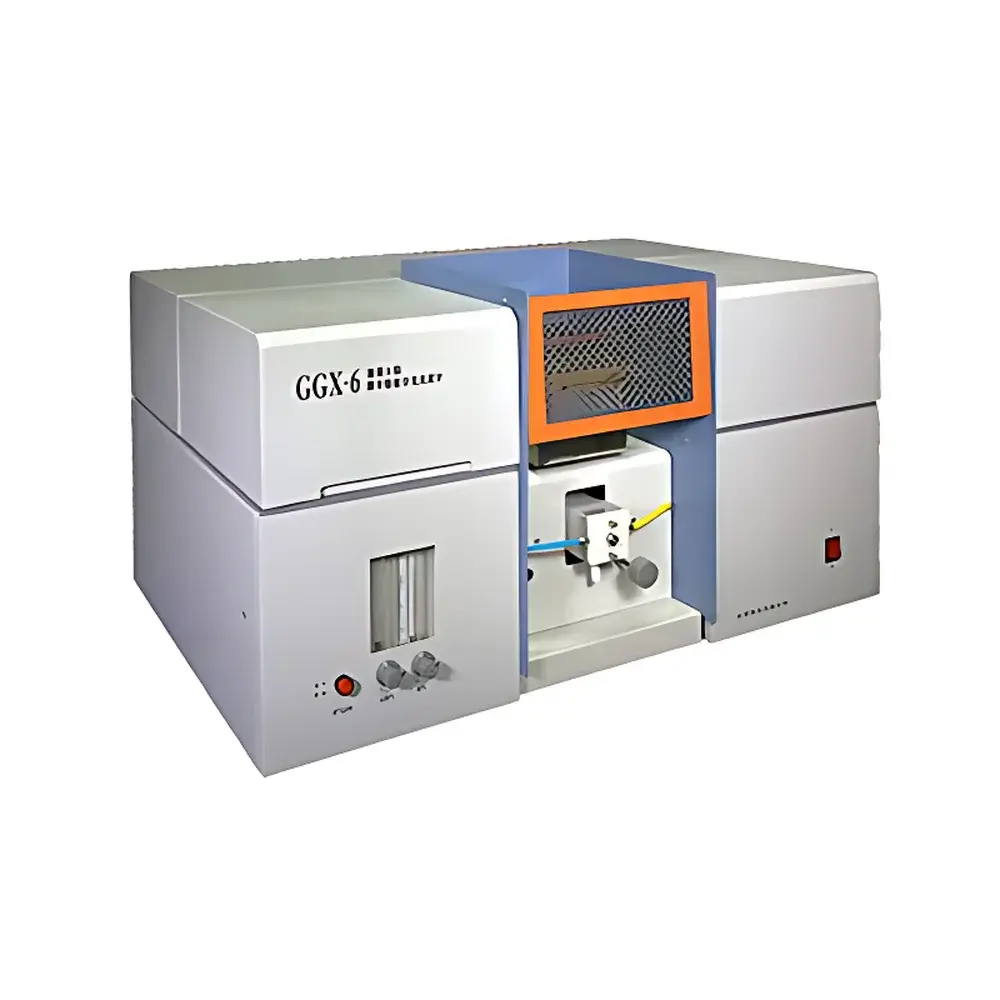
Haiguang GGX-6 Zeeman Atomic Absorption Spectrophotometer
| Brand | Haiguang Instrument |
|---|---|
| Type | Flame AAS |
| Background Correction | Zeeman-effect |
| Optical System | Single-beam with quasi-dual-channel reference |
| Monochromator | Concave grating |
| Detector | Photomultiplier tube (PMT) |
| Slit Width Options | 0.2, 0.4, 1.0, 2.0 nm |
| Magnetic Field | 1 T DC transverse configuration |
| Cooling | Water-cooled magnet assembly |
| Safety | Interlock and flashback arrestor systems |
| Software Platform | Windows 7/8-based control and data processing suite |
| Measurement Modes | Atomic absorption, Zeeman background correction, flame emission |
Overview
The Haiguang GGX-6 Zeeman Atomic Absorption Spectrophotometer is a high-performance flame atomic absorption spectrometer engineered for precise elemental quantification in complex matrices. It operates on the fundamental principle of atomic absorption spectroscopy—where ground-state atoms in a flame absorb characteristic radiation emitted by a hollow cathode lamp—and integrates advanced Zeeman-effect background correction to eliminate spectral and non-spectral interferences. Unlike conventional deuterium arc or continuum-source background correction methods, the GGX-6 employs a stable 1 Tesla transverse DC magnetic field applied across the atomization zone, inducing polarization splitting of the absorption line (π and σ components). This enables real-time, wavelength-specific background measurement at the exact analytical line position—delivering superior accuracy in samples with high salt content, organic load, or elevated molecular absorption. Its quasi-dual-beam architecture—comprising independent sample and reference optical channels—ensures exceptional baseline stability and minimizes drift from source intensity fluctuations or burner noise.
Key Features
- Transverse Zeeman background correction with >80-fold correction capacity—validated against ASTM D5191 and ISO 11885 for multi-element environmental analysis.
- Water-cooled permanent magnet system maintaining field homogeneity ±0.5% over continuous operation; integrated thermal alarm prevents field degradation due to overheating.
- Czerny-Turner optical design with 270 mm focal length and 1800 grooves/mm plane grating—optimized for high optical throughput and resolution without compromising compactness.
- Titanium alloy burner head with three-axis micrometer adjustment—resistant to thermal stress and corrosive fuels (e.g., acetylene–nitrous oxide), ensuring long-term alignment reproducibility.
- Corrosion-resistant hybrid nebulizer chamber with impact bead glass concentric nebulizer—designed to minimize memory effects and withstand aggressive acid digests (HNO₃, HCl, HF).
- Full-automated wavelength scanning, slit width selection (0.2–2.0 nm), lamp current optimization, and gain balancing—reducing operator dependency and method transfer variability.
- Dual-lamp turret with instant-switch capability—no preheating required—enabling rapid sequential multi-element analysis without recalibration.
- Integrated safety architecture: gas/air interlocks, flame-out detection, automatic fuel cutoff during power loss, and hardware-level flame emission mode for alkali metals (K, Na, Li).
Sample Compatibility & Compliance
The GGX-6 is validated for liquid samples prepared via acid digestion (EPA Method 3050B, 3051A), dilution, or direct aspiration—including aqueous extracts, biological digests, soil leachates, and food homogenates. Its full-spectrum Zeeman correction supports compliance with multiple regulatory frameworks: GB 5009.x series (China National Food Safety Standards), HJ 491-2019 and HJ 757-2015 (China Environmental Monitoring Standards), and harmonized protocols aligned with ISO/IEC 17025 quality management requirements. The instrument’s background correction performance meets USP criteria for trace metal assays in pharmaceutical excipients and satisfies GLP audit readiness through electronic logbook functionality and user-accessible calibration history.
Software & Data Management
Control and data acquisition are managed via a native Windows 7/8-compatible application supporting ICH-GCP-compliant audit trails, user role-based permissions, and electronic signature capability per FDA 21 CFR Part 11 Annex 11 guidelines. All measurement parameters—including lamp settings, slit width, integration time, and background correction status—are automatically timestamped and stored with raw signal traces. Quantitative outputs support concentration direct-read, peak-height, peak-area, and signal averaging modes. Data export is natively compatible with Microsoft Excel (.xlsx), enabling immediate statistical review, LIMS integration, and collaborative reporting. Method templates can be archived, version-controlled, and deployed across laboratory networks without revalidation.
Applications
The GGX-6 serves as a core quantitative tool in accredited food testing laboratories performing Pb, Cd, Cu, Zn, Fe, Mn, Cr, Ni, Ca, Mg, K, and Na determinations per GB 5009.12–5009.242. It is routinely deployed in environmental monitoring for soil (GB/T 17141-1997) and water (HJ 491/HJ 757) analysis, clinical nutrition studies assessing mineral status, geochemical prospecting, metallurgical process control, and academic research requiring interference-free quantification in high-background matrices. Its flame emission mode extends utility to routine alkali metal assays in fertilizers, beverages, and pharmaceutical formulations—eliminating the need for separate photometric instrumentation.
FAQ
What background correction methods does the GGX-6 support?
It exclusively implements transverse Zeeman-effect background correction—no deuterium or continuum-source options are available.
Is the instrument compliant with FDA 21 CFR Part 11?
Yes—the software provides electronic signatures, audit trails, and secure user authentication required for regulated pharmaceutical and clinical labs.
Can the GGX-6 analyze solid samples directly?
No—it requires liquid sample introduction; solids must be digested using EPA, ISO, or GB-standard acid dissolution protocols prior to analysis.
What maintenance intervals are recommended for the water-cooled magnet system?
Coolant level and pump function should be verified daily; full coolant replacement is recommended every 6 months under continuous operation.
Does the system support method validation per ICH Q2(R2)?
Yes—linearity, LOD/LOQ, precision (RSD), and accuracy (spike recovery) assessments are fully supported through built-in validation wizards and report templates.



