
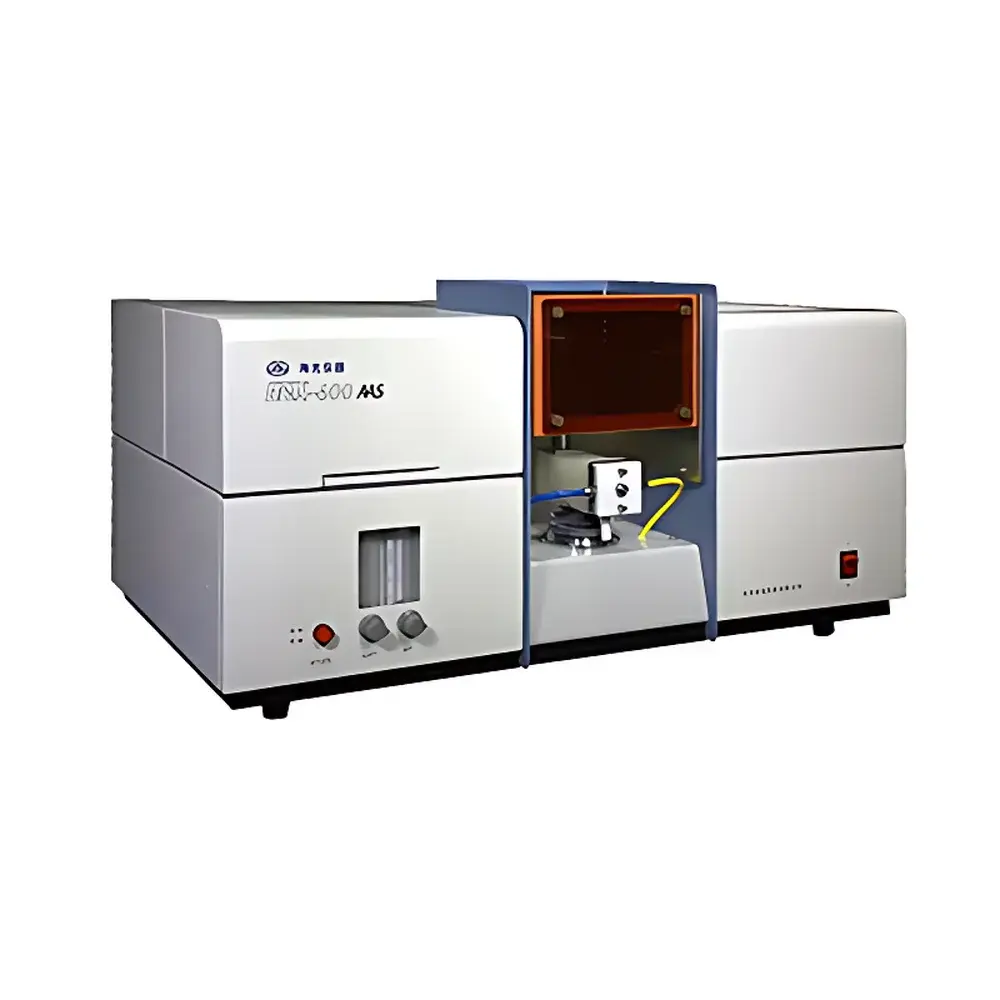
Haiguang GGX-600 Flame Atomic Absorption Spectrometer
| Brand | Haiguang Instrument |
|---|---|
| Origin | Beijing, China |
| Model | GGX-600 |
| Instrument Type | Flame AAS |
| Monochromator | Echelle grating |
| Optical System | Double-beam |
| Detector | Photomultiplier tube (PMT) |
| Background Correction | Deuterium lamp background correction |
| Spectral Bandwidth | 0.2, 0.4, 1.0, 2.0 nm (auto-switchable) |
| Wavelength Range | 190–900 nm |
| Burner Head | Titanium alloy, 3D adjustable |
| Nebulizer | High-efficiency concentric glass nebulizer with impact bead |
| Spray Chamber | Corrosion-resistant treated mixed-type chamber |
| Safety Features | Gas cutoff interlock, flame-out protection, power failure auto-shutdown |
| Software Platform | Windows 7/8/XP compatible AAS control and data analysis suite |
| Compliance | GB 5009.x series, HJ 491-2019, HJ 757-2015, GB/T 17141-1997 |
Overview
The Haiguang GGX-600 Flame Atomic Absorption Spectrometer (Flame AAS) is a robust, laboratory-grade analytical instrument engineered for precise quantification of metallic elements in liquid samples at trace to major concentration levels. Based on the fundamental principle of atomic absorption spectroscopy—where ground-state free atoms in a flame absorb characteristic radiation emitted by a hollow cathode lamp—the GGX-600 delivers high reproducibility and long-term stability in routine elemental analysis. Designed specifically for flame-based atomization, it supports quantitative determination of over 60 elements—including Na, K, Li, Ca, Mg, Fe, Cu, Zn, Pb, Cd, Cr, Ni, and Mn—across diverse matrices such as food extracts, environmental water, soil digests, pharmaceutical preparations, and industrial process solutions. Its double-beam optical architecture compensates for source intensity fluctuations and lamp drift, ensuring baseline stability critical for regulatory-compliant measurements under GLP or ISO/IEC 17025 environments.
Key Features
- Czerny-Turner optical design with 270 mm focal length: optimized for high radiant throughput and minimal stray light
- Echelle grating monochromator with 1800 grooves/mm plane grating: enables high spectral resolution and accurate line isolation
- Four-step automatic spectral bandwidth selection (0.2, 0.4, 1.0, 2.0 nm): configurable per element to balance sensitivity and selectivity
- Full wavelength scanning with automated peak search and centroid positioning: ensures precise spectral alignment without manual calibration
- Deuterium lamp background correction with >60-fold correction capacity: effectively compensates for structured molecular absorption and scattering in complex matrices
- Titanium alloy burner head with three-axis mechanical adjustment: enhances flame geometry optimization and improves atomization efficiency across fuel/oxidant ratios
- Corrosion-resistant mixed-type spray chamber with low memory effect: validated for repeated analysis of acidic digestates and halogen-rich samples
- Concentric glass nebulizer featuring integrated impact bead: delivers stable aerosol generation with <2% RSD for 10 µg/mL Cu standard over 30 min
- Integrated safety interlocks: automatic gas shutoff upon flame extinction, power loss, or air/gas pressure deviation beyond preset thresholds
- Full-plastic enclosure housing: chemically inert against ambient HCl, HF, and HNO₃ vapors commonly present in wet-lab digestion workflows
Sample Compatibility & Compliance
The GGX-600 is validated for aqueous and dilute acid-digested samples (e.g., 2–5% HNO₃, 1% HCl), including those prepared per AOAC, EPA, and ISO digestion protocols. It meets method requirements specified in multiple national and industry standards, including GB 5009.12–2017 (Pb in food), GB 5009.15–2014 (Cd in food), HJ 491–2019 (Cu, Zn, Pb, Ni, Cr in soils), and HJ 757–2015 (Cr in water). While not certified to FDA 21 CFR Part 11 out-of-the-box, its software architecture supports audit trail configuration, user access control, and electronic signature integration when deployed within validated IT infrastructure. The system complies with IEC 61010-1 for electrical safety and EN 61326-1 for electromagnetic compatibility in laboratory settings.
Software & Data Management
The GGX-600 operates via a native Windows-based application supporting multi-language UI (English default), intuitive method setup wizards, and real-time signal visualization. Measurement modes include atomic absorption, deuterium-corrected absorption, background-only, and flame emission—enabling dual-mode analysis of alkali metals (e.g., Na/K ratio in serum). All acquisition parameters (lamp current, slit width, integration time, calibration curve type) are stored with metadata (operator ID, timestamp, instrument serial). Raw absorbance/time traces and processed results export directly to CSV or Excel-compatible formats; no proprietary file lock-in. Data archiving follows folder-based hierarchical structure compliant with internal lab document control SOPs. Optional LIMS connectivity via ODBC driver facilitates automated result transfer to enterprise systems.
Applications
- Food safety laboratories: Quantitative analysis of essential (Ca, Mg, Fe, Zn) and toxic (Pb, Cd, As, Cr) elements in raw materials, finished products, and dietary supplements per GB 5009 series
- Environmental monitoring: Routine screening of heavy metals in drinking water, wastewater effluents, and leachates per HJ 491 and HJ 757 methods
- Agricultural testing: Soil nutrient profiling (K, Na, Ca, Mg, Mn) and contamination assessment (Cu, Zn, Ni) using standardized acid digestion protocols
- Pharmaceutical QC: Elemental impurity testing of APIs and excipients aligned with ICH Q3D guidelines (Category 1 & 2 elements)
- Academic research: Teaching platform for atomic spectroscopy fundamentals; method development for matrix-matched calibration and interference studies
- Metallurgical QA/QC: Rapid verification of alloy composition and plating bath concentrations in production environments
FAQ
What sample introduction systems are supported?
The GGX-600 is configured exclusively for pneumatic nebulization with air-acetylene or nitrous oxide-acetylene flames. It does not support graphite furnace, hydride generation, or cold vapor accessories.
Is the instrument compliant with ISO/IEC 17025 documentation requirements?
Yes—when operated with defined calibration procedures, documented maintenance logs, and version-controlled software configurations, the GGX-600 satisfies technical requirements for accredited testing laboratories under ISO/IEC 17025:2017 Clause 6.4 and 6.5.
Can the software generate 21 CFR Part 11-compliant audit trails?
The base software provides timestamped operator logs and parameter change history. Full Part 11 compliance requires supplementary validation of the local IT environment, including secure user authentication, electronic signatures, and immutable record retention policies.
What maintenance intervals are recommended for optimal performance?
Daily: Nebulizer cleaning, burner head inspection, and flame alignment check.
Weekly: Spray chamber rinse with deionized water and PMT voltage verification.
Annually: Full optical alignment verification, wavelength calibration with holmium oxide reference, and gas flow rate recalibration.
Does the GGX-600 support multi-element sequential analysis?
No—it performs single-element analysis per lamp. Multi-element capability requires lamp rotation and re-optimization of flame conditions between elements, limiting throughput compared to ICP-OES systems.







