
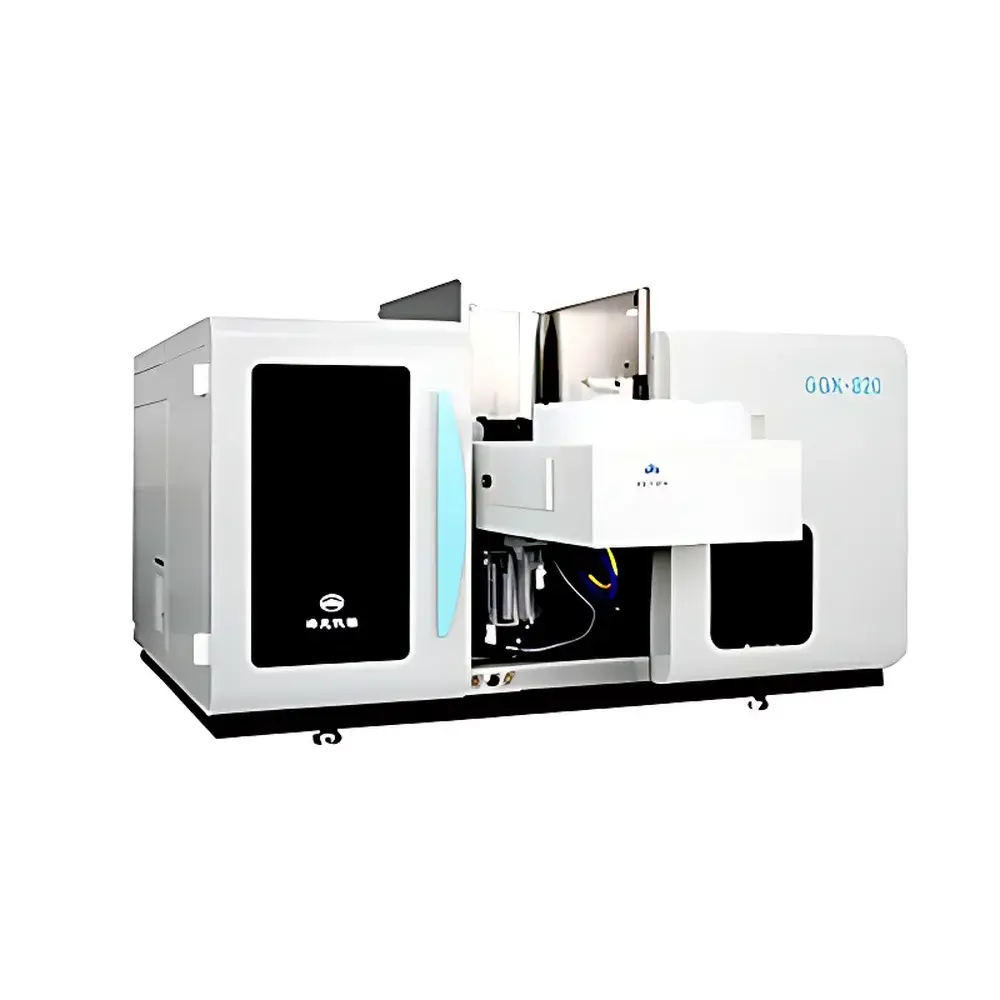
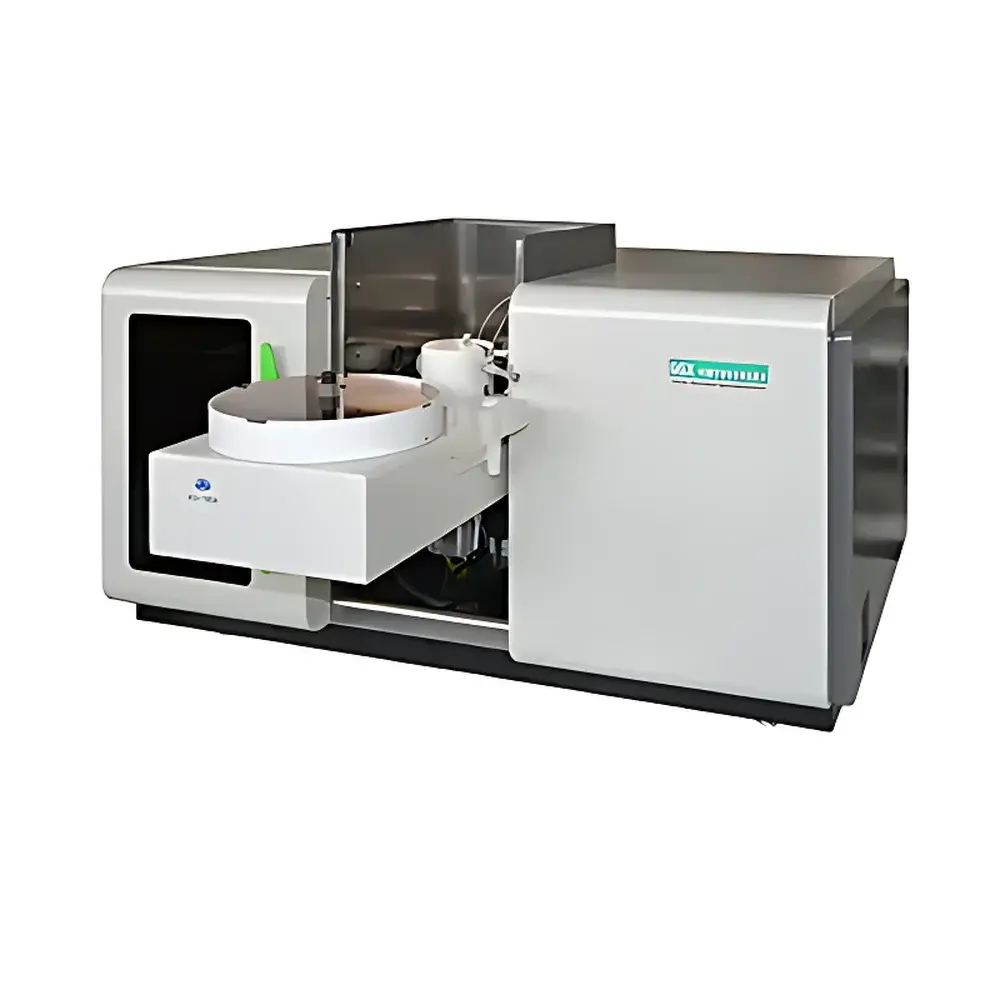
Haiguang GGX-820 Graphite Furnace Atomic Absorption Spectrometer
| Brand | Haiguang Instrument |
|---|---|
| Origin | Beijing, China |
| Model | GGX-820 |
| Instrument Type | Graphite Furnace AAS |
| Optical System | Single-beam |
| Monochromator | Plane grating (1800 lines/mm) |
| Focal Length | 270 mm |
| Background Correction | Deuterium (D₂) Lamp |
| Detector | Photomultiplier Tube (PMT) |
| Atomizer | Integrated Flame/GF system (flame mode optional per GGX-830 reference) |
| Graphite Furnace Heating | Longitudinal |
| Temperature Range | Ambient to 3000 °C |
| Temperature Control Accuracy | ≤0.5% at 2000 °C |
| Maximum Ramp Rate | ≥2000 °C/s |
| Autosampler | 52-position, programmable matrix modifier addition, sample delivery precision ≤±0.5% |
| Safety Systems | Flame failure cutoff, gas pressure monitoring, liquid level sensing, water seal detection, anti-flashback design, automatic gas shutoff |
Overview
The Haiguang GGX-820 is a high-performance graphite furnace atomic absorption spectrometer engineered for trace elemental analysis in complex matrices. Operating on the fundamental principle of atomic absorption spectroscopy (AAS), the instrument quantifies elemental concentrations by measuring the attenuation of hollow cathode lamp (HCL) radiation as ground-state atoms—generated in a thermally controlled graphite tube—absorb characteristic wavelengths. Its Czerny-Turner (C-T) optical layout with a 270 mm focal length and 1800 lines/mm plane diffraction grating delivers optimized spectral throughput and mechanical stability, critical for reproducible absorbance measurements in regulated environments. Designed for dual-mode operation (with flame capability available in the closely related GGX-830 platform), the GGX-820 prioritizes graphite furnace performance, enabling sub-ppt detection limits for over 60 elements—including Pb, Cd, Cr, Ni, Cu, Zn, Mn, Fe, Ca, Mg, Na, and K—across food, environmental, clinical, and industrial samples.
Key Features
- Deuterium (D₂) lamp background correction for accurate compensation of non-specific absorption and scattering in turbid or high-salt samples.
- Vertical 8-lamp turret with simultaneous pre-heating—reducing warm-up delays and improving inter-element measurement efficiency.
- Longitudinally heated graphite furnace with precise temperature control (≤0.5% deviation at 2000 °C) and ultra-rapid thermal ramping (≥2000 °C/s), enabling optimized pyrolysis and atomization steps per ASTM D3682 and ISO 11171 protocols.
- 52-position autosampler featuring programmable reagent addition (e.g., NH₄H₂PO₄, Pd-Mg nitrate modifiers), volumetric accuracy ≤±0.5%, and automated calibration curve generation.
- Integrated safety architecture: real-time monitoring of acetylene/O₂ pressure, waste liquid level, water seal integrity, flame status, and automatic fuel cutoff upon flame extinction or abnormal thermal event.
- Titanium alloy burner head (flame mode) and all-plastic corrosion-resistant nebulizer chamber ensure longevity in aggressive acid digestates; high-efficiency glass concentric nebulizer supports robust aerosol generation.
Sample Compatibility & Compliance
The GGX-820 supports direct analysis of aqueous digests (HNO₃/HCl/HF-based), biological fluids (after dilution or matrix-matched calibration), soil extracts (per EPA Method 7000B and HJ 491–2019), and food homogenates compliant with GB 5009 series standards. Its measurement traceability aligns with ISO/IEC 17025 requirements for testing laboratories. The system’s operational parameters—particularly furnace temperature programming, background correction timing, and integration time—are fully configurable to satisfy method validation criteria under USP , FDA 21 CFR Part 11 (when paired with compliant LIMS software), and GLP audit trails. All safety interlocks conform to IEC 61010-1:2010 for laboratory electrical equipment.
Software & Data Management
Instrument control, method development, and quantitative analysis are managed via Haiguang’s proprietary AAWin software. The interface supports multi-point calibration (linear, quadratic, and weighted least-squares), peak-area/peak-height integration, standard addition, and spike recovery calculations. Audit-ready data files include full acquisition metadata: lamp current, slit width, furnace temperature profile timestamps, background-corrected absorbance traces, and user-defined QC checkpoints. Raw data export is compatible with CSV, TXT, and XML formats for third-party statistical review or integration into enterprise LIMS platforms supporting ASTM E1384 and ISO 15197 interoperability frameworks.
Applications
The GGX-820 serves as a primary analytical tool in accredited food safety labs conducting Pb (GB 5009.12–2017), Cd (GB 5009.15–2014), and Cr (GB 5009.123–2014) testing in infant formula, cereals, and seafood. Environmental applications include soil heavy metal screening (GB/T 17141–1997, HJ 491–2019) and wastewater Cr(VI)/total Cr speciation (HJ 757–2015). In pharmaceutical QC, it verifies catalyst residues (Pd, Pt, Ni) in APIs per ICH Q2(R2). Educational institutions utilize its modular design for hands-on AAS training—from lamp alignment and wavelength selection to furnace optimization and interference mitigation strategies.
FAQ
What sample introduction options are supported?
The GGX-820 uses a 52-position graphite furnace autosampler with programmable syringe-based delivery. Flame mode (available on GGX-830) employs pneumatic nebulization with titanium burner and all-plastic spray chamber.
Is the system compliant with 21 CFR Part 11?
Yes—when deployed with validated AAWin software configuration, electronic signatures, audit trail logging, and role-based access controls meet FDA requirements for regulated bioanalytical laboratories.
Can the instrument perform sequential multi-element analysis?
No—it is a single-element AAS system; however, the 8-lamp turret enables rapid switching between elements without manual lamp replacement.
What maintenance intervals are recommended for the graphite tubes?
Tube lifetime depends on matrix severity; typical replacement occurs after 200–500 firings for organic-rich samples, monitored via integrated absorbance drift diagnostics and visible inspection.
Does the system support hydride generation or cold vapor accessories?
Not natively—the GGX-820 is optimized for electrothermal atomization; hydride/cold vapor modules require external coupling and are not part of the standard configuration.




