
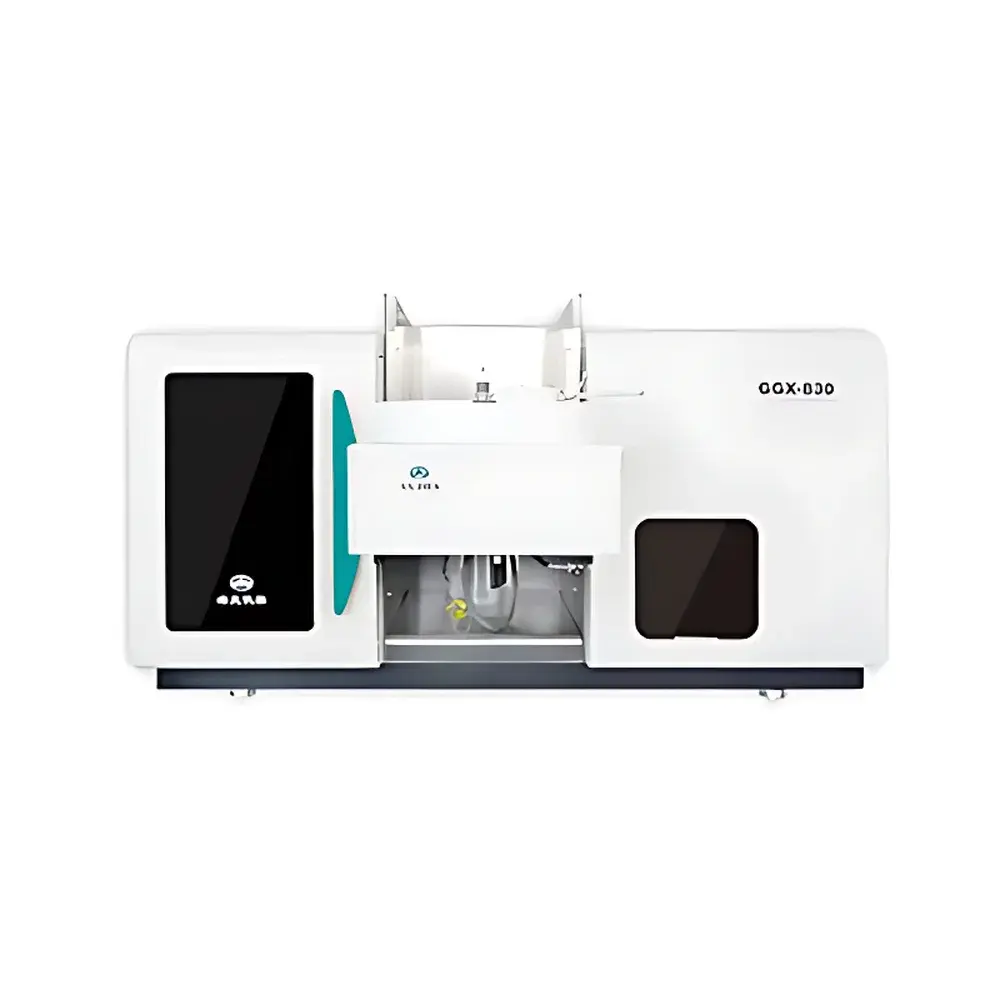
Haiguang GGX-830 Flame and Graphite Furnace Atomic Absorption Spectrometer
| Brand | Haiguang Instrument |
|---|---|
| Origin | Beijing, China |
| Model | GGX-830 |
| Instrument Type | Flame and Graphite Furnace AAS |
| Monochromator | Plane grating (1800 lines/mm) |
| Optical System | Single-beam |
| Detector | Photomultiplier tube (PMT) |
| Background Correction | Deuterium (D₂) lamp |
| Burner Head | Titanium alloy |
| Graphite Furnace | Longitudinal heating, temperature range: ambient to 3000 °C, temperature control accuracy ≤0.5% at 2000 °C, ramp rate ≥2000 °C/s |
| Autosampler | 52-position graphite furnace autosampler with automated calibration curve generation, matrix modifier addition capability, and sample delivery precision ≤±0.5% |
| Safety Systems | Flame monitoring, gas pressure sensing, water seal detection, waste liquid level detection, anti-flashback protection, automatic fuel cutoff upon flameout |
Overview
The Haiguang GGX-830 Flame and Graphite Furnace Atomic Absorption Spectrometer is a dual-mode analytical instrument engineered for trace metal quantification across diverse sample matrices. It operates on the fundamental principle of atomic absorption spectroscopy (AAS), wherein ground-state atoms in a gaseous state absorb characteristic wavelengths of light emitted by element-specific hollow cathode lamps. The GGX-830 integrates both flame atomization (for higher-concentration elements) and electrothermal graphite furnace atomization (for sub-ppt level detection), enabling method flexibility without hardware reconfiguration. Its Czerny–Turner monochromator—featuring a 270 mm focal length and 1800-line/mm plane diffraction grating—delivers high spectral resolution and photon throughput, while the single-beam optical architecture ensures mechanical stability and thermal robustness during extended operation. The system employs deuterium (D₂) arc lamp background correction to compensate for non-specific molecular absorption and scattering, particularly critical in complex environmental and biological digests.
Key Features
- Integrated flame/graphite furnace platform with one-touch mode switching—no manual component replacement or realignment required.
- Vertical 8-lamp turret with simultaneous preheating capability, minimizing analysis cycle time and improving inter-element reproducibility.
- Titanium-alloy flame burner head with auto-ignition sequence; corrosion-resistant all-plastic nebulizer chamber and high-efficiency glass concentric nebulizer for stable aerosol generation and simplified maintenance.
- Comprehensive safety architecture: real-time flame monitoring, gas pressure validation, water seal integrity check, waste liquid level sensing, and automatic fuel shutoff upon flame extinction or abnormal thermal event.
- Longitudinally heated graphite furnace with precise temperature control (≤0.5% deviation at 2000 °C) and rapid thermal ramping (≥2000 °C/s), supporting optimized pyrolysis–atomization–cleaning cycles per ASTM E1946 and ISO 11170.
- 52-position programmable graphite furnace autosampler with volumetric accuracy ≤±0.5%, capable of automated standard dilution, matrix modifier addition, and multi-point calibration curve construction.
Sample Compatibility & Compliance
The GGX-830 supports aqueous solutions, acid-digested solids (e.g., food, soil, sediment, biological tissue), and filtered environmental extracts. Its dual-atomization capability aligns with major regulatory frameworks: it fulfills method requirements specified in GB 5009.x series (China National Food Safety Standards) for Pb, Cd, Cu, Cr, Ni, Zn, Fe, Mn, Mg, Ca, K, and Na; GB/T 17141-1997 for soil Pb/Cd; HJ 491-2019 and HJ 757-2015 for water and soil metals via flame AAS; and ISO 11170, EPA Method 7000B, and EN 1483 for trace metal analysis in environmental matrices. All operational parameters—including lamp current, slit width, integration time, and furnace temperature programs—are fully configurable and auditable, supporting GLP/GMP compliance when paired with secure user authentication and electronic record retention.
Software & Data Management
The instrument is controlled via Haiguang’s dedicated AAS acquisition and analysis software, compliant with FDA 21 CFR Part 11 requirements for electronic records and signatures. The interface provides real-time spectral visualization, peak integration with baseline subtraction options (including D₂-corrected and Zeeman-corrected modes), multi-point calibration with quadratic fitting, and QC flagging based on RSD thresholds and recovery standards. Audit trails log all method modifications, data exports, user logins, and instrument status events. Data export formats include CSV, TXT, and XML for seamless integration into LIMS platforms. Software updates are delivered via encrypted firmware packages with version-controlled release notes.
Applications
The GGX-830 is routinely deployed in food safety laboratories for lead, cadmium, and arsenic screening per GB 5009.12–2017 and GB 5009.15–2014; in environmental testing labs for heavy metal profiling in wastewater (HJ 757-2015), soils (GB/T 17141), and sediments (HJ 491-2019); in pharmaceutical QA/QC for catalyst residue analysis (e.g., Pd, Pt, Ni in APIs); in agricultural research for micronutrient mapping in plant tissues and fertilizers; and in academic settings for method development in hydride generation–AAS coupling and solid sampling techniques. Its robustness and dual-atomization versatility make it suitable for routine high-throughput screening as well as low-level research-grade quantification.
FAQ
What atomization modes does the GGX-830 support?
It supports both flame atomization (for elements with detection limits in the µg/L range) and electrothermal graphite furnace atomization (for sub-ng/L detection capabilities).
Is the system compliant with international regulatory standards?
Yes—the optical and thermal performance specifications, software audit trail functionality, and parameter traceability meet requirements for ISO/IEC 17025 accreditation, FDA 21 CFR Part 11, and GLP-compliant workflows.
Can the autosampler handle organic solvents or high-salt matrices?
The 52-position autosampler is compatible with aqueous acid mixtures (e.g., 5% HNO₃, 1% HCl) and low-percentage organic modifiers (≤5% v/v methanol or isopropanol); for high-salt samples, optional platform modifiers (e.g., Pd-Mg nitrate) and pyrolysis optimization are supported.
How is background correction implemented?
Deuterium (D₂) continuum lamp correction is used for broad-band molecular absorption; the system does not incorporate Zeeman or Smith–Hieftje correction, making it optimal for routine applications where D₂ correction suffices per ISO 11170.
What maintenance intervals are recommended for routine operation?
Nebulizer cleaning every 8–10 hours of flame use; graphite tube replacement after 200–300 firings (depending on matrix); annual wavelength calibration verification using holmium oxide reference; quarterly PM including lamp alignment check and gas line leak testing.





