
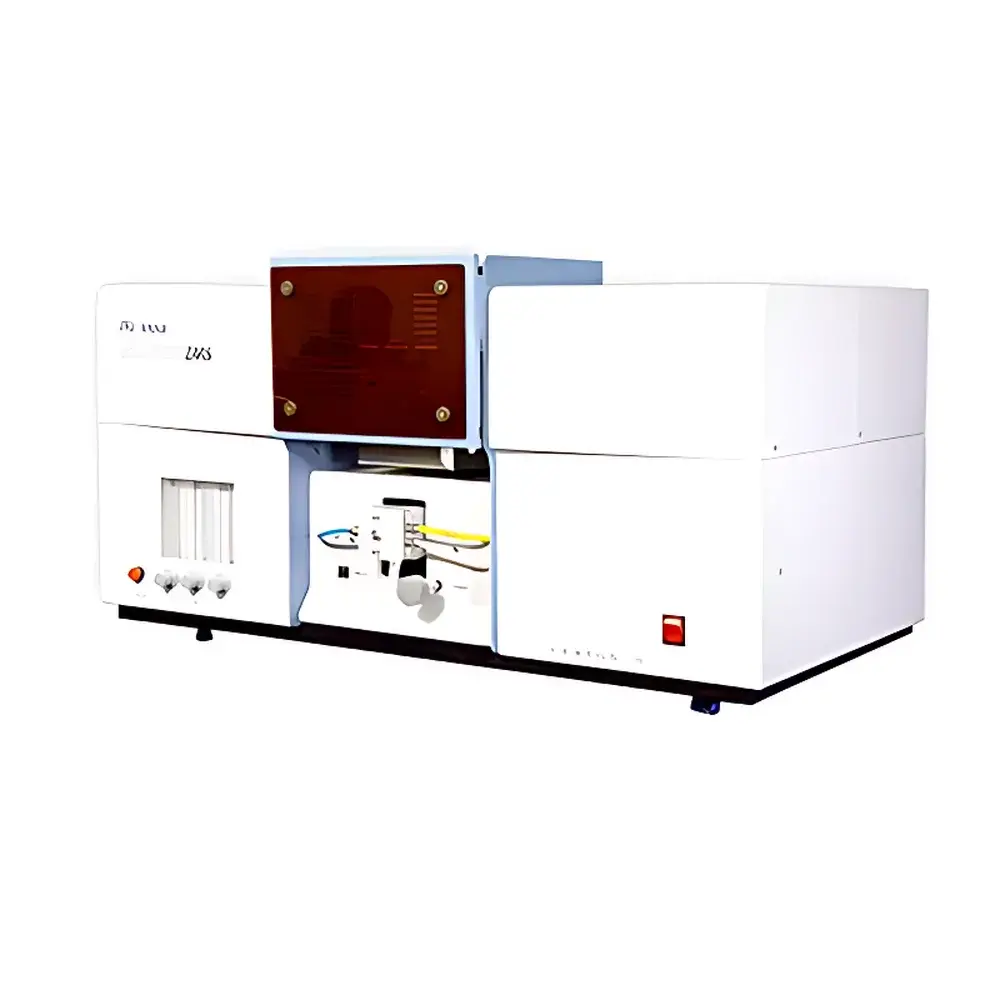
Haiguang GGX-900 Zeeman Atomic Absorption Spectrometer
| Brand | Haiguang Instrument |
|---|---|
| Origin | Beijing, China |
| Model | GGX-900 |
| Instrument Type | Flame AAS |
| Monochromator | Concave Grating |
| Optical System | Dual-Beam |
| Detector | Photomultiplier Tube (PMT) |
| Background Correction | Zeeman Effect |
| Spectral Bandwidth | 0.2 / 0.4 / 1.0 / 2.0 nm (motorized switching) |
| Wavelength Range | 190–900 nm |
| Flame Atomization System | Titanium Alloy Burner, Corrosion-Resistant Hybrid Nebulizer Chamber, High-Efficiency Glass Concentric Nebulizer with Impact Bead |
| Safety Features | Gas/Air Interlock, Automatic Flame-Out Cutoff, Over-Temperature Alarm for Magnet Assembly, Water-Cooled Permanent Magnet |
| Software Platform | Windows 7/8/XP Compatible AAS Control & Data Analysis Suite with ASTM/ISO/GLP-Compliant Audit Trail, Excel Export, Multi-Mode Quantitation (Absorption, Background-Subtracted Absorption, Pure Background, Emission) |
Overview
The Haiguang GGX-900 Zeeman Atomic Absorption Spectrometer is a high-performance flame-based atomic absorption system engineered for precision trace metal analysis in complex matrices. It operates on the fundamental principle of atomic absorption spectroscopy—measuring the attenuation of resonant radiation by ground-state atoms generated in a high-temperature air-acetylene flame. Its distinguishing feature is the integrated transverse Zeeman-effect background correction system, which applies a constant magnetic field perpendicular to the optical path, inducing polarization splitting of the analytical line and enabling true, broadband background correction without spectral interference or lamp-switching artifacts. Unlike deuterium arc or continuum-source methods, Zeeman correction delivers superior accuracy for samples with structured or elevated non-specific absorption—such as biological digests, soil extracts, and industrial effluents—where conventional background subtraction fails.
Key Features
- Transverse Zeeman background correction with water-cooled permanent magnet assembly, ensuring stable magnetic flux density (80× across 190–900 nm.
- Dual-beam optical architecture with independent sample and reference channels; eliminates baseline drift and enables immediate measurement post-startup—no warm-up required.
- Czerny-Turner monochromator with 270 mm focal length and 1800 grooves/mm plane diffraction grating, delivering high photon throughput and inherent resolution sufficient for elemental line isolation per ISO 11043 and ASTM E1762.
- Motorized spectral bandwidth selection (0.2, 0.4, 1.0, 2.0 nm) optimized for sensitivity vs. selectivity trade-offs per analyte and matrix conditions.
- Titanium alloy burner head resistant to thermal shock and halogen-induced corrosion—validated for prolonged use with organic solvents and high-salt digestates.
- Corrosion-resistant hybrid nebulizer chamber with surface-treated interior and impact-bead concentric glass nebulizer, minimizing memory effects and enabling reproducible aspiration of viscous or particulate-laden samples.
- Integrated safety interlocks compliant with IEC 61010-1:2010—automatic fuel gas shutoff upon power loss, air pressure drop, or flame extinction; real-time magnet temperature monitoring with audible/visual alarm.
Sample Compatibility & Compliance
The GGX-900 supports aqueous, acid-digested, and low-organic-content liquid samples compatible with flame atomization (e.g., HNO₃/HCl/HF-digested food, soil, water, and clinical specimens). Its Zeeman correction system meets the technical requirements of multiple national and international standards, including GB 5009.x series (China National Food Safety Standards), HJ 491-2019 (soil and sediment), HJ 757-2015 (water), and ISO 11043:2022 (determination of metals by flame AAS). The instrument’s hardware design and software audit trail functionality support GLP and GMP environments—data integrity safeguards include user authentication, electronic signatures, timestamped method logs, and immutable raw-data archiving aligned with FDA 21 CFR Part 11 principles.
Software & Data Management
The GGX-900 is controlled via a native Windows-based application offering full instrument parameterization—including automated wavelength scanning, lamp current optimization, gain adjustment, and energy balancing. Quantitative workflows support four operational modes: absorbance, Zeeman-corrected absorbance, pure background intensity, and flame emission (for K, Na, Li). All calibration curves are stored with metadata (date, operator, standard lot, instrument configuration). Measurement data export directly to .xlsx format preserves column headers, units, and uncertainty flags; batch processing and report templating are supported. The software includes built-in validation tools for linearity (r² ≥ 0.999), LOD/LOQ estimation per ICH Q2(R2), and QC charting (X-bar/R) for routine monitoring.
Applications
The GGX-900 is routinely deployed in food safety laboratories for Pb, Cd, Cu, Zn, Fe, Mn, Ni, Cr, Ca, Mg, K, and Na quantification per GB 5009.12–5009.242. Environmental labs apply it to HJ 491-2019 and HJ 757-2015 protocols for multi-element screening in wastewater, leachates, and soil extracts. In agricultural testing, it supports nutrient and heavy metal profiling in fertilizers and plant tissues. Clinical and pharmaceutical QA/QC labs use its flame emission mode for alkali metal assays in IV solutions and excipients. Educational institutions leverage its modular architecture for teaching atomic spectroscopy fundamentals—including Zeeman splitting theory, Beer-Lambert law validation, and matrix effect mitigation strategies.
FAQ
What types of samples can be analyzed on the GGX-900?
Aqueous solutions, acid digests (HNO₃, HCl, HF), and low-viscosity organic extracts—provided they meet flame compatibility criteria (e.g., <5% v/v organic content, total dissolved solids <0.2%).
Does the GGX-900 support graphite furnace operation?
No—the GGX-900 is a dedicated flame AAS platform. Haiguang offers separate GF-AAS models (e.g., GGX-800T) for electrothermal atomization.
How is Zeeman background correction validated during routine use?
Users perform daily verification using certified reference materials (e.g., NIST SRM 1643e) and monitor background signal stability at 232.0 nm (Pb) and 283.3 nm (Pb) before and after high-background matrix spikes.
Is the software compliant with regulatory data integrity requirements?
Yes—the audit trail records all critical events (method changes, calibration updates, result overrides) with user ID, timestamp, and IP address; export files retain original acquisition metadata and cannot be altered without breaking digital signature integrity.
What maintenance intervals are recommended for optimal performance?
Nebulizer and burner cleaning after every 100 samples; annual PM including grating alignment verification, PMT dark current check, and magnet cooling loop inspection per Haiguang Service Bulletin AAS-PM-2023.





