
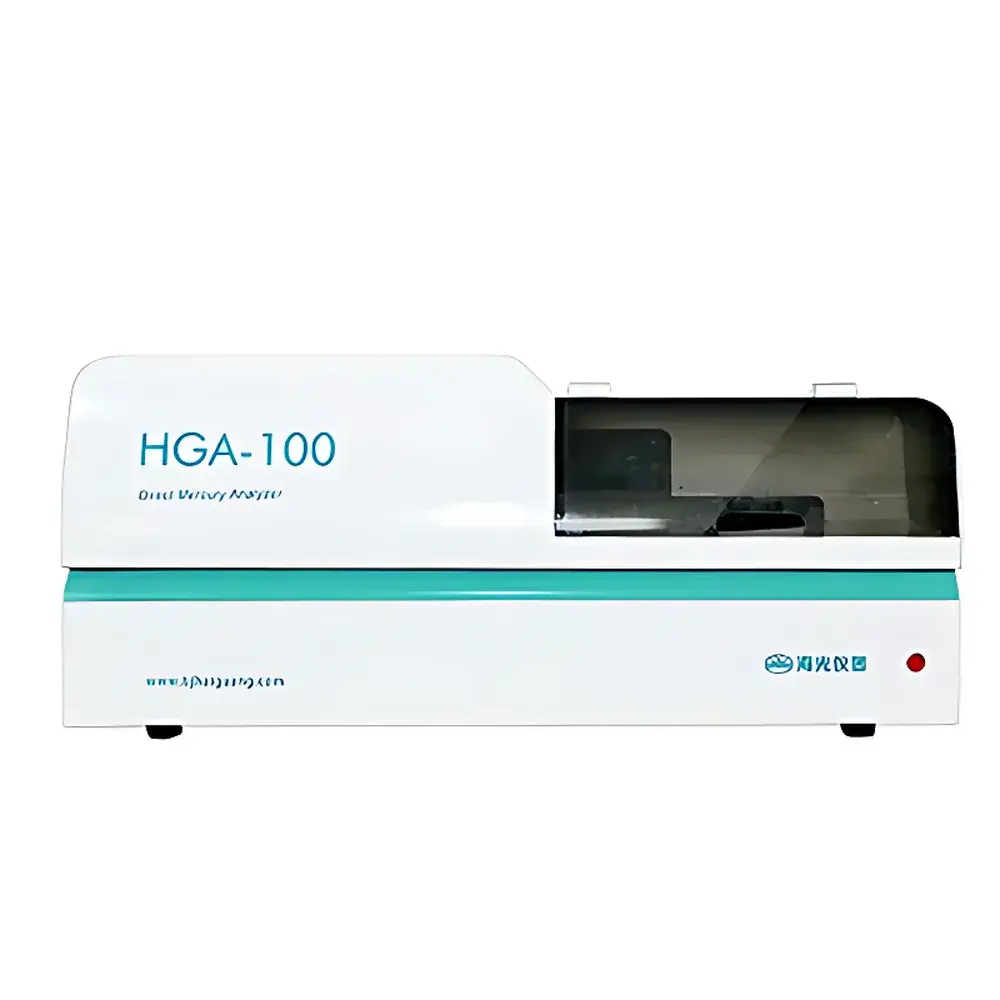
Haiguang HGA-100 Direct-Sampling Mercury Analyzer
| Brand | Haiguang Instrument |
|---|---|
| Origin | Beijing, China |
| Model | HGA-100 |
| Instrument Type | Online Mercury Analyzer |
| Measurement Principle | Cold Vapor Atomic Absorption Spectrometry (CVAAS) |
| Sample Introduction | Solid/Liquid/Gas Direct Injection |
| Analysis Time | <5 min per sample |
| Sample Capacity | 40-position Autosampler |
| Reagent Consumption | Zero chemical reagents required |
| Temperature-Controlled Flow Path | Yes |
| Gold Amalgamation Trap | Nano-coated Au-Hg trap integrated |
| Catalyst System | Dual-stage composite catalyst |
| Exhaust Treatment | Integrated catalytic oxidation + activated carbon adsorption |
| Compliance Framework | Designed for GLP-compliant laboratories |
Overview
The Haiguang HGA-100 Direct-Sampling Mercury Analyzer is a fully automated, online-capable elemental analyzer engineered for trace-level mercury quantification in solid, liquid, and gaseous matrices. It operates on the principle of Cold Vapor Atomic Absorption Spectrometry (CVAAS), wherein mercury is thermally liberated from the sample matrix, reduced to elemental vapor, and atomized in a quartz cell positioned within the optical path of a low-pressure mercury lamp. The absorbance at 253.7 nm is measured with a high-stability photomultiplier tube detector, enabling highly selective and interference-resistant detection. Unlike conventional digestion-based methods, the HGA-100 eliminates wet chemistry preprocessing—mercury is volatilized directly from weighed or injected samples under precisely controlled thermal ramping and carrier gas flow conditions. This design minimizes procedural blank contributions, avoids incomplete recovery due to volatile loss during digestion, and ensures stoichiometric transfer of total mercury into the analytical vapor phase.
Key Features
- True direct-sampling architecture: Accepts solid powders, slurries, aqueous solutions, and gas-phase samples without acid digestion, microwave treatment, or chemical reduction steps.
- Integrated 40-position autosampler with programmable weighing interface support, enabling unattended batch analysis and traceable mass input registration.
- Nano-structured gold amalgamation trap: Features a high-surface-area, thermally regenerable gold-coated quartz trap with optimized coating thickness and porosity for quantitative capture and rapid thermal desorption of mercury vapor.
- Dual-stage catalytic purification: A pre-combustion catalyst removes organic interferences and halogens; a post-combustion catalyst oxidizes residual CO and NOx, ensuring clean vapor delivery to the absorption cell.
- Fully temperature-regulated flow path: From sample boat heating zone through catalytic reactors to amalgamation trap and absorption cell—each segment maintains setpoint stability within ±1 °C to suppress memory effects and condensation artifacts.
- Zero-reagent operation: No KMnO4, SnCl2, or BrCl required—reducing consumable costs, hazardous waste generation, and operator exposure risk.
- Onboard exhaust abatement: Catalytic oxidation followed by activated carbon adsorption ensures mercury-laden effluent is retained to <0.001 µg/m³ (per ISO 10156), meeting OSHA PEL and EU Directive 2017/164 standards.
Sample Compatibility & Compliance
The HGA-100 accommodates diverse sample types—including soil, sediment, coal, fish tissue, pharmaceutical excipients, wastewater, flue gas condensates, and ambient air particulates—without method-specific hardware modification. Its thermal release profile (room temperature to 950 °C, programmable ramp rates) enables differentiation of Hg0, Hg2+, and organomercury species via evolved gas analysis (EGA) mode. The system complies with ASTM D6722–22 (Standard Test Method for Total Mercury in Coal and Coal Combustion Residues), EPA Method 7473 (Thermal Decomposition–Amalgamation–Atomic Absorption), and ISO 12846:2012 (Water quality — Determination of mercury — Method using cold-vapor atomic absorption spectrometry). Its modular firmware architecture supports configurable audit trail logging, electronic signature enforcement, and user-access-level controls aligned with FDA 21 CFR Part 11 and EU Annex 11 requirements when deployed in regulated QC environments.
Software & Data Management
The HGA-100 is operated via Haiguang’s MercuryControl v3.2 software, a Windows-based platform supporting method development, sequence scheduling, real-time spectral monitoring, and calibration curve management (linear, quadratic, or weighted least-squares). All instrument parameters—including furnace temperature profiles, carrier gas flow rates, trap desorption timing, and lamp current—are logged with timestamps and user IDs. Raw absorbance data, peak integration parameters, and QC flagging (e.g., baseline drift >5%, trap breakthrough warning) are stored in vendor-neutral .csv and .xml formats compatible with LIMS and ELN systems. Optional API integration allows bidirectional communication with enterprise laboratory informatics platforms for automated result reporting and compliance documentation.
Applications
- Environmental monitoring labs performing routine analysis of mercury in EPA-regulated matrices (TCLP leachates, sediment cores, biota).
- Power generation facilities conducting coal and fly ash mercury speciation per MATS compliance protocols.
- Pharmaceutical QA/QC units verifying elemental impurities in APIs and excipients per ICH Q3D guidelines.
- Food safety laboratories screening fish, rice, and infant formula for methylmercury and inorganic mercury content.
- Research institutions studying mercury cycling in atmospheric aerosols, volcanic emissions, and geothermal fluids.
- Industrial hygiene programs assessing workplace air and surface wipe samples for elemental mercury exposure assessment.
FAQ
Does the HGA-100 require daily calibration verification?
Yes—per ASTM D6722 and EPA 7473, a continuing calibration verification (CCV) standard must be analyzed every 10 samples or at the start/end of each batch.
Can the system quantify methylmercury separately from total mercury?
No—the HGA-100 measures total mercury only. Speciation requires coupling with GC or HPLC separation prior to CVAAS detection.
What maintenance intervals are recommended for the gold amalgamation trap?
Regeneration cycles are performed automatically after each analysis; full trap replacement is recommended after 10,000 analyses or if desorption efficiency drops below 95% as verified by certified reference material testing.
Is the instrument compatible with ISO/IEC 17025 accredited laboratories?
Yes—when operated with documented SOPs, calibrated traceable standards, and enabled audit trail functionality, the HGA-100 meets technical requirements for accreditation scope inclusion.
How is carryover between high- and low-concentration samples mitigated?
Through synchronized thermal desorption of the gold trap at 850 °C for 60 seconds, combined with inert gas purging and real-time absorbance baseline validation prior to each measurement cycle.






