
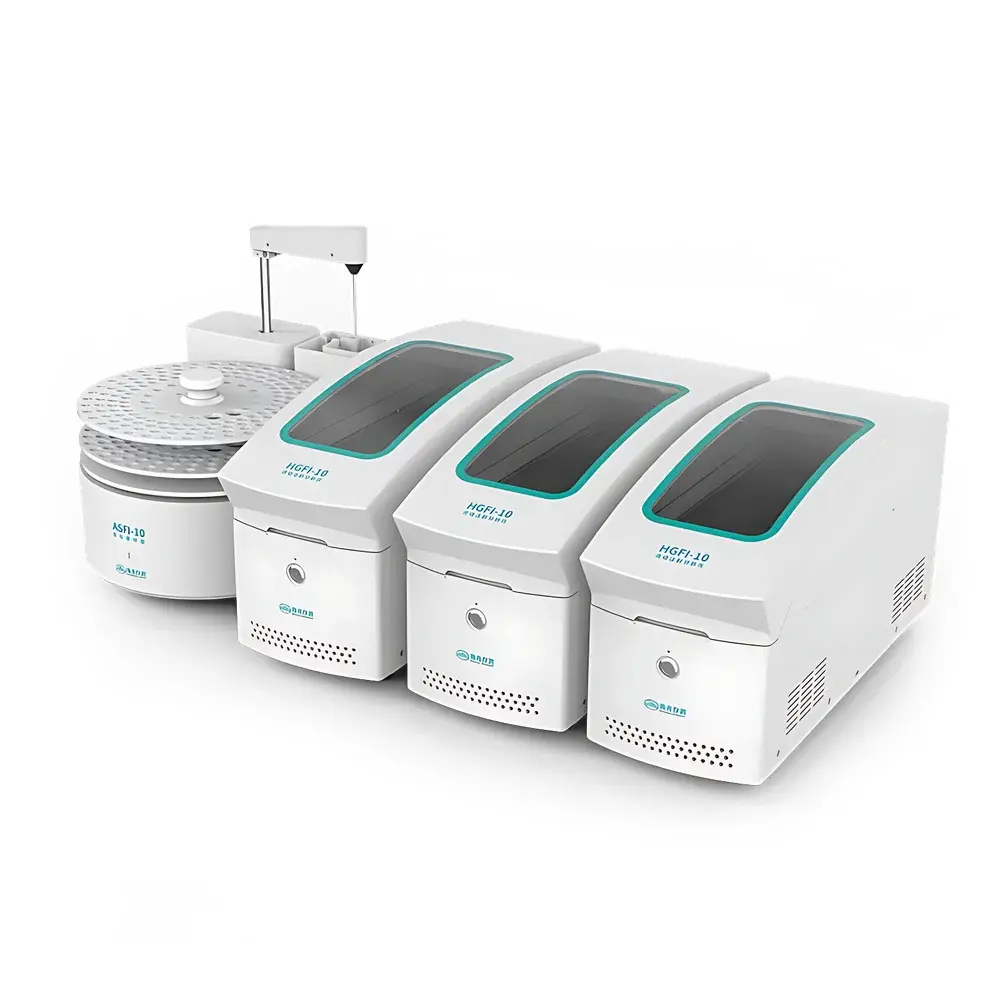
Haiguang HGFI-10 Flow Injection Analyzer
| Brand | Haiguang Instrument |
|---|---|
| Origin | Hebei, China |
| Manufacturer Type | Authorized Distributor |
| Country of Origin | China |
| Model | HGFI-10 |
| Product Category | Flow Injection Analyzer |
Overview
The Haiguang HGFI-10 Flow Injection Analyzer (FIA) is a fully automated, multi-channel analytical platform engineered for high-throughput, reproducible quantification of inorganic and organic analytes in liquid matrices. Based on the core principles of flow injection analysis—precise segmental dispersion of sample plugs within a continuous carrier stream, followed by controlled mixing with reagents, timed reaction, and photometric detection—the HGFI-10 delivers robust performance for routine environmental, food safety, and industrial quality control laboratories. Its modular architecture supports programmable chemical manipulation—including online heating, distillation, UV digestion, liquid–liquid extraction, and post-column reduction—enabling method flexibility without manual intervention. The system operates under laminar flow conditions to ensure consistent dispersion coefficients and precise residence-time control, critical for achieving high inter-run repeatability (RSD < 2% typical for calibrated methods).
Key Features
- Fully automated multi-channel operation: Up to four independent analytical channels can be configured and controlled simultaneously via a unified software workstation, enabling parallel determination of different analytes or method validation cross-checks.
- High-capacity polar-coordinate autosampler: Accommodates up to 144 sample positions (standard configuration), with programmable vial size support (12–20 mm diameter) and temperature-controlled tray option for thermally sensitive samples.
- Integrated online pretreatment modules: Onboard heating (up to 120 °C), steam distillation, UV photocatalytic digestion (254 nm low-pressure mercury lamp), solvent extraction, and gas-phase reduction units are housed within the main chassis, minimizing external plumbing and contamination risk.
- Dual-beam optical detection system: Compensates for source drift and cuvette fouling in real time; features thermoelectrically stabilized blue-enhanced photodiode detector (peak sensitivity at 450 nm) with adjustable integration time (10–500 ms) and 16-bit analog-to-digital conversion.
- Chemical-resistant fluidic path: All wetted components—including peristaltic pump tubing (Pharmed BPT), manifold blocks (acrylic/PFA), and reaction coils (PTFE, 0.5–1.0 mm ID)—are selected for compatibility with acidic, alkaline, and organic solvent-based chemistries.
Sample Compatibility & Compliance
The HGFI-10 is validated for direct analysis of aqueous environmental and biological extracts, including surface water, groundwater, drinking water, seawater, wastewater effluents, soil leachates, tobacco extracts, fertilizer solutions, dairy products, and food homogenates. It conforms to multiple Chinese national and ecological standards, including GB 8538–2016 (mineral water testing), HJ 666–2013 (ammonia nitrogen), HJ 668–2013 (total nitrogen), HJ 671–2013 (total phosphorus), HJ 823–2017 (cyanide), HJ 824–2017 (sulfide), HJ 825–2017 (phenols), HJ 826–2017 (anionic surfactants), and HJ 908–2017 (hexavalent chromium). While not pre-certified to ISO/IEC 17025 or ASTM D5179, its hardware design and data handling protocols support laboratory implementation of GLP-compliant workflows, including audit-trail-enabled method versioning and raw signal archiving.
Software & Data Management
The HGFI-10 is operated via Haiguang’s FIA-Studio v3.x software suite, a Windows-based application supporting method development, sequence scheduling, real-time chromatogram visualization, peak integration (tangent skim, valley-to-valley), calibration curve fitting (linear, quadratic, weighted least-squares), and QC flagging (e.g., carryover, baseline drift, response deviation >5%). Raw absorbance/time data are stored in vendor-neutral .csv format; metadata (method parameters, instrument logs, user annotations) are embedded in XML headers. The software includes built-in report templates aligned with HJ-series standard requirements and supports export to LIMS via ODBC drivers. All data modifications are timestamped and user-attributed, satisfying basic FDA 21 CFR Part 11 readiness when deployed on network-isolated, domain-authenticated workstations.
Applications
The HGFI-10 supports over 15 standardized determinations across regulatory and research domains: total and free cyanide (pyridine-barbituric acid), volatile phenols (4-AAP), ammonia nitrogen (salicylate), nitrate/nitrite (diazotization), orthophosphate and total phosphorus (molybdenum blue), total nitrogen (persulfate UV digestion), sulfide (methylene blue), hexavalent chromium (DPC), anionic surfactants (methylene blue active substances), urea (diacetyl monoxime), permanganate index (acidic KMnO₄ oxidation), and chloride (mercuric thiocyanate). Its adaptability extends to method development for emerging contaminants—such as iodide, bromide, and hydrazine—through custom manifold reconfiguration and kinetic parameter optimization.
FAQ
What types of samples require filtration prior to FIA analysis?
Samples containing suspended solids >10 µm (e.g., untreated wastewater, soil extracts) must be filtered through 0.45 µm membrane filters to prevent manifold clogging. Centrifugation (3,000 × g, 10 min) is recommended for colloidal suspensions.
Can the HGFI-10 perform sequential injection analysis (SIA) or only classical FIA?
The system operates exclusively in continuous-flow FIA mode with fixed-rate peristaltic pumping. It does not support syringe-driven SIA or lab-on-valve configurations.
Is third-party software integration (e.g., LabVIEW, Python) supported?
Direct API access is not provided; however, .csv output and ODBC-compliant database exports enable integration with external scripting environments for batch processing and statistical reporting.
What maintenance intervals are recommended for long-term reliability?
Peristaltic pump tubing should be replaced every 500 operational hours; UV lamp intensity should be verified monthly; optical windows require cleaning with ethanol weekly if analyzing turbid or high-salt matrices.
Does the system include built-in calibration verification standards?
No certified reference materials are supplied; users must procure traceable CRM solutions (e.g., NIST SRM for nitrate, CRM for phosphate) separately for initial calibration and periodic verification.





