
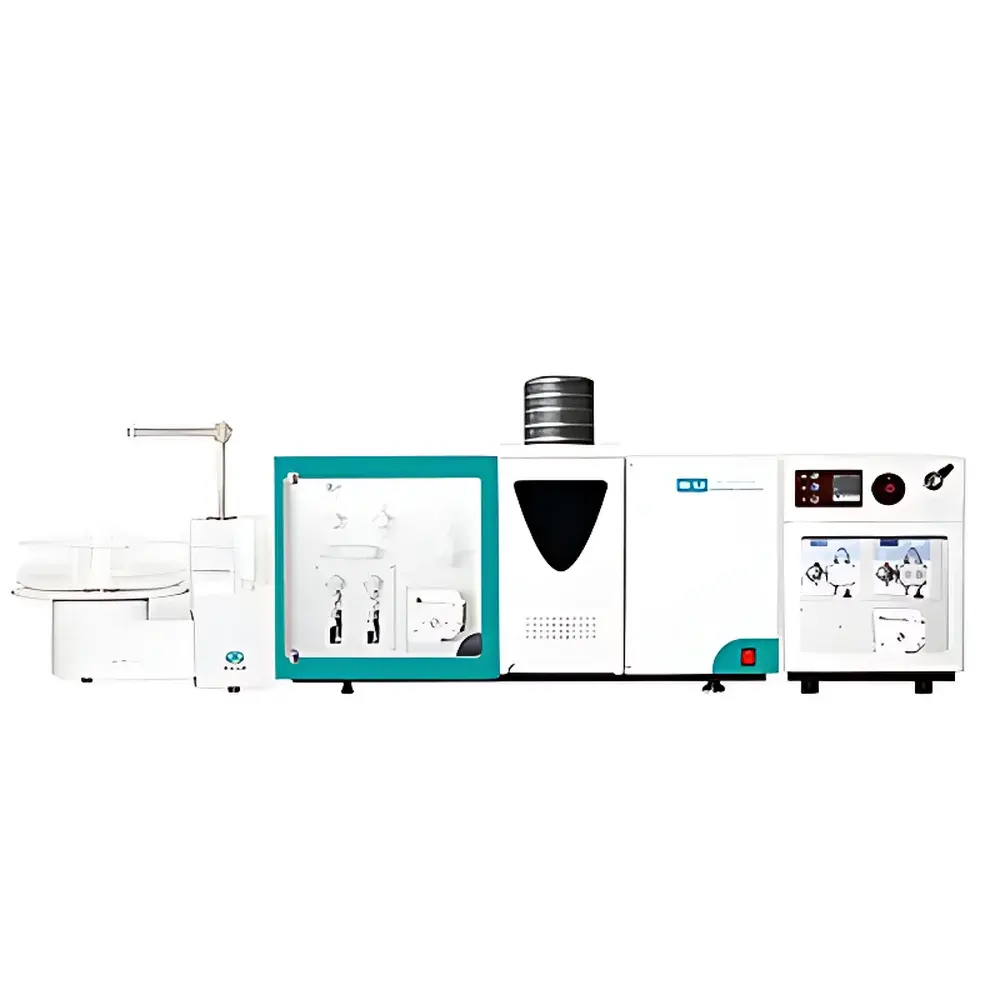
Haiguang LC-AFS9560 Liquid Chromatography–Atomic Fluorescence Spectrometer
| Brand | Haiguang Instrument |
|---|---|
| Origin | Beijing, China |
| Manufacturer Type | Authorized Distributor |
| Regional Classification | Domestic (China) |
| Model | LC-AFS9560 |
| Price Range | USD 70,000 – 85,000 |
| Instrument Type | Hyphenated LC-AFS System |
| Sample Introduction | Dual Sequential Injection Pumps |
| Detectable Elements (Speciation & Total) | As, Hg, Se, Pb, Ge, Sn, Sb, Bi, Cd, Te, Zn, Au |
| Regulatory Compliance | Fully aligned with GB 5009.11–2023 (inorganic arsenic), GB 5009.17–2023 (methylmercury), and ISO/IEC 17025 method validation requirements |
| Software Architecture | Integrated workstation with GLP-compliant audit trail, electronic signature support per FDA 21 CFR Part 11 |
| Hardware Integration | Modular LC unit with integrated UV post-column digestion, column oven, six-port injection valve, hydride/vapor generation, and dual-stage membrane-based gas–liquid separation |
Overview
The Haiguang LC-AFS9560 is a purpose-engineered hyphenated analytical system that couples high-resolution liquid chromatography (LC) with atomic fluorescence spectrometry (AFS) for quantitative speciation analysis of trace metalloids and metals in complex matrices. Unlike standalone AFS or ICP-MS platforms, the LC-AFS9560 implements a true on-line coupling architecture—where chromatographic separation, post-column UV or non-UV oxidative digestion, hydride/vapor generation, and atomization occur within a thermally stabilized, low-dead-volume fluidic pathway. This design enables direct, real-time detection of labile species—including inorganic arsenic (AsIII/AsV), methylmercury (CH3Hg+), selenomethionine, and antimony species—with sub-ppt (ng/L) detection capability under optimized conditions. The system operates on the principle of hydride generation atomic fluorescence spectroscopy (HG-AFS), where analyte-specific volatile hydrides (e.g., AsH3, Hg0, H2Se) are generated in situ, swept into a quartz atomizer by argon carrier gas, and excited by element-specific hollow cathode lamp radiation. Fluorescence emission is measured at right angles to the excitation beam, minimizing background scatter and delivering high signal-to-noise ratios essential for regulatory compliance in food safety, environmental monitoring, and clinical toxicology laboratories.
Key Features
- Patented LC–AFS interface module (ZL 2014202805509) enabling seamless switching between speciation and total-element analysis modes without hardware reconfiguration.
- Dual sequential injection pump system with corrosion-resistant PTFE/PEEK fluid paths, supporting precise gradient elution and automated online dilution of high-concentration samples.
- Integrated speciation unit: includes binary LC pump, thermostatically controlled column oven (ambient–80 °C), 6-port high-pressure injection valve, UV photolysis reactor (254 nm, adjustable intensity), and membrane-based dual-stage gas–liquid separator—eliminating manual acid addition or waste handling.
- Four-lamp turret with auto-identification encoding; lamps powered via pulsed constant-current supply to extend lifetime and stabilize emission intensity.
- Shielded quartz furnace atomizer operating at <800 °C, minimizing fluorescence quenching from O2/H2O vapor and enhancing atomic cloud density.
- Argon-saving pneumatic circuit with array-type solenoid valves and dynamic flow modulation—reducing average Ar consumption by >40% versus conventional systems.
- Modular autosampler compatibility: supports both polar-coordinate 183-position and XYZ Cartesian 130-position robotic platforms with wash-probe functionality and carryover <0.005%.
- Sample–carrier isolation technology preventing longitudinal diffusion during injection, ensuring peak integrity and reproducible retention times across multi-day sequences.
Sample Compatibility & Compliance
The LC-AFS9560 is validated for direct analysis of aqueous extracts from food (rice, seafood, infant formula), soil leachates, biological fluids (urine, blood serum), and industrial wastewater. Its speciation workflow complies with Chinese national standards GB 5009.11–2023 (determination of inorganic arsenic in foods) and GB 5009.17–2023 (methylmercury in fishery products), as well as AOAC Official Method 2015.03 for total and speciated arsenic in rice. All hardware and software modules adhere to ISO/IEC 17025:2017 requirements for method validation—including linearity assessment (r² ≥ 0.999 over 3 orders of magnitude), repeatability (RSD ≤ 3.5% for n = 6), and limit of quantification (LOQ) verification per ICH Q2(R2). The embedded workstation maintains full audit trails, user access logs, and electronic signatures compliant with FDA 21 CFR Part 11 for regulated environments.
Software & Data Management
The dedicated Haiguang SpeciationPro™ workstation provides unified control of LC parameters (flow rate, gradient profile, column temperature), AFS acquisition settings (lamp current, delay time, integration period), and post-run data processing. It supports automatic calibration curve generation (single-point, multi-point, or bracketed), peak deconvolution for co-eluting species, and export of raw spectral/data files in ASTM E1382-compliant .csv and .txt formats. All instrument events—including lamp warm-up, valve actuation, pressure alarms, and UV lamp output decay—are timestamped and stored locally with SHA-256 hashing for data integrity verification. Remote monitoring via secure HTTPS interface enables centralized fleet management across multi-site laboratories.
Applications
- Quantification of AsIII, AsV, MMA, DMA in rice flour and seaweed extracts.
- Simultaneous determination of CH3Hg+ and C2H5Hg+ in tuna tissue homogenates using reversed-phase C18 chromatography.
- Total elemental analysis of Pb, Cd, and Sb in drinking water per EPA Method 1638 revision.
- Speciation of Se(IV), Se(VI), selenocystine, and selenomethionine in dietary supplement tablets.
- Method transfer support for laboratories transitioning from ICP-MS to cost-optimized HG-AFS workflows without sacrificing sensitivity or regulatory acceptance.
FAQ
Does the LC-AFS9560 support simultaneous multi-element speciation?
Yes—the system enables concurrent detection of up to four elements (e.g., As, Hg, Se, Sb) using time-resolved peak collection and element-specific lamp modulation, provided their chromatographic retention windows do not overlap.
Can it be integrated into an existing LIMS environment?
Yes—via ODBC-compliant database connectors and configurable XML/JSON API endpoints for bidirectional data exchange with major LIMS platforms including LabWare, Thermo Fisher SampleManager, and Agilent OpenLab.
What maintenance intervals are recommended for the UV digestion unit?
The mercury-xenon UV lamp requires replacement every 1,200 operational hours; quartz reaction coil cleaning is advised after every 200 injections using 10% v/v HNO3 rinse protocol.
Is GMP/GLP documentation available for installation qualification (IQ) and operational qualification (OQ)?
Yes—Haiguang provides vendor-qualified IQ/OQ protocols, factory calibration certificates traceable to NIM (National Institute of Metrology, China), and U.S. NIST-traceable standard reference materials for As and Hg speciation.
How does the system handle high-salt matrices such as seawater or brine extracts?
The dual-stage membrane gas–liquid separator and PTFE-lined reaction chamber minimize salt deposition; optional inline desalting cartridges (e.g., Agilent Onyx) can be inserted pre-column without modifying core fluidics.





