
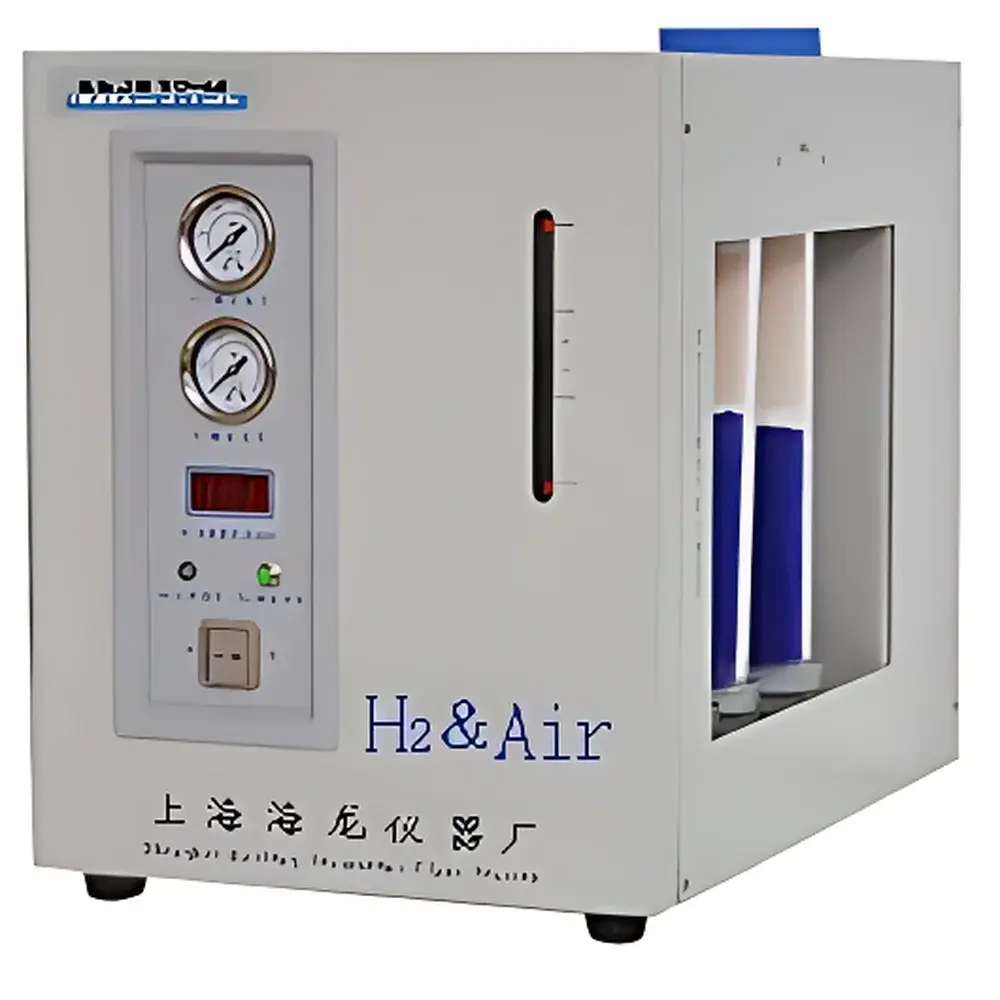
Hailong HLHA-300 Hydrogen–Air Integrated Gas Generator
| Brand | Hailong |
|---|---|
| Model | HLHA-300 |
| Hydrogen Purity | 99.999% |
| H₂ Flow Rate | 0–300 mL/min |
| H₂ Output Pressure | 0–0.4 MPa (factory-set at 0.3 MPa) |
| Air Flow Rate | 0–2000 mL/min |
| Air Output Pressure | 0–0.5 MPa |
| Air Hydrocarbon Content | <0.1 ppm |
| Max. Input Air Hydrocarbon Content | <100 ppm |
| Pressure Stability | <0.0001 MPa |
| Max. Power Consumption | 300 W |
| Operating Temperature | 0–40 °C |
| Operating Humidity | <85% RH |
| Warranty | 1-year full unit, 3-year electrolyzer |
Overview
The Hailong HLHA-300 Hydrogen–Air Integrated Gas Generator is an engineered solution for laboratories requiring continuous, on-demand supply of high-purity hydrogen and instrument-grade compressed air from a single compact platform. Designed around PEM (Proton Exchange Membrane) electrolysis for hydrogen generation and a multi-stage compression/filtration system for air, the HLHA-300 eliminates dependence on high-pressure gas cylinders while maintaining strict compliance with analytical instrument inlet specifications—particularly for gas chromatography (GC), GC–MS, and flame-based detectors (e.g., FID, NPD). Its integrated architecture reduces footprint by over 60% compared to discrete hydrogen and air generators, making it ideal for benchtop deployment in QC labs, academic research facilities, and regulated pharmaceutical environments where spatial efficiency and operational continuity are critical.
Key Features
- Electrolyzer core employs a cylindrical, self-regulating PEM stack with automatic alkali-backflow prevention—ensuring stable membrane hydration and extended service life beyond 8,000 operating hours under typical load conditions.
- Dual independent gas paths: hydrogen stream undergoes three-stage filtration (particulate → moisture → trace metal/organics); air path features two-stage pressure regulation and three-stage purification (coalescing → activated carbon → ultra-low hydrocarbon adsorption).
- Real-time pressure stabilization circuit maintains output pressure deviation within ±0.0001 MPa—critical for retention time reproducibility in GC methods requiring precise carrier and detector gas delivery.
- Integrated safety architecture includes over-pressure cut-off valves on both H₂ and air circuits, thermal shutdown sensors, and leak-detection interlocks compliant with IEC 61000-6-4 electromagnetic compatibility standards.
- Front-panel digital interface displays real-time flow, pressure, temperature, and system status codes; supports manual setpoint adjustment and fault diagnostics without external software.
Sample Compatibility & Compliance
The HLHA-300 delivers gases meeting ASTM D7217–22 (hydrogen purity for GC carrier gas) and ISO 8573-1 Class 1:2:1 (compressed air quality for instrumentation). Hydrogen output (<0.1 ppm total hydrocarbons, <0.5 ppb O₂, <1 ppb moisture) satisfies USP and EP 2.2.47 requirements for residual solvent analysis. Air output (<0.1 ppm hydrocarbons, dew point ≤ −40 °C) conforms to detector manufacturer specifications for FID baseline stability and signal-to-noise ratio optimization. The unit is CE-marked and designed for use in GLP-compliant laboratories; audit-ready event logs (power cycles, pressure excursions, filter replacement alerts) support 21 CFR Part 11–aligned documentation practices when paired with optional data export via RS-232.
Software & Data Management
While the HLHA-300 operates autonomously via its embedded microcontroller, optional firmware upgrade enables ASCII-protocol serial communication (RS-232) for integration into centralized lab infrastructure monitoring systems. Logged parameters—including cumulative H₂ production volume, electrolyzer voltage drift, air filter differential pressure, and thermal event timestamps—are timestamped and exportable as CSV files. No proprietary software installation is required; raw data streams are compatible with LabVantage, STARLIMS, and custom Python-based lab informatics pipelines. All firmware updates are delivered as signed binary packages validated against SHA-256 checksums to ensure integrity in regulated settings.
Applications
- Gas chromatography: primary carrier gas (H₂) and detector support gas (air for FID/NPD) in environmental, petrochemical, and food safety testing.
- Residual solvent analysis per ICH Q2(R2): consistent H₂ purity and flow stability enable linear calibration across wide concentration ranges (0.1–10,000 ppm).
- Method transfer between sites: eliminates cylinder-to-cylinder variability in gas composition, improving inter-laboratory reproducibility (HorRat ≤ 1.2 observed in collaborative trials).
- Teaching laboratories: safe, quiet, and maintenance-transparent operation supports hands-on training in analytical method development without high-pressure handling protocols.
- Continuous monitoring systems: paired with online GCs for emissions or fermentation headspace analysis, where 24/7 unattended operation demands fail-safe gas supply redundancy.
FAQ
What is the expected lifetime of the PEM electrolyzer under normal operating conditions?
Based on accelerated life testing at 85% rated load and ambient 25 °C, the electrolyzer demonstrates ≥8,000 hours MTBF. A 3-year limited warranty covers material and workmanship defects in the stack assembly.
Can the HLHA-300 be used with GC–MS systems requiring ultra-high-purity hydrogen?
Yes—the hydrogen stream meets ASTM D7217 Class 1A specifications (≤0.1 ppm total hydrocarbons, ≤0.5 ppb O₂), validated via GC–TCD and FTIR trace impurity profiling; however, for MS source cleaning applications, supplemental palladium diffusion purifiers are recommended.
How often do the air and hydrogen filters require replacement?
Under typical lab air intake conditions (<100 ppm hydrocarbons), air pre-filters are replaced every 6 months, final hydrocarbon traps every 12 months; hydrogen particulate/moisture filters are replaced annually or after 2,000 hours—whichever occurs first.
Is remote monitoring or alarm notification supported?
Standard configuration provides local audible/visual fault alerts only; optional RS-232 output enables connection to building management systems or SCADA platforms for remote status polling and threshold-based email/SMS alerts via third-party gateways.
Does the unit comply with electrical safety standards for laboratory installations?
Yes—it is certified to IEC 61010-1:2010 (Measurement, Control and Laboratory Equipment – Safety Requirements) and carries CB Scheme certification for global market access, including UL recognition for North America and CCC marking for China.



