
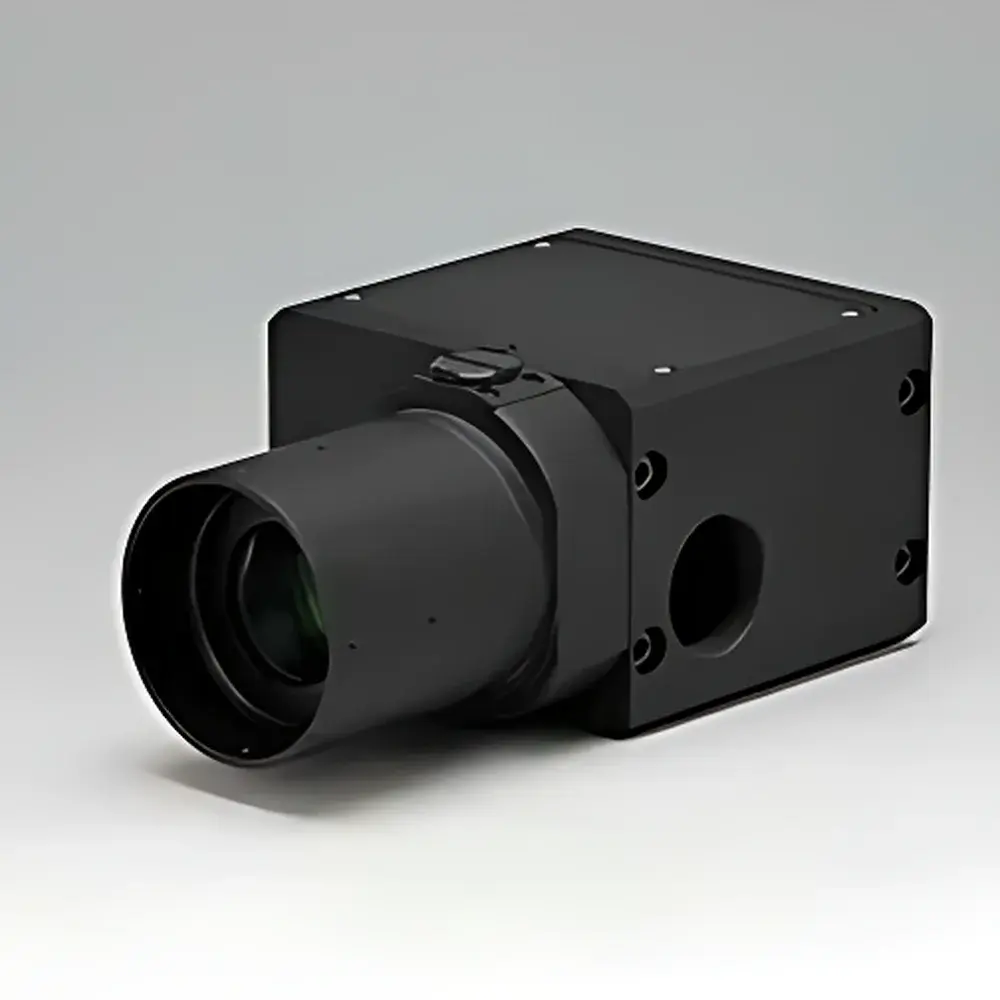
Hamamatsu C10516 Laser Beam Scanning Module
| Brand | Hamamatsu |
|---|---|
| Origin | Japan |
| Manufacturer Type | Original Equipment Manufacturer (OEM) |
| Import Status | Imported |
| Model | C10516 |
| Component Category | Optical Element |
| Optical Design | Telecentric F-θ Lens Integrated with Dual-Axis Galvanometric Scanners |
| Clear Aperture | 21.5 mm Diameter |
| Spectral Range | Visible Spectrum (400–700 nm) |
| Mounting Interface | Standard C-Mount |
Overview
The Hamamatsu C10516 Laser Beam Scanning Module is a precision-engineered optical subsystem designed for high-fidelity, two-dimensional laser beam deflection in visible-light applications. Built upon a dual-axis galvanometric scanning architecture, it integrates a telecentric f-θ lens to ensure uniform spot size, minimal field curvature, and linear scan displacement across the entire imaging plane—critical parameters for quantitative optical metrology and confocal imaging. Unlike conventional scanning optics that suffer from off-axis aberrations or focal shift, the C10516’s telecentric design maintains constant magnification and perpendicular incidence over its 21.5 mm clear aperture, enabling diffraction-limited performance when coupled with high-NA microscope objectives. As an OEM-grade optical building block—not a standalone instrument—the module is intended for integration into custom-built laser scanning platforms, including fluorescence microscopes, reflectance microscopes, and point-scanning confocal systems compliant with ISO 10110 optical component standards.
Key Features
- Dual-axis galvanometric scanners with low-inertia mirrors, optimized for sub-millisecond step response and high positional repeatability (±0.005° typical)
- Integrated telecentric f-θ lens with diffraction-limited MTF performance across 400–700 nm, supporting broadband visible laser sources (e.g., 488 nm, 532 nm, 640 nm diodes)
- 21.5 mm diameter usable field of view—enabling wide-area sample interrogation without mechanical stage translation
- C-mount mechanical interface (17.526 mm flange focal distance, 1″–32 UNC thread) for direct attachment to commercial inverted or upright microscopes
- OEM-optimized mechanical housing with black-anodized aluminum construction, minimizing stray light and thermal drift
- No internal electronics: requires external driver amplifiers and position feedback controllers compatible with standard analog ±10 V input signals
Sample Compatibility & Compliance
The C10516 is compatible with a broad range of biological and industrial specimens—including fixed and live-cell monolayers, tissue sections, semiconductor wafers, and microarray substrates (e.g., DNA and protein chips). Its telecentric illumination geometry ensures consistent signal intensity and depth-independent resolution—essential for quantitative intensity mapping per ASTM E2915-21 (Standard Guide for Evaluating Microscopy Image Quality). When integrated into GLP- or GMP-regulated environments, the module supports traceable calibration via NIST-traceable alignment targets and can be validated under ISO/IEC 17025 requirements for optical measurement systems. It does not incorporate embedded firmware or data logging; therefore, it inherently complies with FDA 21 CFR Part 11 when used within validated host software architectures featuring audit trails and electronic signatures.
Software & Data Management
As a hardware-only optical module, the C10516 does not include proprietary control software or onboard firmware. System-level operation relies on third-party motion controllers (e.g., Cambridge Technology NanoScan series) and acquisition platforms such as National Instruments LabVIEW, MATLAB Instrument Control Toolbox, or open-source frameworks like Python-based PyVISA + NI-DAQmx. Scan pattern generation—including raster, spiral, Lissajous, or region-of-interest (ROI) trajectories—is implemented externally. Data synchronization between scanner position, laser modulation, and PMT/SPAD detector readout is achieved via TTL trigger lines and shared clock domains. For regulated workflows, integration with validated software packages enables full audit trail capture, version-controlled configuration files, and raw image metadata embedding per DICOM Supplement 145 (Optical Microscopy Imaging).
Applications
- Laser scanning fluorescence microscopy (LSFM) requiring high spatial fidelity and photobleaching minimization
- Confocal reflectance and transmission imaging of optically thick biological tissues and engineered materials
- High-throughput microarray scanning for genomics and proteomics platforms
- Industrial inspection systems for wafer defect detection and PCB trace analysis
- Custom-built optical coherence tomography (OCT) light delivery arms operating in visible/near-IR transition bands
- Adaptive optics testbeds requiring programmable beam steering with sub-arcsecond resolution
FAQ
Is the C10516 suitable for ultraviolet or near-infrared wavelengths?
No—the integrated f-θ lens is optimized for the visible spectrum (400–700 nm); transmission drops significantly outside this range due to substrate material absorption and coating design.
Can the module be used with pulsed lasers?
Yes, provided pulse repetition rates remain within the galvanometer’s small-signal bandwidth (< 500 Hz for full-scale step response) and average power stays below 500 mW to avoid thermal lensing in the lens assembly.
Does Hamamatsu provide calibration certificates for individual units?
Calibration is performed at the production level per ISO 10110-5; however, unit-specific test reports (including wavefront error and scan linearity maps) are available upon request as part of OEM procurement agreements.
What is the maximum recommended scan angle for linear f-θ performance?
The specified linear field of view (21.5 mm diameter) corresponds to ±12.5° mechanical deflection per axis; exceeding this degrades telecentricity and introduces >0.5% radial distortion.
Is vacuum or cleanroom compatibility available?
Standard units are rated for Class 10,000 cleanroom use; vacuum-compatible variants (with outgassing-certified adhesives and lubricants) can be supplied under custom OEM contracts.




