
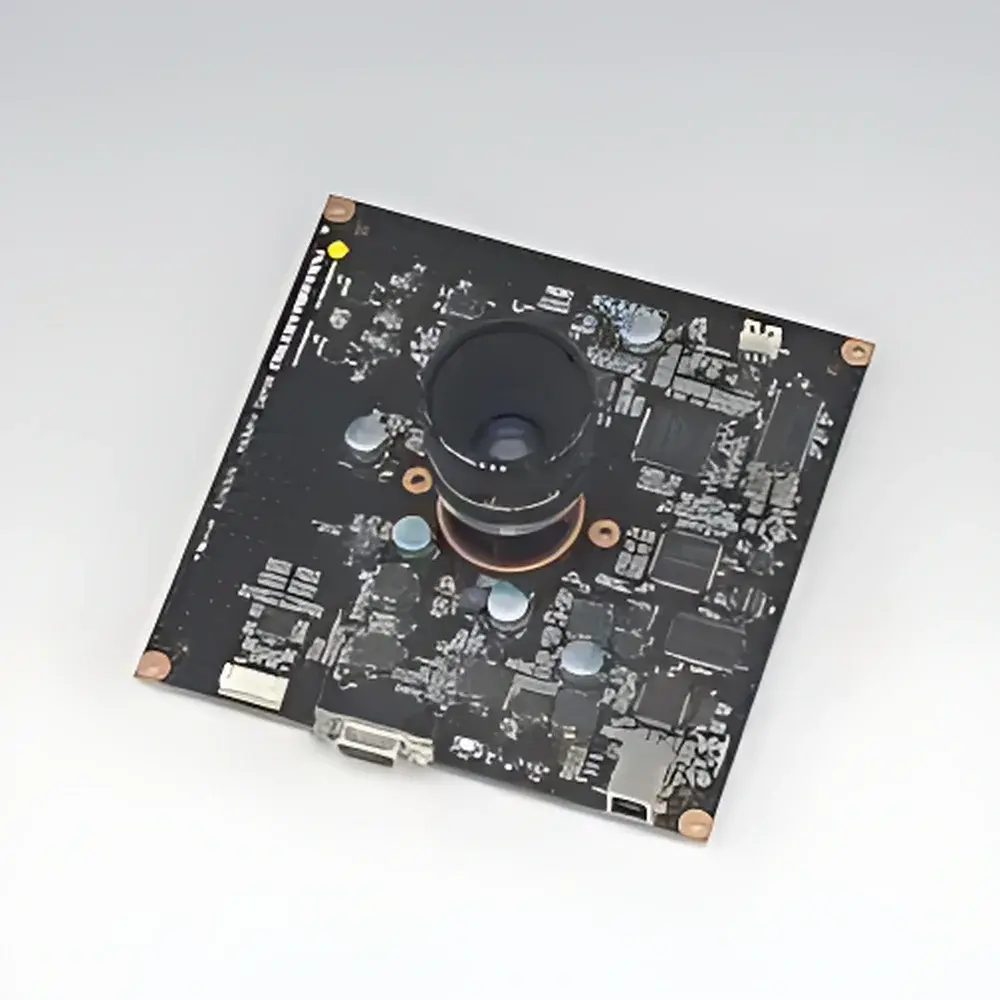
Hamamatsu C10990-90 OEM Board-Level Digital CCD Camera
| Brand | Hamamatsu |
|---|---|
| Origin | Japan |
| Manufacturer Type | Original Equipment Manufacturer (OEM) |
| Product Category | Imported |
| Model | C10990-90 |
| Pricing | Upon Request |
Overview
The Hamamatsu C10990-90 is a high-sensitivity, board-level digital CCD camera engineered for integration into custom optical instrumentation systems requiring precise, low-noise monochrome imaging in demanding scientific and industrial applications. Built around a 1344 × 1024-pixel progressive-scan interline-transfer CCD sensor with 4.65 µm square pixels, the camera delivers high quantum efficiency across visible to near-infrared wavelengths (350–1100 nm), optimized for fluorescence detection, low-light microscopy, and quantitative photon-limited measurements. Its compact PC-board form factor—without housing, cooling fan, or external lens mount—enables seamless embedding into OEM platforms such as automated microscopes, semiconductor inspection tools, X-ray scintillator readout systems, and analytical instruments where space, thermal management, and signal integrity are critical constraints. The device operates on a single +12 V DC supply and supports flexible exposure control from 5 ms to 20 s, making it suitable for both rapid kinetic imaging and long-integration radiometric applications.
Key Features
- 1344 (H) × 1024 (V) interline-transfer CCD sensor with 4.65 µm pixel pitch and 6.25 mm × 4.76 mm active area
- Low readout noise of 13 e⁻ rms at room temperature (20 °C), enabling high-fidelity signal capture under sub-saturation conditions
- 12-bit A/D conversion with USB 2.0 high-speed interface (equivalent bandwidth), supporting real-time frame transfer without host-side buffering bottlenecks
- Programmable region-of-interest (ROI) readout and on-chip binning (2×2 and 4×4), enhancing effective sensitivity and frame rate for targeted analysis
- Overflow charge suppression circuitry to minimize blooming and vertical smear during overexposure—critical for heterogeneous fluorescence intensity fields
- Stable dark current performance (5 e⁻/pixel/s at 20 °C), ensuring consistent baseline subtraction in time-series quantitative assays
- C-mount lens interface compatible with standard microscope objectives and telecentric lenses; mechanical design optimized for minimal parasitic light coupling
Sample Compatibility & Compliance
The C10990-90 is designed for use with transparent, semi-transparent, or luminescent samples commonly encountered in life science and materials characterization workflows. It meets key functional requirements for GLP-compliant imaging systems when integrated with traceable calibration sources (e.g., NIST-traceable neutral density filters and uniform LED illuminators). While the camera itself does not carry CE, FCC, or UL certification as a standalone end-product, its board-level architecture complies with IPC-6012 Class 2 fabrication standards and RoHS 2015/863/EU material restrictions. When embedded in final equipment, users must validate electromagnetic compatibility (EMC) and safety per IEC 61326-1 (measurement/control laboratory equipment) and IEC 61010-1 (safety requirements for electrical equipment for measurement, control, and laboratory use).
Software & Data Management
Hamamatsu provides the HCImage Live SDK (Windows/Linux), a comprehensive software development kit supporting native integration via C/C++, Python (PyHamamatsu), and MATLAB interfaces. The SDK enables full control over exposure timing, ROI definition, binning mode, trigger synchronization (TTL input/output), and real-time histogram generation. All acquired frames include embedded metadata (timestamp, exposure duration, gain setting, sensor temperature approximation) compliant with TIFF 6.0 and FITS 4.0 formats—facilitating interoperability with third-party analysis platforms including ImageJ/Fiji, HALCON, and MATLAB’s Image Processing Toolbox. Audit trail functionality—including parameter change logging and user-defined annotation fields—is available for systems configured to meet FDA 21 CFR Part 11 electronic record/electronic signature requirements.
Applications
- Fluorescence microscopy: GFP/YFP/RFP detection, FISH, live-cell calcium imaging, and multiplexed spectral unmixing with narrow-band filter sets
- Pathology and cytology: Automated slide scanning, nuclear morphometry, and ploidy analysis in brightfield and epifluorescence modes
- Materials science: Metallographic imaging, defect mapping in wafers and thin films, and cathodoluminescence signal acquisition
- Radiation detection: Readout of CsI(Tl), Gd₂O₂S, and other scintillating screens coupled to fiber-optic tapers or lenses
- Dynamic imaging: High-temporal-resolution motion tracking in DIC/phase contrast combined with fluorescence channels
- Quality assurance: In-line inspection of printed circuit boards, solder joint integrity, and micro-optical component alignment
FAQ
Is the C10990-90 suitable for vacuum or high-humidity environments?
No—the camera is rated for operation only in non-condensing ambient humidity up to 70 % RH and temperatures between +10 °C and +40 °C. Extended exposure to elevated humidity may compromise solder joint reliability and increase dark current drift.
Does the camera support hardware triggering for synchronized multi-camera acquisition?
Yes—TTL-compatible trigger input and output lines enable precise external synchronization with lasers, shutters, or motion stages, with jitter < 1 µs.
Can the camera be operated without a computer host?
No—it requires continuous USB 2.0 host communication for configuration, image streaming, and power delivery; no onboard memory or autonomous operation mode is provided.
What is the recommended method for dark frame correction?
Hamamatsu recommends acquiring dark frames at identical exposure time and temperature as light frames, then applying pixel-wise subtraction during post-processing; the SDK includes built-in routines for master dark generation and application.
Is cooling available for extended exposures?
The C10990-90 is air-cooled only. For exposures >5 s where thermal noise becomes significant, users should implement external Peltier cooling of the PCB assembly or integrate active airflow aligned with the sensor substrate.




