
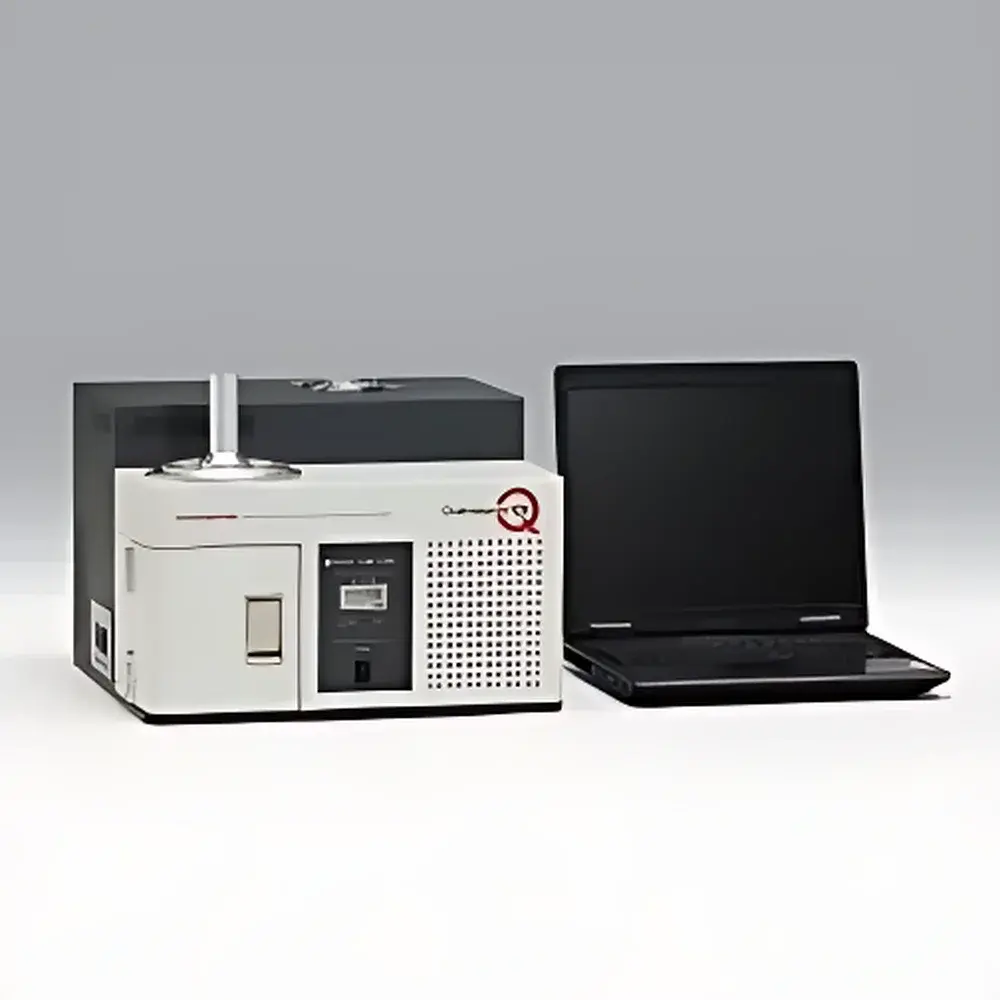
Hamamatsu C11347-11 Absolute Photoluminescence Quantum Yield Measurement System
| Brand | Hamamatsu |
|---|---|
| Origin | Japan |
| Manufacturer Type | Original Equipment Manufacturer (OEM) |
| Product Category | Imported Instrument |
| Model | C11347-11 |
| Measurement Mode | DC |
| Excitation Wavelength Range | 250–800 nm |
| Excitation Bandwidth (FWHM) | <10 nm |
| PL Emission Range | 300–950 nm |
| Spectrometer Type | Czerny-Turner |
| Detector | Cooled Back-Illuminated CCD (1024 channels, -15 °C, 16-bit A/D) |
| Spectral Resolution | <2 nm |
| Integrating Sphere Material | Spectralon® |
| Sphere Diameter | 3.3 inch |
| Fiber Optic Bundle | 1.5 m, 1 mm Ø input aperture |
| Sample Temperature Range | -196 °C (77 K) to +180 °C |
| Sample Forms | Solution, Thin Film, Powder, Solid |
Overview
The Hamamatsu C11347-11 Absolute Photoluminescence Quantum Yield (PLQY) Measurement System is a fully integrated, benchtop instrument engineered for the precise, reference-free determination of absolute photoluminescence quantum yield—defined as the ratio of emitted photons to absorbed photons under controlled excitation. Unlike comparative methods requiring calibrated reference standards, the C11347-11 employs a dual-spectrometer architecture with a high-fidelity integrating sphere (Spectralon® coating, 3.3-inch diameter) and a cooled back-illuminated CCD detector (1024-channel, -15 °C operation, 16-bit digitization) to simultaneously capture both excitation and emission spectra across 300–950 nm. Its optical design follows rigorous radiometric principles: the system measures total hemispherical emission from the sample while concurrently quantifying unabsorbed excitation light via spectral subtraction, enabling traceable, absolute PLQY calculation without empirical correction factors. The excitation source is a stabilized 150 W xenon arc lamp coupled to a manual monochromator (250–800 nm range, <10 nm FWHM bandwidth), ensuring spectrally resolved, reproducible photoexcitation. This architecture conforms to the physical foundations of Jablonski diagram-based photophysics, supporting quantitative interpretation of radiative (e.g., fluorescence, phosphorescence) and non-radiative decay pathways.
Key Features
- Reference-free absolute quantum yield measurement—no certified standard required
- Dual-spectrum acquisition: simultaneous detection of excitation transmission and photoluminescence emission using a single cooled CCD detector
- High-sensitivity detection enabled by thermoelectrically cooled back-illuminated CCD (dark current <0.001 e⁻/pix/s at -15 °C)
- Integrating sphere with >99% diffuse reflectance Spectralon® coating ensures uniform collection efficiency across UV–NIR
- Flexible excitation control: manual monochromator with fine wavelength selection (250–800 nm) for excitation-dependent quantum yield mapping
- Multi-temperature sample environment: ambient to +180 °C heating stage; optional liquid nitrogen cryostat for solution samples down to 77 K
- Compact, modular footprint (<0.5 m²) with fiber-coupled optical path (1.5 m, 1 mm core diameter)
- Czerny-Turner spectrometer configuration delivering <2 nm optical resolution across full 200–950 nm spectral range
Sample Compatibility & Compliance
The C11347-11 accommodates diverse material formats without modification to core optical alignment: thin films (substrate-free or on quartz/glass), powders (in dedicated Spectralon® sample cups), solid pellets, and solutions (in temperature-controlled cuvettes or cryogenic quartz tubes). Optional accessories include A10095-01/-03 film holders, A10104-01 room-temperature solution cells, A11238-01 low-temperature optical cryostat (77 K), and A10095-04 cryogenic sample tubes. All hardware and software comply with ISO/IEC 17025:2017 general requirements for calibration laboratories, and data acquisition supports audit trails aligned with GLP and GMP documentation practices. While not FDA 21 CFR Part 11–certified out-of-the-box, the system’s deterministic signal processing chain and timestamped raw spectral storage enable full traceability required for regulated R&D environments.
Software & Data Management
The proprietary Quantaurus-QY software provides a guided, dialog-driven interface for method setup, automated spectral acquisition, and real-time quantum yield computation. It supports export of raw intensity data (ASCII, CSV), processed spectra (JPG, PNG), and structured reports (PDF) containing metadata (wavelength, integration time, temperature, sample ID). Key analytical modules include: absolute PLQY calculation per IUPAC-recommended methodology; excitation-emission matrix (EEM) generation; peak wavelength and FWHM extraction; CIE chromaticity coordinates (x,y), correlated color temperature (CCT), and color rendering index (CRI); and excitation-dependent quantum yield profiling. All spectral data are stored with embedded calibration coefficients and environmental logs (detector temperature, lamp intensity drift compensation), satisfying ALCOA+ (Attributable, Legible, Contemporaneous, Original, Accurate, Complete, Consistent, Enduring, Available) data integrity principles for scientific records.
Applications
The C11347-11 serves as a primary metrology tool in photonic materials development where quantum yield directly correlates with device external quantum efficiency (EQE). It is routinely deployed in: OLED emitter screening (triplet harvesting validation in TADF and hyperfluorescence systems); phosphor characterization for solid-state lighting (YAG:Ce, nitride red emitters, quantum dot–polymer composites); dye-sensitized and perovskite solar cell research (charge-transfer state quantum yield assessment); luminescent lanthanide complexes and transition-metal catalysts (non-radiative pathway quantification); and bioconjugate probe optimization (e.g., Alexa Fluor®, IRDye® derivatives under physiological and cryogenic conditions). Its ability to resolve temperature-dependent PLQY trends enables Arrhenius analysis of thermal quenching activation energies—critical for high-brightness display and automotive LED qualification.
FAQ
Does the C11347-11 require a reference standard for absolute quantum yield measurement?
No. It uses an integrating sphere–based dual-spectrum method to determine absorbed photon flux directly from excitation transmission loss, eliminating dependence on certified reference materials.
Can the system measure time-resolved quantum yield?
No—the C11347-11 operates in DC (steady-state) mode only. For lifetime-resolved quantum yield, Hamamatsu recommends coupling with the Quantaurus-Tau fluorescence lifetime spectrometer (C11203 series).
What is the minimum detectable quantum yield with this system?
Under optimal conditions (high-reflectance sphere, cooled detector, long integration), the system achieves reliable quantification down to ΦPL ≈ 0.005 (0.5%) for strongly absorbing samples with clean spectral separation.
Is the software compatible with LIMS or ELN integration?
Yes—CSV and ASCII exports support direct ingestion into laboratory information management systems; custom API access is available under Hamamatsu’s Enterprise Data Services agreement.
How is spectral calibration maintained over time?
The system includes onboard Hg/Ar spectral line sources for daily wavelength verification and NIST-traceable radiometric calibration kits for intensity recalibration every 12 months or after optical reconfiguration.




