
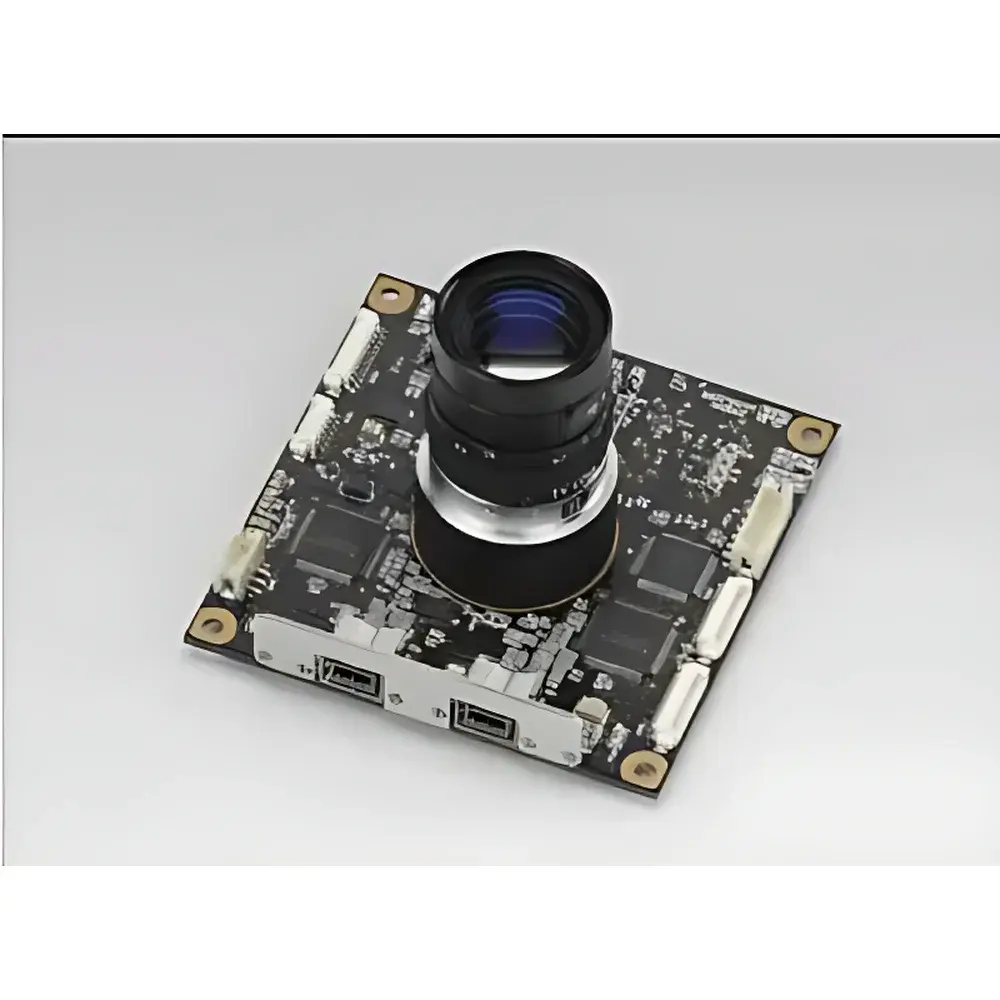
Hamamatsu C11440-50B Scientific CMOS Board-Level Camera
| Brand | Hamamatsu |
|---|---|
| Origin | Japan |
| Manufacturer Type | Original Equipment Manufacturer (OEM) |
| Product Category | Imported Scientific Imaging Device |
| Model | C11440-50B |
| Sensor | FL-280 sCMOS |
| Effective Pixels | 1920 × 1440 |
| Pixel Size | 3.63 µm × 3.63 µm |
| Active Area | 6.97 mm × 5.23 mm |
| Full Well Capacity | 18,000 e⁻ |
| Readout Speed | 22.7–1273 fps (configurable subarray & bit-depth) |
| Readout Noise | 3 e⁻ (at 8× gain) |
| Exposure Time | 20 µs – 1 s (internal/external trigger) |
| Dynamic Range | 4500:1 (1× gain) |
| Analog Gain | 1× or 8× (256-step programmable) |
| Digital Binning | 2×2 |
| Trigger Modes | Edge, Level, Global Shutter Trigger, Synchronous Readout Trigger, Start Trigger |
| Trigger Delay | 0–1000 ms (10 µs resolution) |
| Output Signals | Programmable Timing Output, Global Exposure Timing Output, Trigger Ready Output |
| Interface | Dual IEEE 1394b (FireWire) with industrial 9-pin connectors |
| A/D Conversion | 8-bit or 12-bit selectable |
| Mount | C-mount |
| Power Supply | IEEE 1394b bus power or DC 8–30 V |
| Power Consumption | <3 W |
| Operating Temperature | 0–40 °C |
| Storage Temperature | −10–50 °C |
| Relative Humidity | ≤70% RH (non-condensing) |
Overview
The Hamamatsu C11440-50B is a high-performance scientific complementary metal-oxide-semiconductor (sCMOS) board-level imaging device engineered for demanding optical microscopy and low-light quantitative applications. Unlike traditional CCD architectures, this camera leverages back-illuminated sCMOS sensor technology—specifically the FL-280 chip—to deliver simultaneous high spatial resolution, high quantum efficiency (>80% peak QE), low read noise, and rapid frame rates without compromising dynamic range. Its global shutter operation ensures precise temporal synchronization across all pixels, eliminating motion artifacts in time-resolved fluorescence experiments. Designed as an OEM-ready module, the C11440-50B integrates seamlessly into custom optical systems, including laser scanning microscopes, TIRF platforms, and automated inspection equipment, where compact form factor, deterministic triggering, and thermal stability are critical.
Key Features
- True sCMOS performance: 1920 × 1440 active pixels with 3.63 µm pitch, delivering >95% fill factor and negligible fixed-pattern noise—enabling accurate intensity quantification without pixel-to-pixel correction overhead.
- High-speed, multi-mode readout: Configurable frame rates from 22.7 fps (full-frame, 12-bit) up to 1273 fps (8 × 8 subarray, 8-bit), supporting real-time monitoring of fast biological dynamics such as Ca²⁺ transients or vesicle trafficking.
- Low-noise architecture: 3 e⁻ read noise at 8× analog gain—optimized for photon-starved conditions typical in single-molecule fluorescence or weak X-ray scintillation detection.
- Precision timing control: Hardware-level trigger support—including edge-triggered acquisition, start-delayed exposure, and programmable output signals—ensures sub-millisecond synchronization with lasers, shutters, or stage controllers per GLP-compliant experimental protocols.
- Flexible digitization: Selectable 8-bit or 12-bit A/D conversion allows trade-offs between speed and quantization fidelity; onboard digital binning (2×2) further enhances SNR in low-signal regimes without sacrificing optical resolution.
- Robust OEM integration: Compact board-level design with dual IEEE 1394b interfaces, C-mount lens compatibility, and wide-input DC power range (8–30 V) simplifies integration into embedded instrumentation and industrial metrology systems.
Sample Compatibility & Compliance
The C11440-50B supports a broad spectral response (320–1000 nm), making it suitable for UV-enhanced fluorescence, visible-channel multiplexing (e.g., GFP/mCherry), and near-infrared phosphor imaging. Its linear response (±0.5% deviation over 99% of full scale) meets ASTM E2717-19 requirements for quantitative image-based measurement systems. The camera’s deterministic exposure control and hardware timestamping align with FDA 21 CFR Part 11 expectations for audit-trail-capable acquisition in regulated life science environments. While not certified as a medical device, its design conforms to IEC 61000-6-2 (immunity) and IEC 61000-6-4 (emissions) standards for laboratory-grade electronic equipment.
Software & Data Management
Hamamatsu provides native SDKs for Windows (C/C++, .NET, LabVIEW, MATLAB) and Linux (C/C++), enabling full register-level control of exposure, gain, ROI, and trigger logic. Third-party compatibility includes Micro-Manager (v2.0+), MetaMorph, and NIS-Elements via standardized drivers. All acquired frames include embedded metadata—exposure time, gain setting, timestamp (µs resolution), and sensor temperature—supporting traceable data provenance. Raw 12-bit data streams are delivered losslessly over FireWire, preserving quantitative integrity for post-acquisition processing pipelines compliant with ISO/IEC 17025 analytical validation frameworks.
Applications
- High-speed calcium imaging in neuronal cultures and brain slices
- Ratiometric FRET analysis requiring pixel-wise intensity linearity
- TIRF microscopy with precise evanescent field depth control
- Live-cell GFP expression tracking under variable illumination
- Time-gated luminescence imaging of long-decay phosphors
- Automated semiconductor wafer defect inspection using structured illumination
- FISH signal quantification in cytogenetic diagnostics
- X-ray scintillator readout in synchrotron beamline detectors
- Real-time confocal line-scanning systems with synchronized galvo control
- Failure analysis in IC packaging via infrared thermography coupling
FAQ
Is the C11440-50B compatible with USB3 or GigE Vision interfaces?
No—the camera uses dual IEEE 1394b (FireWire) interfaces exclusively. Adapters to USB3 or GigE are not supported due to deterministic latency and bandwidth requirements inherent to scientific acquisition.
Can I operate the camera in continuous streaming mode without host-side buffering?
Yes—its dual-link FireWire architecture supports sustained 12-bit full-frame transfer at 45.4 fps without dropped frames when configured with sufficient host DMA resources and optimized driver settings.
Does the camera support cooling for extended exposures?
No—it is passively cooled and rated for ambient operation up to +40 °C. For sub-second exposures common in fluorescence applications, thermally induced dark current remains below 0.01 e⁻/pixel/s at 25 °C.
What calibration files are provided with the camera?
Hamamatsu supplies factory-measured flat-field and dark-frame reference sets, along with pixel response non-uniformity (PRNU) maps, for use in quantitative correction workflows.
Is firmware upgrade capability available in the field?
Yes—firmware updates are distributed via Hamamatsu’s official SDK package and applied using the included configuration utility, ensuring compliance with evolving system-level interoperability requirements.





