
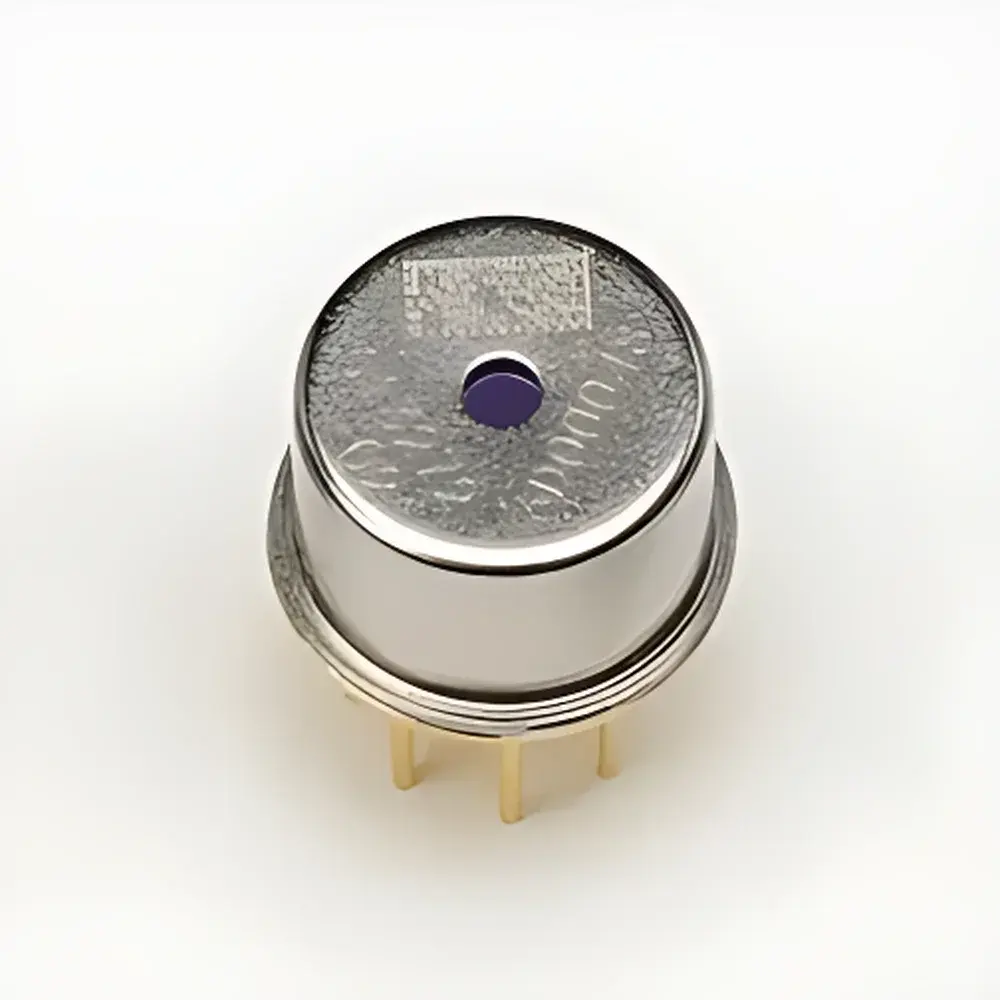
Hamamatsu C13272-02 MEMS-Fabry–Pérot Interferometer Near-Infrared Spectral Detector
| Brand | Hamamatsu |
|---|---|
| Origin | Japan |
| Manufacturer Type | Original Equipment Manufacturer (OEM) |
| Product Category | Imported Optical Component |
| Model | C13272-02 |
| Component Type | Optical Element |
| Package | Hermetically Sealed TO-5 Metal Can |
| Spectral Range | 1550–1850 nm |
| Detector Type | Single-Point InGaAs PIN Photodiode |
| Integrated Bandpass Filter | Yes |
| Onboard Thermistor | Yes |
| Weight | 1 g |
| Housing | Stainless Steel with Glass Window |
| Environmental Rating | Moisture-Resistant Hermetic Seal |
Overview
The Hamamatsu C13272-02 is a monolithic, miniaturized near-infrared (NIR) spectral detection module engineered for integration into space-constrained analytical systems. At its core lies a microelectromechanical systems (MEMS)-based Fabry–Pérot interferometer (FPI), enabling wavelength-selective transmission across a continuous 1550–1850 nm range. Unlike dispersive spectrometers requiring optical benches or scanning mechanisms, the C13272-02 achieves spectral tuning via electrostatic actuation of the MEMS FPI cavity—offering millisecond-scale wavelength switching without moving parts. This principle leverages interference conditions governed by the cavity’s physical gap and refractive index, delivering high spectral purity and repeatability in a footprint smaller than a fingertip (TO-5 metal package, Ø9.2 mm × 4.5 mm height). The integrated single-point InGaAs PIN photodiode provides linear photoresponse with low dark current and high quantum efficiency across the specified band, while an onboard thermistor enables real-time temperature compensation—critical for maintaining wavelength calibration stability under ambient thermal drift.
Key Features
- Monolithic MEMS-FPI tunable filter with <1 nm full-width-at-half-maximum (FWHM) optical bandwidth at center wavelength
- Hermetically sealed TO-5 metal can package ensuring long-term reliability in humid or variable environmental conditions
- Integrated bandpass filter suppressing out-of-band radiation below 1500 nm and above 1900 nm to minimize stray-light-induced measurement error
- On-chip thermistor (NTC type) supporting closed-loop thermal stabilization and wavelength recalibration routines
- Low mass (1 g) and compact geometry optimized for embedded OEM instrumentation including handheld analyzers, process sensors, and drone-mounted NIR modules
- No external optics required—collimated input beam directly coupled through hermetic glass window; compatible with standard fiber-optic interfaces (e.g., SMA 905)
Sample Compatibility & Compliance
The C13272-02 is designed for non-destructive, reflectance- or transmittance-based NIR spectroscopic analysis of organic and polymeric materials. Its spectral window aligns with fundamental overtones and combination bands of C–H, O–H, and N–H bonds—enabling quantitative assessment of moisture content, polymer composition, hydrocarbon saturation, and protein/fat ratios. Applications include inline monitoring of plastic resin batches, ambient gas-phase methane detection (1650 nm Q-branch), grain protein estimation, and ethanol concentration in beverages. As a component-level device, it complies with RoHS Directive 2011/65/EU and REACH Regulation (EC) No. 1907/2006. While not certified as a standalone instrument, its performance characteristics support system-level validation per ISO 17025 for laboratory-developed methods and ASTM E1655-22 for NIR method development and calibration transfer.
Software & Data Management
The detector operates as a voltage-output analog sensor synchronized with external FPI drive signals (typically 0–5 V ramp or PWM-controlled). Hamamatsu provides reference driver firmware (C/C++ and Python-compatible) for common microcontroller platforms (e.g., STM32, Raspberry Pi Pico), including timing-critical MEMS actuation sequences and thermistor linearization lookup tables. Raw spectral scans are acquired as intensity-vs-wavelength datasets; post-processing supports multivariate calibration (PLS, PCR) using open-source tools (scikit-learn, PyMca) or commercial chemometric software (Unscrambler X, GRAMS/AI). Audit-trail functionality—including timestamped acquisition logs, thermal offset records, and FPI drive voltage history—is implementable at the host system level to satisfy GLP/GMP data integrity requirements (aligned with FDA 21 CFR Part 11 when paired with validated software architecture).
Applications
- Portable NIR spectrometers for field-deployable food authenticity verification (e.g., olive oil adulteration, honey purity)
- In-line quality control sensors for extrusion lines monitoring polyethylene density or PET crystallinity
- Environmental monitoring nodes detecting CH₄, CO₂, and NH₃ in agricultural or landfill settings
- Pharmaceutical blend uniformity analysis during continuous manufacturing (per ICH Q8/Q9)
- Research-grade hyperspectral imaging subsystems where pixel-level spectral tunability replaces filter wheels
FAQ
What is the typical spectral resolution achievable with the C13272-02?
Spectral resolution depends on FPI cavity design and drive electronics; nominal FWHM is ≤1.2 nm across the 1550–1850 nm range under optimized bias and temperature control.
Does Hamamatsu provide calibration certificates for individual units?
Unit-specific spectral response and wavelength calibration data are available upon request as part of extended OEM support—not included in standard shipment.
Can the detector be operated in vacuum or elevated temperature environments?
The TO-5 hermetic seal maintains integrity up to 85 °C ambient and 85% RH non-condensing; operation under vacuum requires custom qualification due to potential MEMS stiction effects.
Is there a recommended drive waveform for stable FPI tuning?
Hamamatsu specifies a trapezoidal voltage ramp (0.1–5 V, 10–100 ms period) with hold time ≥5 ms at target wavelength to ensure mechanical settling before signal acquisition.
How does the integrated bandpass filter affect signal-to-noise ratio (SNR)?
The filter reduces broadband background irradiance by >40 dB outside the 1550–1850 nm band, improving effective SNR by minimizing detector saturation and thermal noise contributions from unfiltered IR radiation.






