
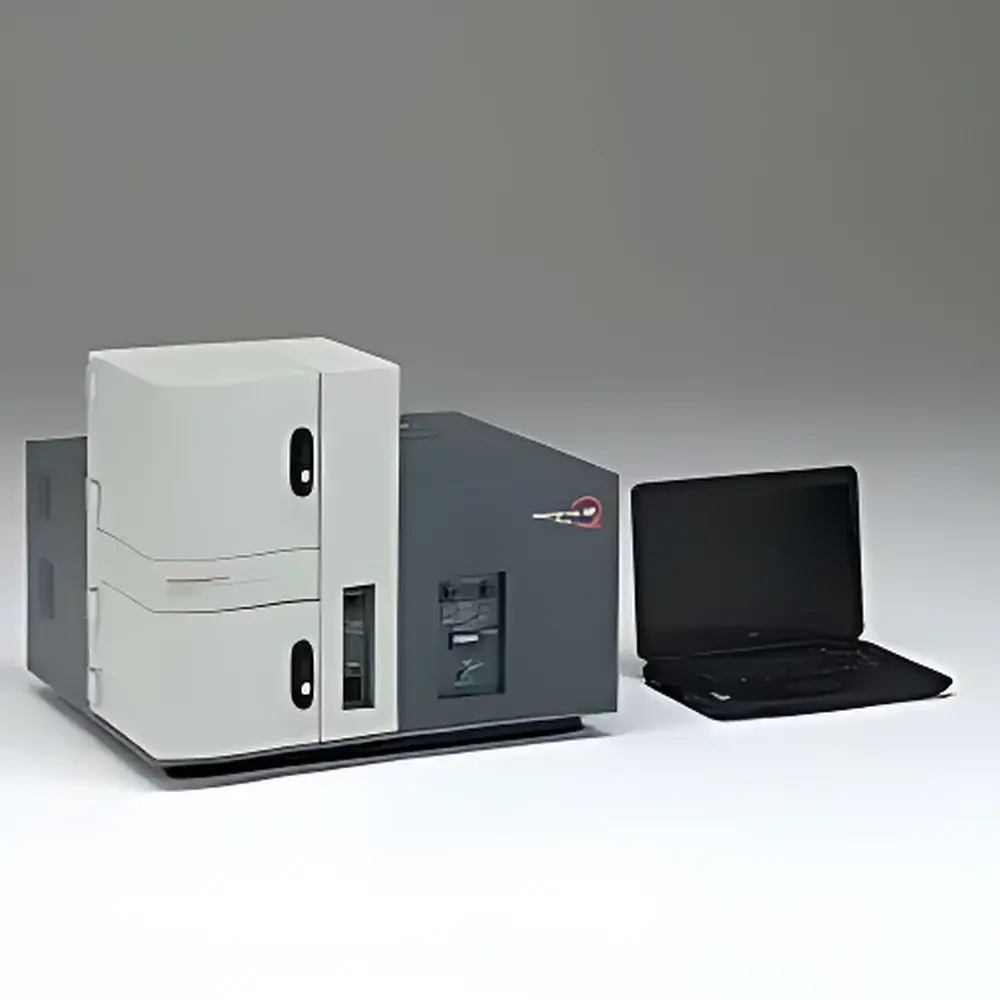
Hamamatsu C13534-11 Quantaurus-QY Plus UV-NIR Absolute Quantum Yield Measurement System
| Brand | Hamamatsu |
|---|---|
| Origin | Japan |
| Manufacturer Type | Original Equipment Manufacturer (OEM) |
| Product Origin | Imported |
| Model | C13534-11 |
| Price Range | USD 140,000 – 280,000 (FOB Japan) |
| Measurement Mode | DC (Steady-State) |
Overview
The Hamamatsu C13534-11 Quantaurus-QY Plus is a high-precision, modular absolute photoluminescence quantum yield (PLQY) measurement system engineered for rigorous characterization of luminescent materials across the ultraviolet to near-infrared spectral range (200–1100 nm). Unlike relative quantum yield methods requiring reference standards, this system implements an integrating sphere-based absolute measurement architecture grounded in calibrated spectral radiometry. It operates under steady-state (DC) excitation conditions using tunable monochromatic light sources—typically xenon arc lamps coupled with double monochromators—to ensure spectrally pure, intensity-stabilized excitation. The core optical design incorporates a dual-detector configuration: a back-illuminated, deep-depletion CCD spectrometer for high quantum efficiency (>90% at 600 nm) and low read noise (<5 e⁻ RMS), and a calibrated silicon photodiode for real-time excitation flux monitoring. This dual-path architecture enables simultaneous acquisition of both sample emission spectra and incident photon flux, eliminating systematic errors from lamp drift or grating efficiency variations—critical for accurate PLQY determination of low-yield or upconversion materials.
Key Features
- Modular detector platform supporting interchangeable spectral sensors—including optional InGaAs detectors—for seamless extension into the short-wave infrared (up to 1700 nm) upon system upgrade.
- Integrated 150 mm diameter PTFE-coated integrating sphere with >99% diffuse reflectance (250–2500 nm), optimized for minimal angular dependence and stray-light suppression.
- Automated wavelength calibration traceable to NIST-traceable tungsten halogen and deuterium lamp standards; spectral resolution ≤1.5 nm (FWHM) across full UV-NIR range.
- Excitation source stability <±0.3% over 1 hour (with active thermal regulation and feedback-controlled power supply), ensuring reproducible PLQY values with standard deviation <1.2% (n=5, certified phosphor standards).
- Rugged, vibration-damped optical bench housed in a light-tight enclosure with EMI-shielded electronics—designed for integration into ISO 17025-accredited material testing labs.
Sample Compatibility & Compliance
The C13534-11 accommodates solid powders, thin films (on quartz or CaF₂ substrates), solutions (in standardized cuvettes), and microcrystalline pellets without mechanical modification. Sample positioning is motorized and software-defined, enabling repeatable geometry control per ASTM E1948-22 (Standard Practice for Measuring Photoluminescence Quantum Yield of Solid Materials). All optical components comply with JIS Z 8103:2020 (Photometric and Radiometric Measurement Terminology) and are compatible with GLP/GMP documentation workflows. Data acquisition logs include full metadata (excitation wavelength, integration time, detector gain, ambient temperature/humidity) required for FDA 21 CFR Part 11-compliant audit trails when paired with Hamamatsu’s optional QY-Manager Pro software module.
Software & Data Management
Control and analysis are performed via Hamamatsu’s QY-Analyzer v4.2 software, a Windows-based application supporting IEC 62443-3-3 cybersecurity principles. It provides automated PLQY calculation per ISO 11679:2021 (Optics and photonics — Methods for measuring photoluminescence quantum yield), including correction for sphere wall absorption, detector responsivity non-uniformity, and air-path dispersion. Raw spectral data exports in industry-standard formats (.spc, .csv, .jdx) with embedded EXIF-like metadata. Batch processing supports up to 96 samples per sequence with customizable pass/fail thresholds based on user-defined uncertainty budgets (k=2). Optional API integration enables direct linkage to LIMS platforms via RESTful endpoints.
Applications
- Quantitative benchmarking of perovskite nanocrystals, quantum dots, and rare-earth-doped phosphors for display backlighting and solid-state lighting (SSL) R&D.
- Validation of upconversion nanoparticles (UCNPs) used in bioimaging—where conventional PLQY systems fail due to weak anti-Stokes signals—leveraging the system’s sub-10 fW detection limit and dark-current-compensated acquisition.
- Accelerated stability testing of OLED emissive layer materials under controlled inert-atmosphere glovebox integration (optional vacuum-compatible sample chamber).
- Support for DOE-funded projects on next-generation scintillators, where absolute light yield quantification directly informs energy resolution modeling in radiation detection simulations.
FAQ
What excitation wavelengths are supported?
Standard configuration covers 250–800 nm with ±0.2 nm wavelength accuracy; optional deep-UV (200 nm) and NIR (900–1100 nm) excitation modules available.
Can the system measure time-resolved quantum yield?
No—the C13534-11 is designed exclusively for steady-state (DC) PLQY. For lifetime-resolved measurements, Hamamatsu recommends coupling with the C11202-11 streak camera or C13528-01 TCSPC module.
Is calibration certificate included?
Yes—each system ships with a factory-issued calibration report traceable to JCSS (Japan Calibration Service System) for spectral irradiance, sphere reflectance, and detector linearity.
What sample volume is required for solution measurements?
Minimum 1.5 mL in standard 10 mm pathlength quartz cuvettes; micro-volume adapter option supports 50–200 µL with matched optical path correction algorithms.
Does the system meet ISO/IEC 17025 requirements for accredited testing?
Yes—when operated with documented SOPs, maintained calibration records, and validated software configurations, it satisfies clause 6.4 (Equipment) and 6.6 (Measurement Traceability) of ISO/IEC 17025:2017.




