
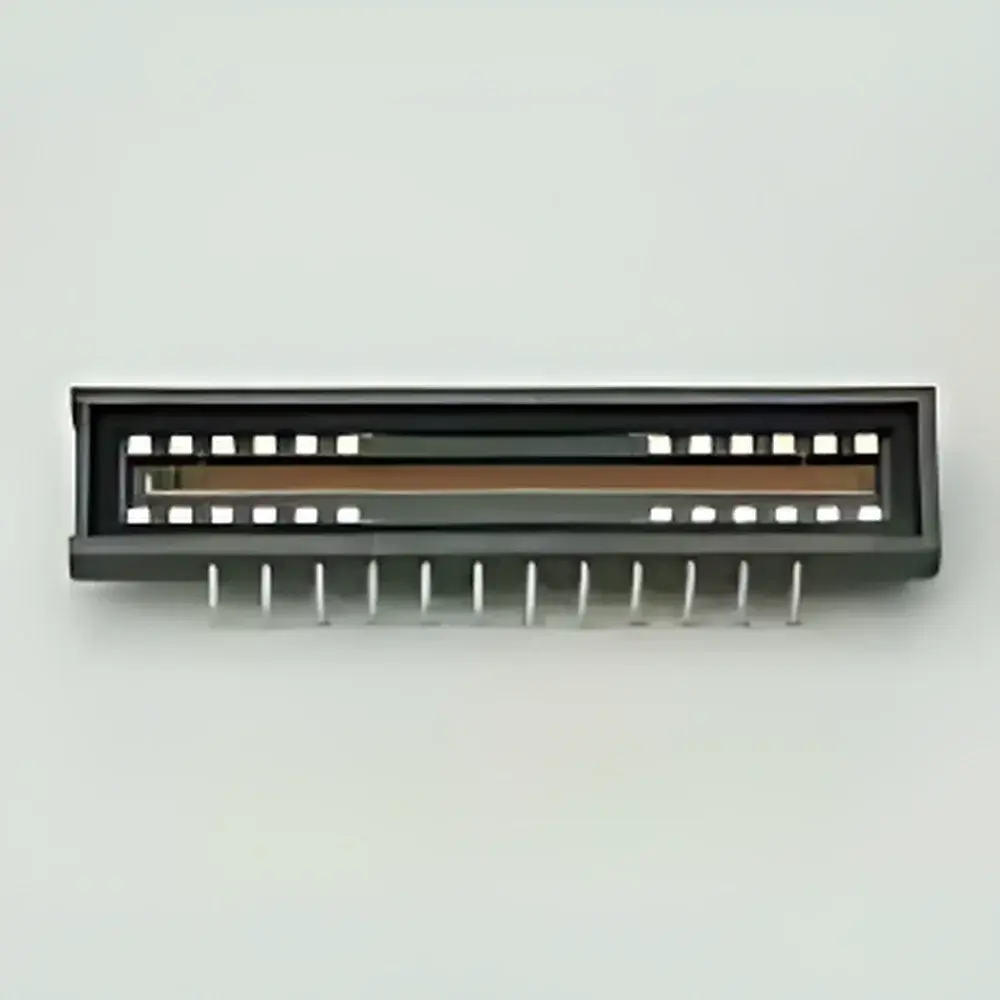
Hamamatsu CMOS Linear Image Sensor S11639-01
| Brand | Hamamatsu |
|---|---|
| Origin | Japan |
| Manufacturer Type | Original Equipment Manufacturer (OEM) |
| Product Category | Optical Component |
| Model | S11639-01 |
| Pixel Count | 2048 × 1 |
| Active Area | 28.672 mm × 0.200 mm |
| Pixel Size | 14 µm × 200 µm |
| Spectral Response Range | 200–1000 nm |
| Sensitivity | 1300 V/(lx·s) |
| Line Rate (Typ.) | 4672 lines/s |
| Operating Voltage | +5 V DC (single supply) |
| Window Material | Quartz |
| Package Type | LCP (Liquid Crystal Polymer) |
| Cooling | Non-cooled |
| Clock Frequency | 10 MHz (max) |
| Video Data Rate | Up to 10 MHz |
| Test Conditions | Ta = 25 °C, Vdd = V(CLK) = V(ST) = 5 V, f(CLK) = 10 MHz |
Overview
The Hamamatsu S11639-01 is a high-sensitivity, monochrome CMOS linear image sensor engineered for precision optical detection in compact spectrometers, UV-Vis-NIR line-scan systems, and laboratory-grade analytical instrumentation. Unlike area-array sensors, this device employs a single-row architecture with vertically elongated pixels (14 µm × 200 µm), optimizing photon collection efficiency—particularly critical in low-light and broadband spectral applications where signal-to-noise ratio directly impacts measurement fidelity. Its quartz window enables robust transmission down to 200 nm, supporting deep-UV spectroscopic use cases without degradation or outgassing under vacuum or inert-gas environments. The sensor operates from a single +5 V DC supply and integrates an on-chip timing generator, eliminating the need for external clock synthesis circuitry and reducing system-level component count. With a 2048-pixel active line and 28.672 mm effective photosensitive length, it delivers spatial resolution suitable for high-dispersion grating configurations while maintaining compatibility with standard Czerny–Turner and crossed-beam optical layouts.
Key Features
- High quantum efficiency across 200–1000 nm, with enhanced UV responsivity enabled by front-illuminated silicon architecture and quartz encapsulation
- Vertically extended pixel geometry (200 µm height) increases fill factor and integration time tolerance for low-flux applications
- On-chip electronic shutter functionality supports programmable integration times—from microseconds to seconds—without mechanical components
- Global charge integration ensures temporal coherence across all 2048 pixels, critical for accurate spectral line profiling and wavelength calibration stability
- Liquid crystal polymer (LCP) package provides dimensional stability over thermal cycling (−40 °C to +85 °C operating range) and minimizes stress-induced pixel non-uniformity
- Integrated timing controller accepts only START and CLK signals, simplifying interface design for FPGA- or microcontroller-based readout systems
Sample Compatibility & Compliance
The S11639-01 is designed for integration into OEM optical subsystems compliant with IEC 61000-6-3 (EMC emission limits) and RoHS Directive 2011/65/EU. Its quartz window meets ISO 10110-7 surface quality standards for optical substrates (scratch-dig 20–10). While not certified as a standalone medical or safety device, the sensor conforms to the optical performance baseline required for instruments referenced in ASTM E275 (UV-Vis spectrophotometer verification), ISO/IEC 17025:2017 (testing laboratory competence), and USP (spectrophotometric absorbance measurement). It is routinely deployed in GLP-compliant UV-Vis array detectors where traceability of spectral response curves is maintained via NIST-traceable calibration sources.
Software & Data Management
Hamamatsu provides the C12880 series evaluation kit firmware (Windows/Linux-compatible) supporting real-time frame capture, dark-current subtraction, and gain normalization. Raw 12-bit digital output (LVDS or CMOS logic compatible) interfaces directly with standard ADC controllers adhering to IEEE 1284 or SPI-4.2 protocols. For regulatory environments, third-party drivers compliant with FDA 21 CFR Part 11 are available through certified integration partners—enabling audit trails, electronic signatures, and secure data archiving when paired with validated acquisition software (e.g., LabVIEW Real-Time, MATLAB Instrument Control Toolbox, or custom Qt-based GUIs). Pixel-level non-uniformity correction (NUC) tables can be stored in EEPROM and applied during initialization to meet ISO 15739 noise performance targets.
Applications
- Miniaturized benchtop and portable UV-Vis-NIR spectrometers for pharmaceutical raw material ID and dissolution testing
- Inline process monitoring in semiconductor photolithography tools requiring real-time exposure dose verification
- Fluorescence lifetime imaging (FLIM) line-scan modules for life science research platforms
- Environmental air/water quality analyzers detecting heavy-metal absorption bands in the 254–365 nm range
- Calibration reference arrays in metrology-grade wavelength standards (e.g., mercury-argon lamp line mapping)
- Custom hyperspectral push-broom sensors for agricultural reflectance analysis (400–900 nm vegetation indices)
FAQ
Is the S11639-01 suitable for vacuum ultraviolet (VUV) applications below 200 nm?
No—the quartz window transmits down to approximately 185 nm under ideal conditions, but practical operation is specified from 200 nm due to atmospheric oxygen absorption and window coating limitations.
Does the sensor require external cooling for stable dark current performance?
No—it is designed for non-cooled operation; dark current remains below 10 e⁻/pixel/s at 25 °C and complies with ISO 15739 low-light noise requirements without thermoelectric stabilization.
Can multiple S11639-01 sensors be synchronized for multi-channel spectral acquisition?
Yes—via shared START and master clock signals, enabling precise inter-sensor timing alignment within ±10 ns jitter, suitable for dual-beam or polarization-divided configurations.
What is the recommended PCB layout practice for minimizing readout noise?
Use controlled-impedance 50 Ω traces for CLK/ST signals, separate analog and digital ground planes with single-point connection near the sensor’s VDD decoupling capacitor, and avoid routing high-speed clocks adjacent to analog output lines.
Is NIST-traceable spectral responsivity data available for this part number?
Yes—Hamamatsu provides factory-measured relative spectral response (RSR) curves calibrated against NIST SRM 2035 (deuterium lamp) and SRM 2036 (tungsten halogen lamp), delivered with each production lot certificate of conformance.




