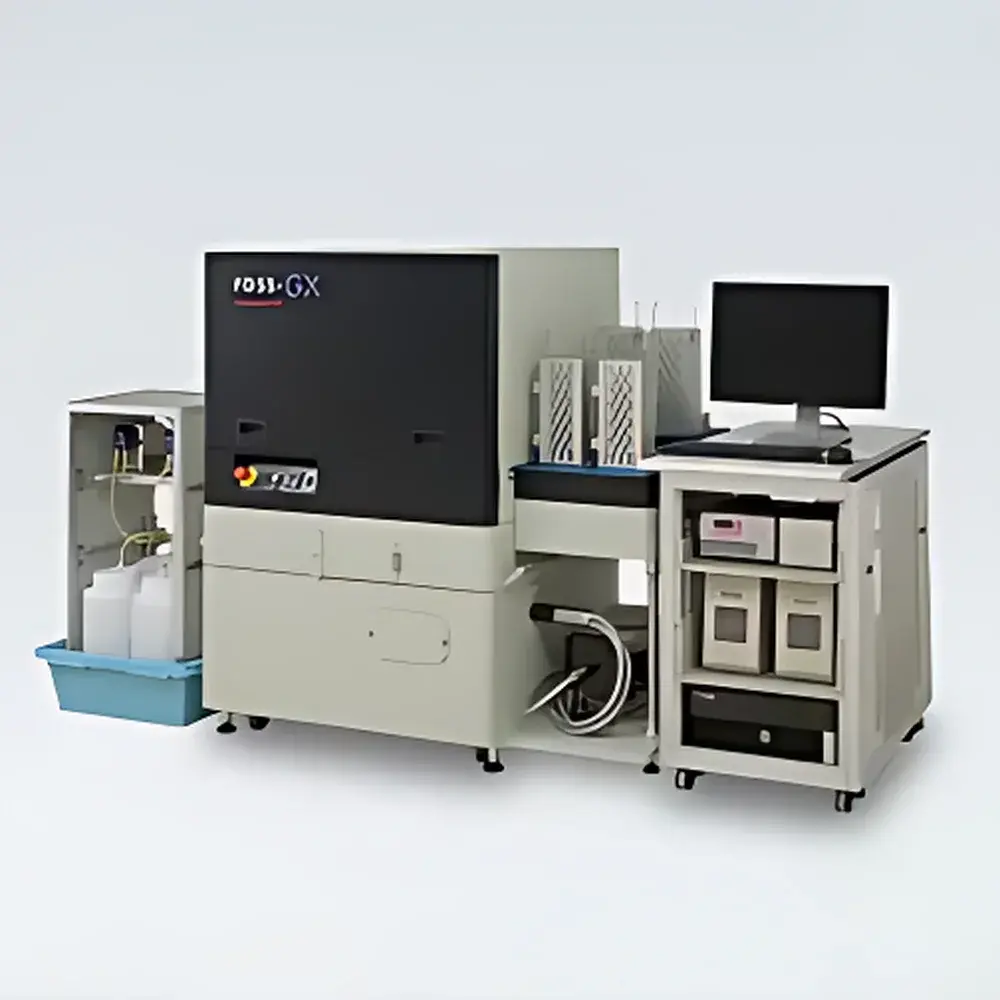
Hamamatsu FDSS®-GX Dynamic Plate Imager C15711-02
| Brand | Hamamatsu |
|---|---|
| Origin | Japan |
| Manufacturer Type | Original Equipment Manufacturer (OEM) |
| Product Category | Imported Instrument |
| Model | C15711-02 |
| Pricing | Upon Request |
Overview
The Hamamatsu FDSS®-GX Dynamic Plate Imager (Model C15711-02) is a high-performance, integrated microplate-based functional assay platform engineered for quantitative kinetic measurement of cellular responses in real time. It employs wide-field fluorescence and bioluminescence imaging combined with synchronized multi-channel liquid dispensing to enable simultaneous stimulation and detection across all wells of 96-, 384-, and 1536-well microplates. Unlike conventional plate readers relying on sequential well scanning or single-point detection, the FDSS-GX utilizes a proprietary qCMOS® sensor architecture to capture full-plate images at up to 120 Hz frame rates—delivering temporal resolution sufficient for monitoring rapid intracellular events such as Ca2+ transients, membrane potential shifts, and G-protein-coupled receptor (GPCR) activation kinetics. Its core optical design incorporates a high-stability, long-life xenon arc lamp coupled with modular excitation/emission filter sets, supporting dual-wavelength ratiometric measurements (e.g., Fura-2, BCECF) and broad-spectrum compatibility from UV to near-infrared. The system is purpose-built for automated high-throughput screening (HTS) environments requiring reproducible pharmacological profiling under GLP-compliant data governance frameworks.
Key Features
- 1536-channel precision dispensing manifold with independent metal piston cylinders—enabling accurate, low-CV (1.89% CV demonstrated at 5 µL/well) delivery across ultra-high-density plates.
- Proprietary Hamamatsu qCMOS® sensor with large active area (≥24 mm diagonal), delivering high quantum efficiency (>80% at 500 nm), wide dynamic range (>105:1), and low read noise (<2 e− RMS) for robust low-light fluorescence and luminescence quantification.
- Dual-path plate handling architecture: front-loading assay plate conveyor and rear-loading compound plate shuttle, supporting semi-automated workflows without robotic integration.
- Modular optical system with user-replaceable excitation/emission filter sets and dichroic mirrors—validated for >30 common fluorescent and luminescent probes including Fluo-8, Cal-520, FMP, JC-1, NanoBRET substrates, and GloSensor constructs.
- Onboard temperature control (up to +40 °C) and programmable plate agitation (0–3000 rpm, 256-step adjustment) to maintain physiological conditions during extended kinetic assays.
- Integrated tip loader (A15623-07), ultrasonic tip washer (up to 3 stations), and stacker capable of holding 20 SBS-format microplates—designed for walk-away operation in regulated laboratories.
Sample Compatibility & Compliance
The FDSS-GX supports standard SBS-compliant microplates with black or clear-bottom configurations (96-, 384-, and 1536-well), accommodating both adherent and suspension cell cultures. It is routinely deployed in assays compliant with ICH M10, USP , and FDA 21 CFR Part 11 requirements when configured with audit-trail-enabled software options (e.g., FDSS Software v5.0+ with electronic signature support). All dispensing performance data—including volumetric accuracy, precision, and carryover—are traceable to Hamamatsu’s internal calibration protocols aligned with ISO/IEC 17025 principles. The system meets CE marking requirements for laboratory instrumentation (2014/30/EU EMC Directive and 2014/35/EU LVD Directive) and operates within Class II biological safety cabinet-compatible dimensions.
Software & Data Management
FDSS Control Software provides instrument orchestration, protocol scripting, real-time visualization, and raw data export in HDF5 and CSV formats. Kinetic acquisition supports up to 50,000 time points per well with configurable sampling intervals (0.0083–1 s). Advanced analysis modules include ratiometric normalization, baseline correction, peak detection, and dose-response curve fitting (logistic 4PL, Hill equation). Raw image stacks are stored with embedded metadata (timestamp, exposure, gain, filter position, plate ID), ensuring full traceability for regulatory submissions. Optional FDSS Analysis Suite enables batch processing across multiple plates and integrates with third-party platforms via RESTful API for LIMS connectivity. Audit trail functionality records all user actions, parameter changes, and data exports—meeting ALCOA+ data integrity standards.
Applications
- Real-time intracellular Ca2+ flux assays using AM ester dyes (Fluo-8, Calbryte-520) or bioluminescent aequorin systems in primary neurons, iPSC-derived cardiomyocytes, and CHO/Gα16 stable lines.
- Membrane potential dynamics assessed with voltage-sensitive dyes (FluoVolt, FMP, VSP) in ion channel safety pharmacology studies (hERG, Nav1.5).
- FRET-based biosensor readouts for kinase activity, protein–protein interactions, and conformational changes in live cells.
- BRET/NanoBRET assays for GPCR–β-arrestin recruitment, receptor internalization, and biased signaling profiling.
- cAMP quantification using GloSensor technology in HEK293 and HUVEC models under agonist/antagonist challenge.
- Cytotoxicity and viability assessment via CytoTox-Glo and RealTime-Glo MT assays with kinetic endpoint discrimination.
FAQ
What microplate formats does the FDSS-GX support?
The system natively supports SBS-standard 96-, 384-, and 1536-well plates with black or clear-bottom configurations, minimum height ≥10 mm.
Is the 1536-channel dispenser compatible with standard tips?
No—it requires Hamamatsu-specific A8687-series black conical tips (e.g., A8687-82 for 1536 format); these are optimized for low dead volume and minimal cross-contamination.
Can the FDSS-GX perform ratiometric measurements?
Yes—dual-excitation/dual-emission capability with motorized filter wheels enables precise Fura-2, BCECF, and SBFI ratio imaging with sub-second switching fidelity.
What is the minimum detectable signal in luminescence mode?
Theoretical detection limit is 3.9 fg/well luciferase (firefly) at 5 s exposure, calculated from background-subtracted RLU values measured under controlled dark conditions.
Does the system comply with 21 CFR Part 11?
Yes—when operated with FDSS Software v5.x and enabled audit-trail, electronic signature, and role-based access control modules, it satisfies electronic record and signature requirements for regulated drug discovery environments.