
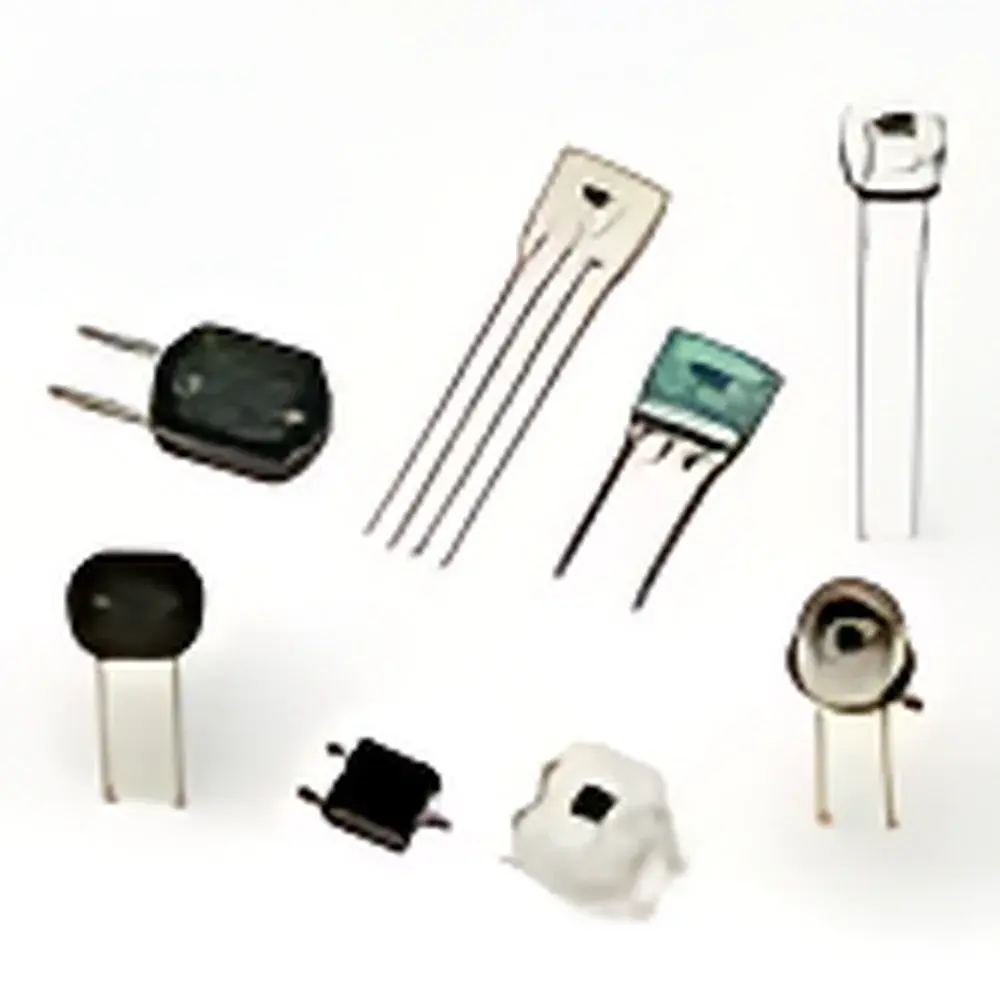
Hamamatsu G11 Series Visible Light Photodiode Sensors
| Brand | Hamamatsu |
|---|---|
| Origin | Japan |
| Manufacturer Type | Original Equipment Manufacturer (OEM) |
| Import Status | Imported |
| Model | G11 Series |
| Component Category | Optical Element |
| Spectral Response Range (typ.) | 300–760 nm |
| Peak Sensitivity | ~550 nm (photopic-matched) |
| Package Options | Metal or Ceramic Hermetic Housing |
| Active Area Options | 1.3 × 1.3 mm to 5.6 × 5.6 mm |
| Rise Time (typ.) | 0.5–15 µs |
| Material | GaAsP |
Overview
The Hamamatsu G11 Series Visible Light Photodiode Sensors are precision semiconductor photodetectors engineered for high-fidelity spectral response closely aligned with the CIE 1931 photopic luminosity function. Based on gallium arsenide phosphide (GaAsP) technology, these devices deliver optimized quantum efficiency across the visible spectrum (300–760 nm), with peak responsivity near 550 nm—matching human photopic vision under daylight-adapted conditions. Unlike broadband silicon photodiodes, the G11 series incorporates tailored epitaxial layer design and anti-reflective coating to suppress UV and NIR out-of-band sensitivity, minimizing spectral mismatch errors in photometric and colorimetric applications. Each sensor is hermetically sealed in either metal or ceramic packages to ensure long-term stability, low dark current (<1 nA at 0 V bias), and resistance to humidity-induced degradation—critical for laboratory-grade optical instrumentation and industrial process monitoring systems requiring traceable photometric accuracy.
Key Features
- Photopic spectral response: Engineered to emulate the CIE V(λ) curve with <±3% deviation across 400–700 nm
- Multiple active area options: Standardized geometries from 1.3 × 1.3 mm² to 5.6 × 5.6 mm² support flexibility in optical coupling and signal-to-noise optimization
- Fast temporal response: Rise times ranging from 0.5 µs (G1735) to 15 µs (G1117/G1120), enabling use in pulsed-light detection, flicker analysis, and high-speed photometry
- Hermetic packaging: Metal or ceramic TO-style housings provide mechanical robustness, thermal stability (operating range: –40°C to +85°C), and immunity to environmental contamination
- OEM-ready interface: Integrated anode/cathode leads compatible with standard PCB mounting and wire bonding; no external amplification required for moderate irradiance levels
- Traceable calibration: Available with NIST-traceable spectral responsivity data sheets upon request for ISO/IEC 17025-compliant installations
Sample Compatibility & Compliance
The G11 series is designed for integration into optical measurement platforms where spectral fidelity and repeatability are essential—including spectrophotometers, colorimeters, luminance meters, and automated visual inspection systems. Devices comply with IEC 60747-5-2 for optoelectronic semiconductor reliability and meet RoHS Directive 2011/65/EU requirements. For regulated environments (e.g., pharmaceutical lighting validation or display manufacturing QA), the sensors support GLP/GMP-aligned documentation packages, including batch-specific test reports and aging data (1,000-hour accelerated life testing per JEDEC JESD22-A108). While not standalone instruments, G11 photodiodes are routinely qualified as critical subsystem components in ASTM E308-compliant color measurement chains and ISO/CIE lighting test setups.
Software & Data Management
As passive analog sensing elements, G11 photodiodes do not include embedded firmware or digital interfaces. However, they are fully compatible with industry-standard signal conditioning architectures: transimpedance amplifiers (TIAs), lock-in amplifiers, and ADC-based data acquisition systems (e.g., National Instruments PXI, Keysight DAQ970A). Hamamatsu provides SPICE models and spectral responsivity datasets (CSV format) for system-level simulation in MATLAB, Python (SciPy), or Zemax OpticStudio. When deployed in validated systems, G11 sensors support audit trails compliant with FDA 21 CFR Part 11 when paired with calibrated DAQ hardware featuring electronic signature and change control functionality.
Applications
- Photometric calibration of LED and OLED light sources against CIE S 026/E:2015 standards
- Real-time luminance feedback in adaptive lighting control systems (e.g., automotive headlamps, architectural tunable-white fixtures)
- Colorimetric channel balancing in multi-spectral imaging systems and machine vision cameras
- Reference detectors in double-beam UV-Vis spectrophotometers requiring stable visible-band monitoring
- Flicker index and percent modulation measurement per IEEE 1789-2015 guidelines for display and lighting safety assessment
- Optical encoder position sensing where ambient light rejection and consistent spectral weighting are required
FAQ
Are G11 sensors supplied with calibration certificates?
Yes—NIST-traceable spectral responsivity calibration reports are available as an optional add-on for individual units or batches, including uncertainty budgets per GUM (JCGM 100:2008).
Can G11 photodiodes operate under reverse bias?
They are optimized for zero-bias (photovoltaic) operation to minimize dark current drift; however, reverse bias up to –5 V may be applied to reduce junction capacitance in high-speed configurations—consult Hamamatsu Application Note AP-004 for bias-dependent linearity limits.
What is the maximum permissible irradiance before saturation?
Saturation threshold depends on load resistance and integration time; typical linear dynamic range spans 10⁻⁶ to 10² lux (at 550 nm, 1 mW/cm² incident power), verified via Hamamatsu’s standardized linearity test protocol (AP-012).
Is there a recommended optical filter pairing for narrowband photopic filtering?
For applications requiring strict V(λ) conformity beyond the native GaAsP response, Hamamatsu recommends combining G11 devices with interference filters such as the LWP-550 (550 ± 10 nm, FWHM) or custom bandpass designs validated per ISO/CIE 13406-2 Annex D.




