
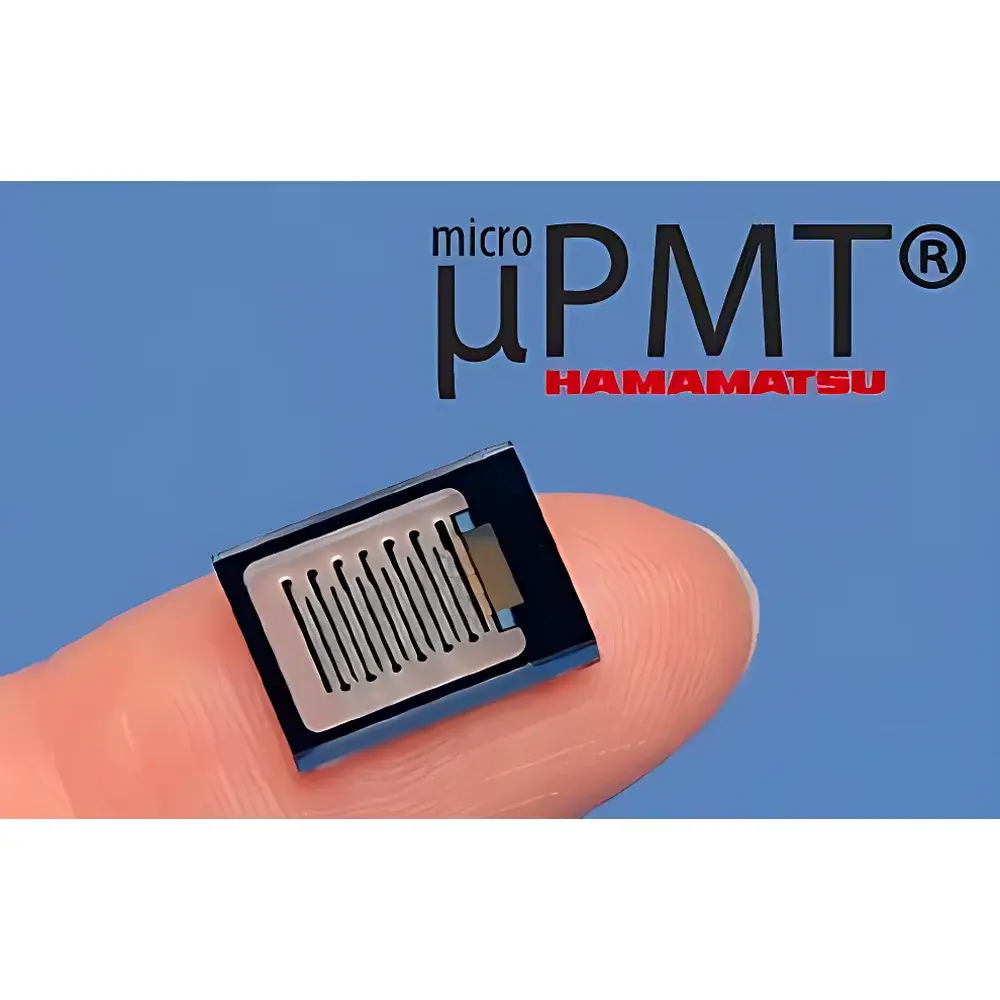
Hamamatsu H12400-00-01 Miniature Photomultiplier Tube (PMT) Assembly
| Brand | Hamamatsu |
|---|---|
| Origin | Japan |
| Manufacturer Type | Original Equipment Manufacturer (OEM) |
| Product Origin | Imported |
| Model | H12400-00-01 |
| Pricing | Upon Request |
Overview
The Hamamatsu H12400-00-01 Miniature Photomultiplier Tube (PMT) Assembly is an integrated, compact optoelectronic detection module engineered for high-sensitivity photon counting and low-light signal amplification in demanding spectroscopic and analytical instrumentation. Unlike standalone PMTs requiring external voltage dividers and shielding, this assembly integrates a hermetically sealed 8-stage side-on photocathode PMT with a precision-matched resistive divider network on a miniature ceramic substrate. Its operation relies on the photoelectric effect followed by secondary electron multiplication within dynode stages—enabling single-photon detection capability with typical anode gains exceeding 1 × 10⁶ at nominal operating voltage (–1000 V). Designed for integration into space-constrained optical paths—such as micro-spectrometers, portable Raman analyzers, fluorescence lifetime measurement systems, and OEM UV-Vis-NIR spectrophotometer modules—the H12400-00-01 maintains stable gain linearity across dynamic light intensity ranges while minimizing microphonic noise and dark current drift.
Key Features
- Integrated design: Pre-aligned PMT and optimized voltage divider circuit eliminate external wiring complexity and reduce parasitic capacitance.
- Compact footprint: Overall dimensions of 25.4 mm × 12.7 mm × 12.7 mm (L × W × H), enabling direct mounting in tight optical benches or handheld instrument enclosures.
- High quantum efficiency: Bialkali (Sb-Rb-Cs) photocathode with peak spectral response at 420 nm and usable range from 160 nm to 650 nm (UV-enhanced quartz window).
- Low dark current: Typical value < 1 nA at –1000 V, supporting high signal-to-noise ratio (SNR) measurements in ultra-low-flux applications.
- Stable gain characteristics: Temperature coefficient of gain ≤ 0.05 %/°C over 15–35 °C ambient range; calibrated divider ensures uniform dynode voltage distribution.
- Robust mechanical construction: Ceramic base with gold-plated pins and epoxy-sealed glass envelope compliant with JEDEC standards for thermal cycling reliability.
Sample Compatibility & Compliance
The H12400-00-01 is compatible with standard NIM and CAMAC-compatible high-voltage power supplies delivering –500 V to –1200 V DC with ripple < 1 mV RMS. It interfaces seamlessly with analog current-output readout electronics (e.g., transimpedance amplifiers) or time-correlated single-photon counting (TCSPC) modules. From a regulatory standpoint, the assembly conforms to IEC 61000-6-3 (EMC emission limits) and IEC 61000-6-2 (immunity requirements) for industrial environments. As a component-level device, it supports end-instrument compliance with ISO/IEC 17025 calibration traceability when paired with NIST-traceable light sources and reference detectors. While not a finished medical or safety-critical device, its construction adheres to RoHS Directive 2011/65/EU and REACH Annex XVII substance restrictions.
Software & Data Management
As a hardware-level detector component, the H12400-00-01 does not include embedded firmware or native software drivers. However, it is routinely integrated into data acquisition ecosystems such as National Instruments LabVIEW, MATLAB Data Acquisition Toolbox, and Python-based frameworks (e.g., PyVISA + NumPy) via analog output conditioning circuits. When deployed in GLP- or GMP-regulated environments—such as pharmaceutical dissolution testing or environmental water quality monitoring—the assembly’s stable gain and low drift support audit-ready data integrity when combined with validated DAQ systems implementing FDA 21 CFR Part 11-compliant electronic signatures, audit trails, and user access controls. Hamamatsu provides comprehensive datasheets, spectral response curves, gain-vs-voltage lookup tables, and aging characterization reports—all accessible via their official technical documentation portal.
Applications
- UV-Vis absorption and fluorescence spectroscopy in benchtop and portable spectrometers.
- Time-resolved luminescence detection in life science instruments (e.g., plate readers, flow cytometers).
- Low-light radiometry and photometry in environmental monitoring sensors (e.g., ozone column density analyzers).
- Scintillation counting in radiation detection modules for nuclear medicine and homeland security screening.
- OEM integration into laser-induced breakdown spectroscopy (LIBS) receivers and plasma diagnostics systems.
- Photon correlation spectroscopy (PCS) and dynamic light scattering (DLS) instrumentation requiring sub-nanosecond timing resolution.
FAQ
What is the recommended operating voltage range for the H12400-00-01?
The nominal high-voltage supply is –1000 V, with a functional range of –500 V to –1200 V. Gain scales approximately linearly with applied voltage; precise calibration is required per application.
Does this assembly include magnetic shielding?
No—external mu-metal shielding is recommended for applications exposed to ambient magnetic fields > 0.1 mT, particularly in proximity to motors or transformers.
Can the H12400-00-01 be used in vacuum environments?
Yes—the hermetic glass-to-metal seal allows operation under vacuum down to 1 × 10⁻⁴ Pa; bake-out above 80 °C is not advised due to epoxy limitations.
Is the photocathode sensitive to humidity or UV exposure during handling?
Yes—exposure to ambient moisture or intense UV prior to installation may degrade quantum efficiency; handling under nitrogen purge or Class 100 cleanroom conditions is strongly advised.
How is gain stability verified over time?
Hamamatsu specifies typical gain change < 5 % after 1000 hours at rated voltage and 25 °C; accelerated life testing reports are available upon request for qualification purposes.





