
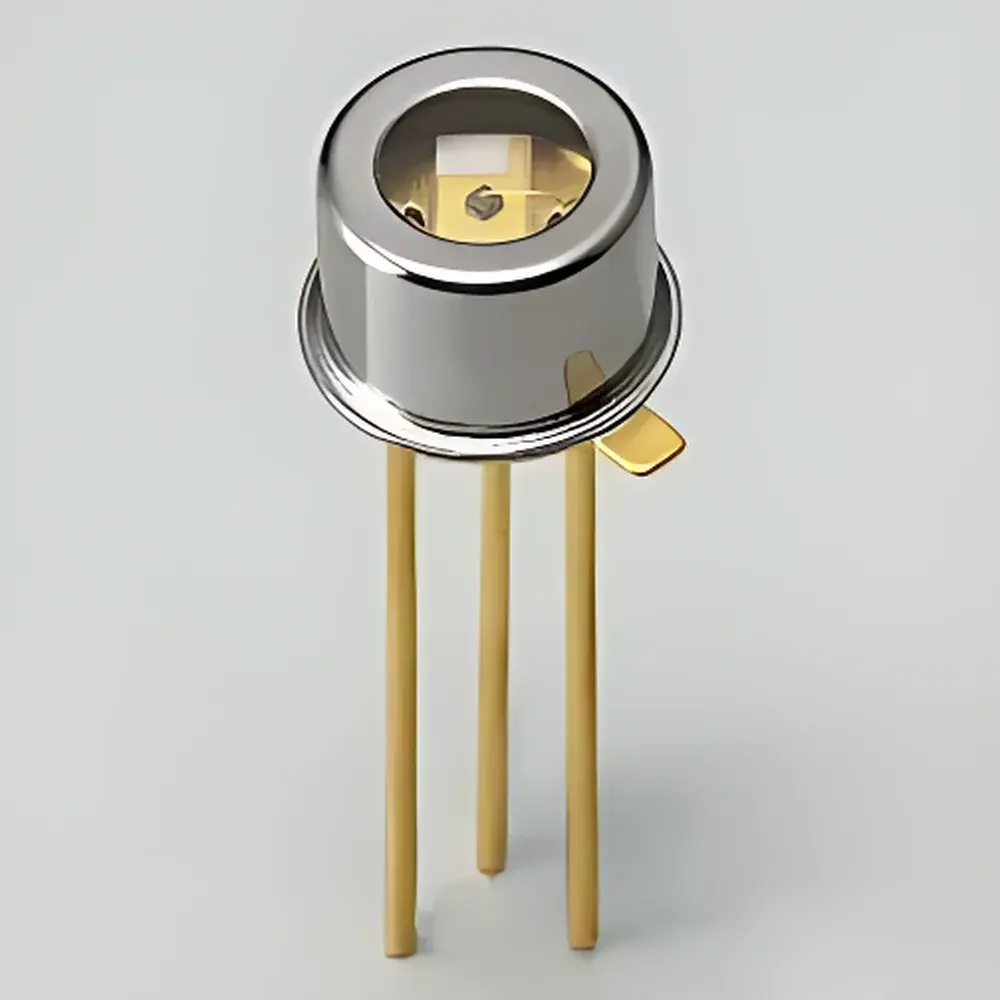
Hamamatsu InGaAs Avalanche Photodiode (APD)
| Brand | Hamamatsu |
|---|---|
| Origin | Japan |
| Manufacturer Type | Original Equipment Manufacturer (OEM) |
| Product Category | Imported Optical Component |
| Model Series | G8931 |
| Component Type | Semiconductor Photodetector |
| Active Area Options | Ø0.04 mm, Ø0.2 mm |
| Spectral Response Range | 900–1700 nm |
| Typical Gain | 10–100 (bias-dependent) |
| Rise Time | <1 ns (depending on active area and bias) |
| Package Type | TO-8 or surface-mount ceramic package |
Overview
The Hamamatsu InGaAs Avalanche Photodiode (APD) is a high-speed, low-noise semiconductor photodetector engineered for sensitive detection of near-infrared (NIR) radiation in the 900–1700 nm wavelength range. Unlike standard PIN photodiodes, this device incorporates internal carrier multiplication via impact ionization under reverse-biased operation—enabling signal amplification prior to external electronics. Its intrinsic gain mechanism provides superior signal-to-noise ratio (SNR) in photon-starved environments, making it particularly suitable for time-resolved measurements where both temporal resolution and quantum efficiency are critical. The G8931 series exemplifies Hamamatsu’s precision fabrication process for InGaAs/InP heterostructure APDs, featuring optimized dark current suppression, stable gain characteristics, and reproducible breakdown voltage thresholds across production lots.
Key Features
- High responsivity (>1.0 A/W at 1550 nm) with tunable avalanche gain (typically 10–100) via precise bias control
- Two standard active area options: Ø0.04 mm for ultrafast response (<1 ns rise time) and Ø0.2 mm for enhanced optical coupling efficiency in fiber-pigtailed configurations
- Low dark current density (<5 nA at M = 10, 25 °C), enabling high dynamic range in low-light applications
- Hermetically sealed TO-8 metal can or compact ceramic surface-mount packages for long-term reliability and thermal stability
- Designed for integration into OEM modules compliant with Telcordia GR-468-CORE reliability standards for telecom-grade photonic components
Sample Compatibility & Compliance
The G8931-series APDs are compatible with single-mode and multimode optical fibers (SMF-28, PMF, or graded-index MMF), supporting butt-coupling or lensed-fiber configurations. Devices are qualified per JEDEC JESD22-A108 for temperature cycling and JESD22-A110 for highly accelerated stress testing (HAST). All units meet RoHS Directive 2011/65/EU and REACH Regulation (EC) No. 1907/2006 requirements. For regulated laboratory environments, traceable calibration data—including spectral responsivity curves and gain vs. bias characterization—are available upon request to support ISO/IEC 17025-compliant measurement systems.
Software & Data Management
While the APD itself is a passive detector element, Hamamatsu provides comprehensive technical documentation—including SPICE-compatible equivalent circuit models, thermal derating curves, and noise spectral density plots—for system-level simulation in tools such as MATLAB, LTspice, or OptiSystem. Integration with Hamamatsu’s C13272 series bias controllers enables programmable gain stabilization and temperature-compensated biasing. When embedded in validated instrument platforms (e.g., time-correlated single-photon counting systems), full audit trails—including bias voltage logs, ambient temperature timestamps, and gain calibration history—can be maintained to satisfy FDA 21 CFR Part 11 and GLP/GMP data integrity requirements.
Applications
- Fiber-optic communication systems requiring high-sensitivity receivers for 10 Gbps and 25 Gbps PON and coherent transmission
- LIDAR and time-of-flight (ToF) distance measurement systems operating at 1310 nm or 1550 nm eye-safe wavelengths
- Quantum optics experiments involving heralded single-photon detection and entanglement verification
- Optical time-domain reflectometry (OTDR) for fault localization in telecom infrastructure
- Near-infrared spectroscopy (NIRS) in biomedical and industrial process monitoring setups
FAQ
What is the maximum recommended bias voltage for the G8931-04 model?
The absolute maximum reverse bias is specified as 60 V; however, optimal operation occurs between 30–55 V depending on target gain and thermal management conditions.
Can these APDs be operated in Geiger mode?
No—G8931 devices are designed for linear avalanche operation only and lack the quenching circuitry required for single-photon counting in Geiger mode.
Is thermoelectric cooling required for stable performance?
Cooling is not mandatory but strongly recommended for applications demanding sub-nA dark current stability over extended acquisition periods; Hamamatsu offers compatible TEC mounts (e.g., C11203 series) for integration.
How does active area size affect bandwidth and sensitivity?
Smaller active areas (Ø0.04 mm) yield lower junction capacitance and higher bandwidth, while larger areas (Ø0.2 mm) improve coupling efficiency and total photocurrent, trading off speed for signal amplitude.
Are evaluation boards available for rapid prototyping?
Yes—Hamamatsu provides the C10721 series evaluation kits, including transimpedance amplifier stages, adjustable HV bias supplies, and SMA-fiber interfaces for immediate functional validation.





