
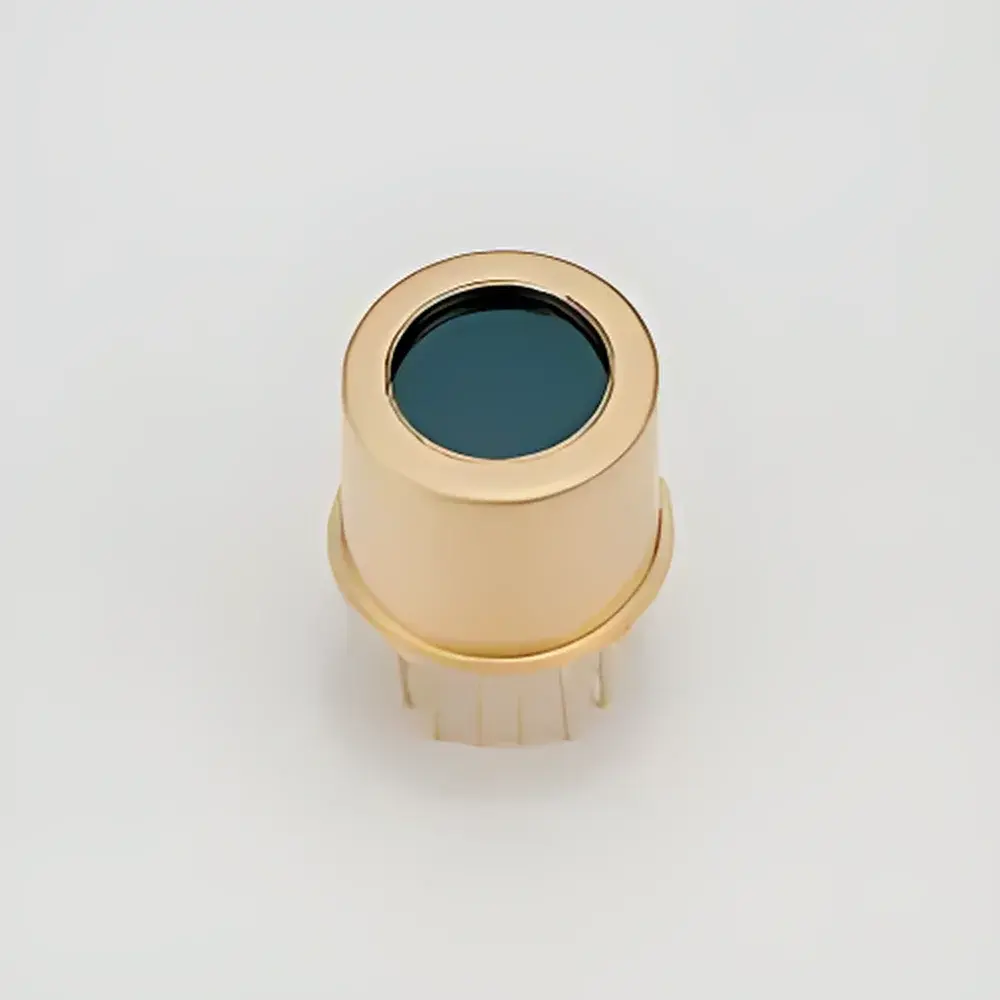
Hamamatsu L12015-1901T-C DFB Pulsed Quantum Cascade Laser
| Brand | Hamamatsu |
|---|---|
| Origin | Japan |
| Manufacturer Type | Original Equipment Manufacturer (OEM) |
| Product Category | Imported Instrument |
| Model | L12015-1901T-C |
| Core Component | Semiconductor Laser Device |
| Laser Type | Distributed Feedback (DFB), Pulsed Operation |
| Peak Emission Wavelength (Typ.) | 5.26 µm |
| Operating Temperature Range (QCL) | 10–50 °C |
| Spectral Linewidth (Max.) | 0.2 cm⁻¹ |
| Wavelength Tuning Range (Min.) | ±1.0 cm⁻¹ |
| Pulse Radiant Power (Min.) | 50 mW |
| Threshold Current (Max.) | 1.5 A |
| Side Mode Suppression Ratio (Min.) | 25 dB |
| Package | TO-8 |
| Dimensions | Standard TO-8 footprint (13.0 mm diameter, 4.5 mm height) |
Overview
The Hamamatsu L12015-1901T-C is a distributed feedback (DFB) quantum cascade laser (QCL) engineered for high-resolution, tunable mid-infrared spectroscopy in demanding analytical and industrial environments. Unlike conventional interband semiconductor lasers, QCLs operate on intersubband transitions within engineered quantum well heterostructures—enabling precise, narrow-linewidth emission in the 4–12 µm spectral region where fundamental vibrational absorption bands of numerous gases (e.g., CO, NO, CH₄, NH₃, H₂S, and VOCs) reside. This model is specifically optimized for pulsed operation, delivering stable, spectrally pure output at a nominal peak wavelength of 5.26 µm—ideal for time-resolved gas sensing, photoacoustic spectroscopy (PAS), and extractive or open-path trace gas monitoring systems requiring high signal-to-noise ratio and minimal thermal drift.
Key Features
- DFB grating-integrated design ensures single-mode emission with <0.2 cm⁻¹ spectral linewidth—critical for resolving closely spaced rovibrational lines in complex gas mixtures.
- Pulsed operation mode supports gated detection schemes (e.g., lock-in amplification, Q-switched PAS), mitigating ambient thermal noise and enabling duty-cycle control to manage average heat load.
- Thermally stabilized operation across 10–50 °C ambient range, compatible with compact TEC-based mounts and integrated driver modules compliant with industrial temperature cycling requirements.
- High side-mode suppression ratio (>25 dB) guarantees robust spectral purity without external filtering—reducing optical complexity and alignment sensitivity in OEM sensor platforms.
- TO-8 metal-can package provides mechanical rigidity, hermetic sealing, and standardized pinout for direct integration into laser diode drivers, fiber-pigtailed modules, or free-space optical benches.
- Wavelength tunability of ±1.0 cm⁻¹ via current modulation enables scanning across target absorption features without mechanical tuning elements—supporting rapid, reproducible spectral acquisition.
Sample Compatibility & Compliance
The L12015-1901T-C is designed for use in gas-phase optical absorption measurements and is routinely deployed in analyzers meeting ASTM D6348 (standard test method for determining gaseous pollutants by FTIR), ISO 12039 (stationary source emissions—determination of carbon monoxide, carbon dioxide, and oxygen), and EPA Method 320 (infrared spectroscopy for organic compound analysis). Its emission band overlaps key absorption lines of regulated pollutants under US EPA Tier 2 and EU IED Annex VI monitoring frameworks. The device complies with IEC 60825-1:2014 Class 3B laser safety requirements when operated within specified pulse parameters; full compliance documentation—including RoHS 2011/65/EU and REACH SVHC declarations—is available upon request for system-level regulatory submissions (e.g., FDA 21 CFR Part 11–enabled environmental monitoring instruments).
Software & Data Management
While the L12015-1901T-C operates as a hardware component rather than a standalone instrument, it integrates seamlessly with industry-standard laser control and data acquisition ecosystems. Hamamatsu provides detailed electrical interface specifications (including pulse rise/fall time limits, maximum drive voltage, and bias sequencing) compatible with third-party drivers from Wavelength Electronics (QCL series), ILX Lightwave (LDC-37xx), and Stanford Research Systems (DG645 + LDC501). When embedded in analytical platforms, its spectral output is typically synchronized with digitizers (e.g., National Instruments PXIe-5171R) and processed using libraries supporting HITRAN-based line fitting (e.g., Python’s hapi, MATLAB’s GasAbsorption Toolbox). Audit-trail-capable firmware implementations—required for GLP/GMP-compliant environmental labs—can log timestamped current/temperature settings, pulse count, and operational uptime per IEC 62304 Class B software lifecycle standards.
Applications
- Trace gas detection in stack emissions monitoring (CEMS) and fugitive emission surveys, particularly for nitrogen oxides (NOₓ), sulfur compounds, and halogenated hydrocarbons.
- Industrial process control in petrochemical refineries and semiconductor fabrication cleanrooms, where real-time detection of ppm-level contaminants ensures product yield and worker safety.
- Research-grade mid-IR spectroscopy in university and national lab settings—used in cavity-enhanced absorption spectroscopy (CEAS), frequency comb-referenced calibration, and dual-comb interferometry development.
- Portable and UAV-mounted environmental sensors for atmospheric chemistry field campaigns, leveraging the device’s low power consumption in pulsed mode and compatibility with battery-operated TEC controllers.
- Calibration source for Fourier-transform infrared (FTIR) spectrometers and tunable diode laser absorption spectrometers (TDLAS), providing NIST-traceable reference lines near 5.26 µm.
FAQ
Is the L12015-1901T-C suitable for continuous-wave (CW) operation?
No—this model is specifically configured for pulsed operation only. CW functionality requires alternative Hamamatsu QCL variants (e.g., L12015-1902T-C) with modified thermal management and drive architecture.
What is the recommended driver configuration for optimal spectral stability?
A low-noise, current-regulated pulsed driver with sub-100 ns rise time and active temperature feedback to the QCL mount is required. Hamamatsu recommends pairing with a closed-loop TEC controller maintaining ±0.1 °C stability at the laser baseplate.
Does Hamamatsu provide optical alignment fixtures or collimation optics for this device?
No—optical mounting and collimation are application-specific responsibilities. However, Hamamatsu supplies mechanical drawings (including TO-8 flange dimensions and beam divergence profile) to support custom lens holder design.
Can this QCL be fiber-coupled?
Yes—when integrated with commercially available mid-IR fiber couplers (e.g., ZnSe aspheric lenses paired with chalcogenide or hollow-core fibers), though coupling efficiency depends strongly on beam parameter product (M²) and NA matching.
Is factory calibration data (e.g., wavelength vs. current curves) included with shipment?
Each unit is tested for threshold current, slope efficiency, and spectral center wavelength at 25 °C. Full characterization reports—including spectral scans and thermal tuning coefficients—are available as optional add-ons upon order placement.




