
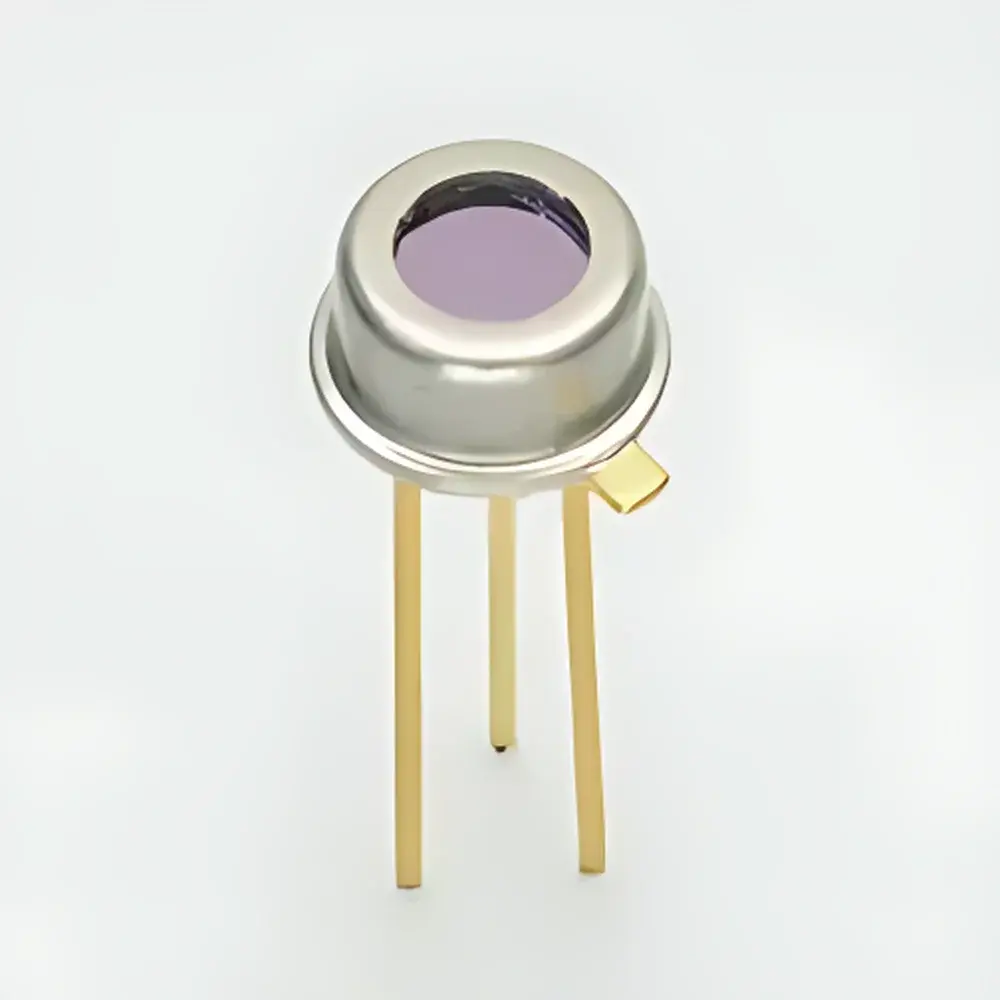
Hamamatsu L13771-0330M Mid-Infrared LED
| Brand | Hamamatsu |
|---|---|
| Origin | Japan |
| Manufacturer Type | Original Equipment Manufacturer (OEM) |
| Product Category | Imported |
| Model | L13771-0330M |
| Light Source Type | Infrared LED |
| Illumination Mode | External Illumination |
| Peak Emission Wavelength (Min) | 3100 nm |
| Peak Emission Wavelength (Typ.) | 3300 nm |
| Peak Emission Wavelength (Max) | 3400 nm |
| Spectral FWHM | 300 nm |
| Radiant Flux (Typ.) | 0.25 mW |
| Forward Voltage (Typ.) | 2.1 V |
| Operating Temperature | Ta = 25 °C (unless specified) |
Overview
The Hamamatsu L13771-0330M is a high-output, metal-packaged mid-infrared light-emitting diode engineered for precision gas sensing applications—particularly methane (CH4) detection in analytical and environmental monitoring systems. Operating on the principle of electroluminescence from optimized III-V semiconductor heterostructures, this device emits broadband infrared radiation centered at 3.3 µm—a spectral region corresponding to the fundamental C–H stretching vibrational absorption band of methane. Its emission profile is defined by a typical peak wavelength of 3300 nm, with a full width at half maximum (FWHM) of 300 nm, enabling effective spectral overlap with target absorption features while maintaining sufficient optical power density for robust signal-to-noise ratio in non-dispersive infrared (NDIR) and photoacoustic spectroscopy (PAS) configurations.
Key Features
- High Radiant Output: Delivers a typical radiant flux of 0.25 mW under standard DC bias conditions (IF = 100 mA, Ta = 25 °C), supporting low-noise detection in compact optical path designs.
- Optimized Spectral Match: Peak emission range (3100–3400 nm) aligns with the strongest CH4 absorption line near 3.3 µm, minimizing reliance on costly optical filtering while maximizing analyte-specific sensitivity.
- Fast Electrical Response: Sub-microsecond rise/fall times enable pulsed operation for time-resolved measurements and synchronous lock-in detection—critical for mitigating thermal drift and ambient IR interference.
- Hermetic Metal Package: Sealed TO-18-style housing ensures long-term stability in humid or chemically aggressive environments, meeting industrial reliability requirements for continuous-duty deployment.
- Thermal Robustness: Designed for stable performance across ambient temperatures up to 60 °C, with forward voltage drift characterized and compensated in calibrated sensor firmware.
Sample Compatibility & Compliance
The L13771-0330M is compatible with standard TO-can mount fixtures and fiber-coupling adapters (e.g., ZnSe or Chalcogenide-based lenses). It is routinely integrated into NDIR gas modules compliant with ISO 8573-5 (compressed air purity), EN 14624 (methane detectors for mining), and IEC 60079-29-1 (explosive atmosphere gas detection). While the LED itself does not carry CE or UL certification, its use in end-systems supports compliance with functional safety standards including IEC 61508 (SIL2-capable architectures) when implemented with appropriate current regulation, thermal management, and redundancy protocols.
Software & Data Management
This LED functions as a hardware-level optical excitation source and does not incorporate embedded firmware or digital interfaces. Integration requires external constant-current drivers (e.g., Hamamatsu C13220 series) and temperature stabilization (e.g., thermoelectric coolers or PID-controlled heatsinks). System-level data acquisition—such as intensity normalization, wavelength calibration via reference photodiodes, and drift compensation—is managed through host instrumentation software (e.g., LabVIEW, Python-based PyVISA frameworks, or vendor-specific SDKs). When deployed in regulated environments (e.g., pharmaceutical cleanroom air monitoring), audit trails for LED drive current, junction temperature, and output stability can be logged in accordance with FDA 21 CFR Part 11 requirements using validated SCADA or LIMS platforms.
Applications
- Non-dispersive infrared (NDIR) methane sensors for landfill gas monitoring and natural gas leak detection
- Photoacoustic spectroscopy (PAS) transducers in portable emissions analyzers (e.g., vehicle exhaust, biogas composition)
- Calibration sources for Fourier-transform infrared (FTIR) spectrometer alignment in research laboratories
- Reference emitters in dual-beam differential absorption setups for atmospheric remote sensing prototypes
- Embedded light sources in OEM gas analysis modules for HVAC IAQ (indoor air quality) systems
FAQ
What is the recommended drive current for stable operation?
The device is rated for continuous forward current up to 100 mA; optimal lifetime and spectral stability are achieved at 70–90 mA with active thermal regulation.
Can this LED be modulated at kHz frequencies?
Yes—its intrinsic carrier recombination time supports square-wave modulation up to 500 kHz; however, driver circuit parasitics and thermal inertia limit practical duty-cycle fidelity above 100 kHz.
Is the emission spectrum temperature-dependent?
Yes: peak wavelength exhibits a redshift of ~0.3 nm/°C, and radiant flux decreases ~0.5%/°C above 25 °C; these coefficients are documented in Hamamatsu’s L13771 datasheet Rev. D.
Does Hamamatsu provide spectral calibration certificates?
Standard units ship without individual spectral calibration; traceable NIST-traceable spectral radiance data is available upon request for volume orders (>100 pcs) under Hamamatsu’s QA-IR-002 protocol.
How does this LED compare to quantum cascade lasers (QCLs) in CH4 sensing?
Unlike QCLs, the L13771-0330M offers lower cost, higher reliability, and simpler drive electronics—but trades off narrow linewidth and absolute wavelength accuracy required for high-resolution multi-gas discrimination.



