
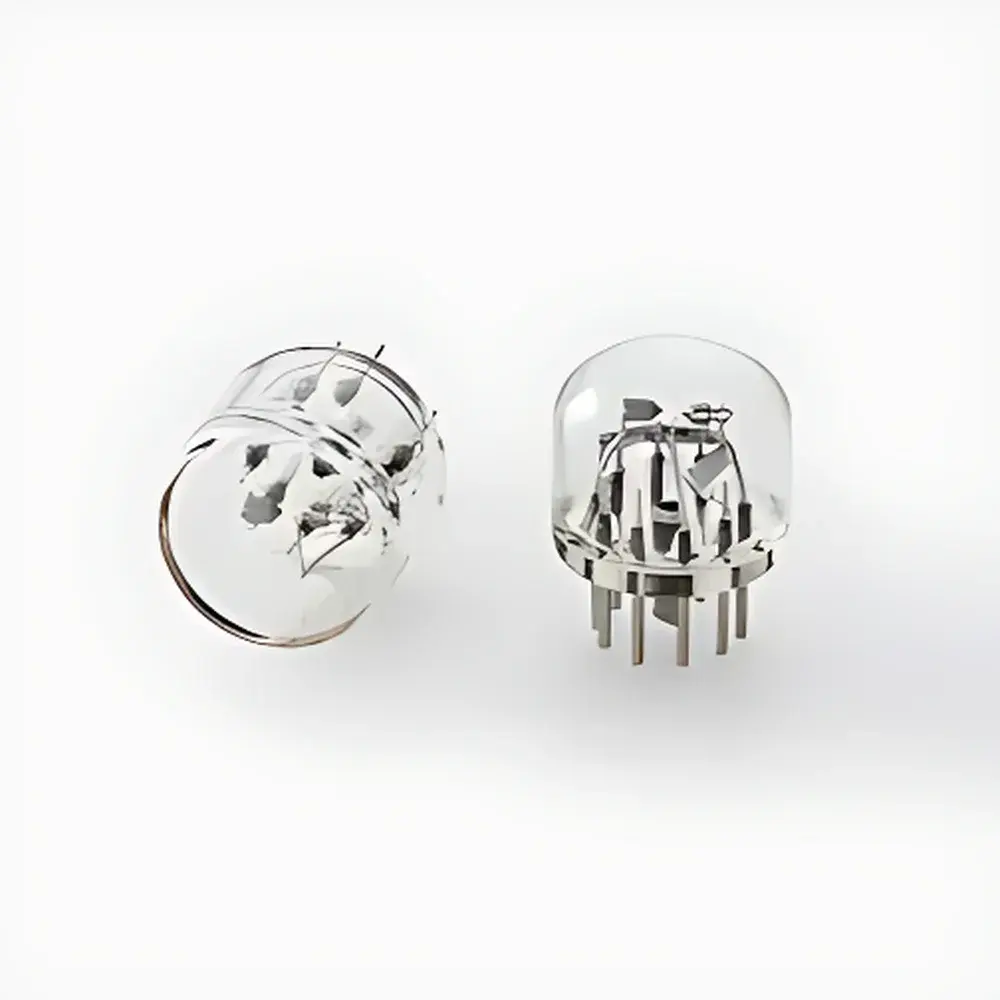
Hamamatsu L4640-L4647 Series 10 W Pulsed Xenon Flash Lamp Modules
| Brand | Hamamatsu |
|---|---|
| Origin | Japan |
| Manufacturer | Hamamatsu Photonics K.K. |
| Lamp Type | Pulsed Xenon Arc Lamp |
| Optical Window Options | Hemispherical or Flat Quartz (UV-Grade Fused Silica or Borosilicate) |
| Arc Size | 1.5 mm or 3.0 mm |
| Spectral Range | 185–2500 nm (L4640/L4642/L4644/L4646) / 240–2500 nm (L4641/L4643/L4645/L4647) |
| Operating Voltage Range | 300–1000 V (Recommended: 700–1000 V) |
| Max Pulse Energy | 100 mJ (at 0.2 µF, 1000 V) |
| Max Repetition Rate | 100 Hz |
| Max Average Power | 10 W (continuous operation) |
| Output Stability (CV) | ≤0.5% (typ.), ≤1.0% (guaranteed) |
| Output Stability (p-p) | ≤4.5% (typ.), ≤4.0% (guaranteed) |
| Lifetime | ≥1 × 10⁹ flashes (defined at 50% spectral irradiance decay in 190–1100 nm band under 1000 V / 0.2 µF / 100 Hz conditions) |
| Trigger Voltage | 5–7 kV p-p |
| Cooling | Passive (no forced cooling required) |
| Operating Temperature | +5 to +40 °C |
| Storage Temperature | −40 to +90 °C |
| Humidity (operating) | <85% RH (non-condensing) |
| Humidity (storage) | <95% RH (non-condensing) |
| Compatible Trigger Units | E2442, E2418 (sold separately) |
| Compatible Power Supplies | C13316-02, C13315 (sold separately) |
Overview
The Hamamatsu L4640–L4647 Series comprises a family of compact, high-reliability pulsed xenon flash lamp modules engineered for precision optical instrumentation requiring stable, broadband ultraviolet-to-near-infrared (UV–NIR) illumination. These 10 W average-power lamps operate on the principle of transient gas discharge—where high-voltage pulses ionize xenon gas within a sealed quartz envelope, generating intense, short-duration (typically sub-millisecond) broadband light bursts. Unlike continuous-wave (CW) sources, the pulsed architecture minimizes thermal load on optical components and enables precise temporal gating—critical for time-resolved spectroscopy, synchronous detection, and low-noise photometric measurements. Each model is optimized for specific spectral output profiles and mechanical integration requirements, with variants featuring either hemispherical or flat UV-grade fused silica or borosilicate windows—ensuring high transmission down to 185 nm where applicable. The lamps are designed for OEM integration into analytical platforms including spectrophotometers, HPLC detectors, MTP readers, and flow cytometry systems.
Key Features
- Stable pulsed output with ≤0.5% coefficient of variation (CV) and ≤4.5% peak-to-peak (p-p) fluctuation under standard operating conditions (1000 V, 0.2 µF, 100 Hz).
- Extended operational lifetime of ≥1 × 10⁹ flashes, validated per Hamamatsu’s standardized test protocol (190–1100 nm irradiance decay to 50% of initial value under defined electrical stress).
- Dual window configuration options: hemispherical (L4640/L4641/L4644/L4645) and flat (L4642/L4643/L4646/L4647), supporting both collimated and focused beam geometries.
- Two arc gap sizes (1.5 mm and 3.0 mm) enabling trade-offs between spatial coherence and radiant intensity—ideal for applications ranging from wide-field illumination to fiber-coupled excitation.
- UV-transmissive quartz envelope (UV-grade fused silica) ensures minimal absorption below 200 nm—supporting compliance with ASTM E275 and ISO 17025 methods requiring deep-UV source validation.
- No active cooling required; passive thermal management enables silent, maintenance-free operation in space-constrained enclosures.
- Compatible with industry-standard trigger units (E2442/E2418) and modular power supplies (C13316-02/C13315), facilitating seamless system-level qualification under IEC 61000-4 EMC standards.
Sample Compatibility & Compliance
These lamps are routinely deployed in regulated analytical environments where traceable performance and long-term reproducibility are mandatory. Their spectral stability and low temporal drift meet the baseline requirements for GLP-compliant UV-Vis absorbance quantification (e.g., USP , EP 2.2.25) and FDA 21 CFR Part 11–aligned instrument qualification protocols. The L4640/L4642/L4644/L4646 variants—with 185–2500 nm coverage—are suitable for ozone-free UV photochemistry, fluorescence excitation below 220 nm, and semiconductor wafer inspection. The L4641/L4643/L4645/L4647 series (240–2500 nm) offer enhanced visible/NIR throughput for colorimetric assays and NIR spectroscopy applications. All models conform to RoHS Directive 2011/65/EU and are manufactured in Hamamatsu’s ISO 9001–certified facilities in Japan.
Software & Data Management
While the lamp modules themselves are analog devices, their integration into automated platforms is supported via Hamamatsu’s standard interface documentation—including timing diagrams, trigger pulse specifications, and voltage tolerance envelopes. When paired with compatible power supplies (e.g., C13316-02), users can implement closed-loop energy monitoring using external photodiode feedback (e.g., S1336-8BQ) and log pulse-by-pulse irradiance data for audit trails. System-level software (e.g., LabVIEW drivers, Python SDKs for Hamamatsu’s DCU series controllers) enables synchronization with CCD/CMOS detectors, shutter control, and automated calibration routines compliant with ISO/IEC 17025 Clause 5.9 (traceability of measurement uncertainty).
Applications
- UV–Vis Spectrophotometry: Reference-grade broadband source for double-beam and diode-array instruments across pharmaceutical QC and environmental water analysis.
- HPLC Detection: High-stability excitation for post-column derivatization and native fluorescence detection in clinical chemistry analyzers.
- MTP Microplate Readers: Uniform illumination for absorbance, fluorescence, and luminescence assays in high-throughput screening (HTS) workflows.
- Flow Cytometry & Imaging Cytometry: Synchronized flash triggering for gated acquisition of cell populations in brightfield and fluorescent channels.
- Gas & Atmospheric Sensing: Multi-wavelength absorption spectroscopy (e.g., DOAS, TDLAS) leveraging broad spectral continuity from UV to NIR.
- Mineralogical & Gemological Analysis: Reflectance and fluorescence mapping in portable Raman and LIBS systems requiring flash-based excitation.
- In Vitro Diagnostics: Photometric quantification of enzymatic reactions (e.g., ALP, AST, ALT) in point-of-care blood/urine analyzers.
FAQ
What is the difference between hemispherical and flat-window lamp variants?
Hemispherical windows provide near-Lambertian emission useful for diffuse illumination and integrating sphere coupling. Flat windows enable tighter beam collimation and higher radiance when used with off-axis parabolic mirrors or fiber launch optics.
Can these lamps be operated continuously at 100 Hz?
Yes—provided the average power remains ≤10 W and thermal derating is observed in ambient temperatures >35 °C. For extended duty cycles, ensure adequate airflow around the lamp housing per Hamamatsu Technical Note TN-002.
Is spectral calibration data available for each lamp unit?
Hamamatsu provides batch-level spectral irradiance curves (190–2500 nm, ±0.5 nm resolution) with NIST-traceable reference lamps upon request for IQ/OQ documentation.
How is lifetime defined and verified?
Lifetime is measured as total flash count until integrated irradiance (190–1100 nm) decays to 50% of initial value under controlled electrical stress (1000 V, 0.2 µF, 100 Hz), per Hamamatsu Standard Test Method HTM-014.
Are replacement electrodes or re-gassing services offered?
No—these are hermetically sealed, non-serviceable modules. End-of-life units must be replaced as complete assemblies to maintain spectral integrity and safety certification.





