
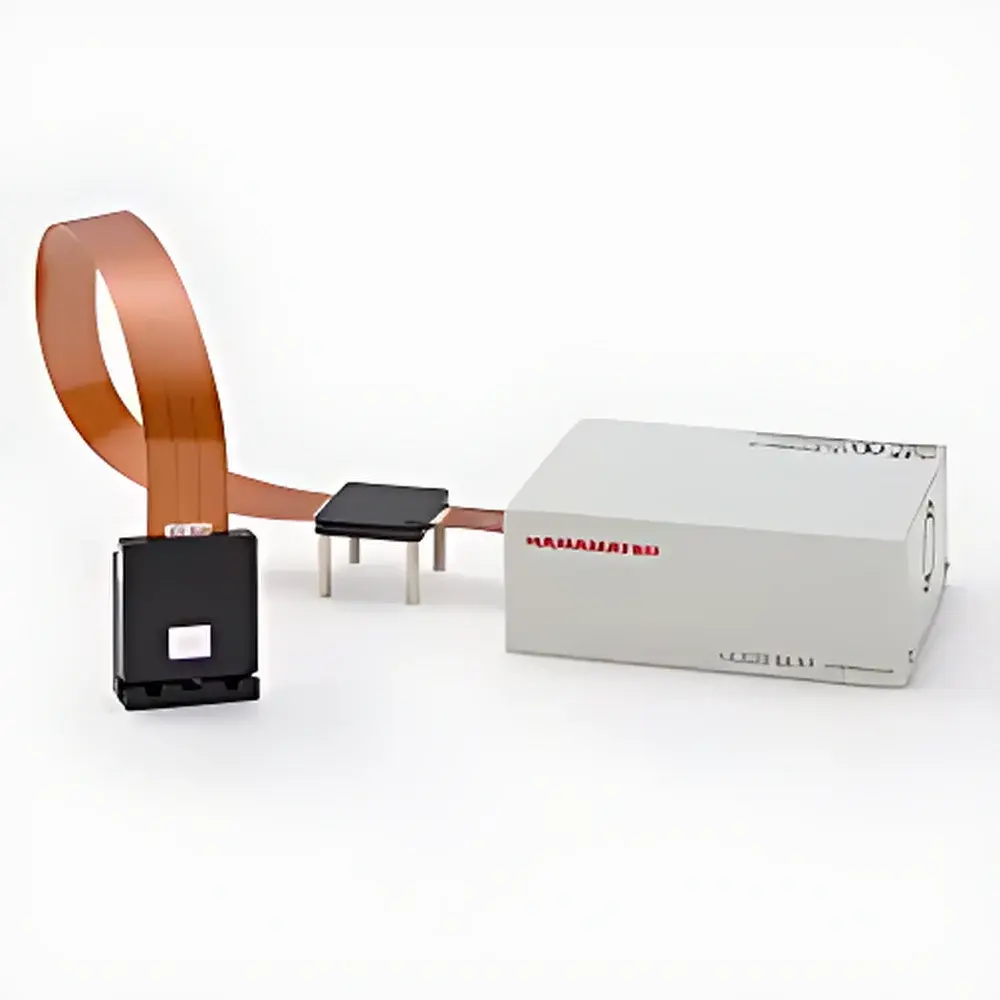
Hamamatsu LCOS-SLM (Spatial Light Modulator) X15213-07
| Brand | Hamamatsu |
|---|---|
| Origin | Japan |
| Manufacturer Type | Original Equipment Manufacturer (OEM) |
| Import Status | Imported |
| Model | X15213-07 |
| Pricing | Upon Request |
Overview
The Hamamatsu X15213-07 is a high-performance reflective-mode, pure-phase spatial light modulator (SLM) based on silicon-on-silicon liquid crystal on silicon (LCOS) technology. Engineered for precision wavefront control in advanced optical systems, it operates across a broad near-infrared to visible spectral range (620–1100 nm), with peak optical utilization efficiency measured at 82% at 1064 nm. Unlike transmissive SLMs or segmented deformable mirrors, the X15213-07 achieves continuous, analog phase modulation via direct voltage addressing of the nematic liquid crystal layer deposited on a CMOS backplane—enabling sub-wavelength wavefront correction, holographic beam shaping, adaptive optics compensation, and programmable diffraction grating synthesis. Its monolithic LCOS architecture ensures high pixel-to-pixel uniformity, minimal phase crosstalk, and robust thermal stability under sustained illumination—critical for applications demanding long-term repeatability in laser-based interferometry, quantum optics, and ultrafast pulse shaping.
Key Features
- Pure-phase modulation architecture with negligible amplitude coupling—optimized for high-fidelity wavefront engineering
- High optical utilization efficiency (82% @ 1064 nm), achieved through anti-reflection coatings, optimized LC alignment, and >96% pixel fill factor
- SXGA-resolution active array (1272 × 1024 pixels) with 12.5 µm pitch, delivering 40 lp/mm maximum spatial resolution over a 15.9 × 12.8 mm effective aperture
- DVI-D interface compatibility (60 Hz frame rate, 8-bit grayscale input) enables plug-and-play integration with standard industrial PCs—no proprietary frame grabbers or drivers required
- Fast electro-optic response: 10 ms rise time and 80 ms fall time, supporting dynamic phase pattern updates in quasi-real-time applications
- High-power handling capability—designed for continuous-wave and pulsed laser operation up to Class 4 intensity levels when used with appropriate beam conditioning and thermal management
- Onboard calibration support: factory-characterized nonlinearity and wavefront distortion maps are provided for software-based phase error correction using Hamamatsu’s SLM Control Software or third-party APIs (e.g., Python, MATLAB)
Sample Compatibility & Compliance
The X15213-07 is compatible with collimated free-space optical beams incident within ±12° angular tolerance relative to surface normal. It supports polarization-sensitive operation—optimal performance is achieved with linearly polarized input aligned to the device’s designated orientation axis (supplied in calibration documentation). The module complies with IEC 61000-6-3 (EMC emission standards) and IEC 60825-1:2014 (laser product safety classification) when integrated into end-user optical systems. While not certified as a standalone medical or aerospace component, its design adheres to ISO 9001-aligned manufacturing controls and traceable metrology protocols consistent with Hamamatsu’s OEM-grade quality assurance framework. No regulatory filings (e.g., FDA 510(k), CE marking as an independent instrument) apply, as the device is supplied as a component-level optical engine.
Software & Data Management
Control is implemented via DVI-D video signal input synchronized with USB-B 2.0 host communication for firmware configuration and real-time parameter adjustment. Hamamatsu provides a Windows-compatible SLM Control Suite that supports LUT-based phase map loading, gamma correction, temporal dithering, and hardware-triggered pattern sequencing. The software exports calibrated phase-response curves in HDF5 and CSV formats and supports scripting interfaces (COM/ActiveX, .NET DLL) for integration into LabVIEW, Python (via PyHamamatsu), or MATLAB environments. Audit-trail functionality—including timestamped phase map versioning, user login logging, and change history—is available when deployed under GLP/GMP-aligned laboratory information management systems (LIMS), though native 21 CFR Part 11 electronic signature compliance requires customer-side validation and system-level configuration.
Applications
- Adaptive optics in astronomy and ophthalmology—real-time correction of atmospheric turbulence or ocular aberrations
- Holographic optical trapping and structured illumination microscopy (SIM)
- Ultrafast laser pulse compression and spectral phase modulation in CPA and OPCPA systems
- Quantum information experiments requiring programmable multi-path interferometers or spatial mode sorters
- Optical testing: generation of Zernike-polynomial wavefronts for sensor calibration and null testing
- Industrial laser materials processing—dynamic beam splitting, focus steering, and multi-spot parallel drilling
FAQ
Is the X15213-07 suitable for use with femtosecond lasers?
Yes—when operated within specified average and peak power density limits and paired with appropriate dispersion-compensated optics, it supports phase-only modulation of ultrashort pulses without measurable group delay distortion.
Does Hamamatsu provide phase calibration data for custom wavelengths?
Factory calibration is performed at 633 nm, 780 nm, and 1064 nm. Custom wavelength characterization (e.g., 800 nm or 980 nm) can be requested as a value-added service subject to lead time and NDA terms.
Can multiple X15213-07 units be synchronized for multi-plane wavefront control?
Yes—external trigger input/output ports enable hardware-synchronized frame updates across up to four units with sub-millisecond jitter, supporting multi-conjugate adaptive optics configurations.
What is the recommended method for minimizing zero-order diffraction leakage?
Use of blazed hologram encoding algorithms (e.g., Gerchberg-Saxton with iterative Fourier filtering) combined with proper beam expansion to fully illuminate the active aperture minimizes residual zero-order intensity.
Is thermal drift compensated during extended operation?
The LCOS chip incorporates passive thermal stabilization; for applications requiring <0.02π rad/h phase stability, active temperature control of the mount (±0.1°C) is recommended and supported by Hamamatsu’s optional thermal management kit.




