
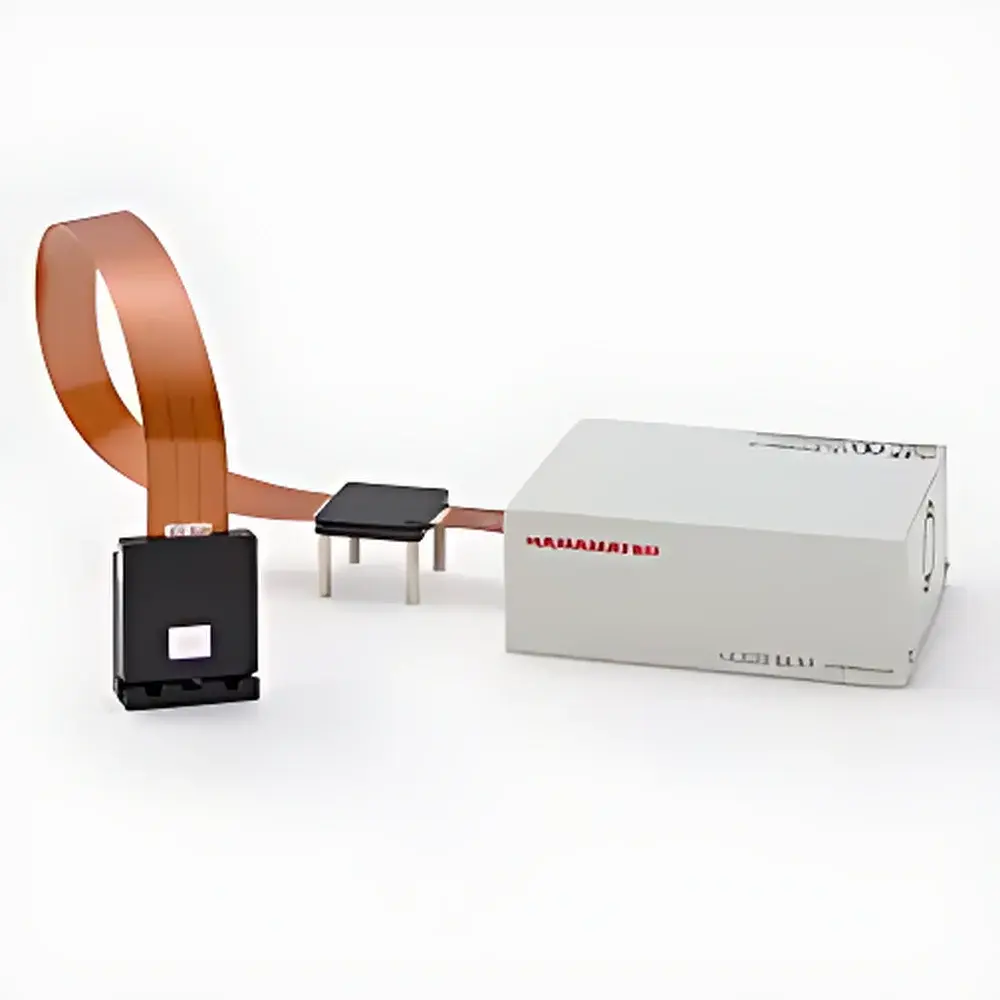
Hamamatsu LCOS-SLM X15213-03BR Reflective Pure-Phase Spatial Light Modulator
| Brand | Hamamatsu |
|---|---|
| Origin | Japan |
| Manufacturer | Hamamatsu Photonics K.K. |
| Type | Imported Optical Instrument Component |
| Model | X15213-03BR |
| Control Interface | DVI-D + USB-B (2.0 High-Speed) |
| Native Resolution | 1272 × 1024 pixels (SXGA) |
| Pixel Pitch | 12.5 µm |
| Active Area | 15.9 × 12.8 mm |
| Fill Factor | 96% |
| Operating Wavelength Range | 1000–1100 nm |
| Peak Optical Efficiency | 97% (at λ = 1064 nm) |
| Phase Modulation Depth | >2π (full 0–2π range) |
| Rise/Fall Time | 27 ms / 83 ms |
| DVI Frame Rate | 60 Hz |
| Input Gray Levels | 256 (8-bit) |
| Maximum Spatial Frequency | 40 lp/mm |
| Power Handling | High-power compatible (designed for pulsed and CW lasers up to 10 W/cm² average intensity, 1050 ± 50 nm) |
Overview
The Hamamatsu LCOS-SLM X15213-03BR is a high-performance reflective pure-phase spatial light modulator engineered for precision wavefront control in advanced optical systems. Based on silicon-on-insulator liquid crystal on silicon (LCOS) technology, it enables deterministic, voltage-driven phase modulation of incident light without amplitude interference—critical for applications requiring diffraction-limited beam shaping, adaptive optics correction, holographic optical trapping, and ultrafast pulse shaping. Unlike transmissive SLMs, its monolithic reflective architecture minimizes thermal lensing and absorption losses, making it especially suitable for high-average-power laser systems operating within the 1000–1100 nm spectral band—including Yb-doped fiber lasers (1030–1080 nm) and optical parametric amplifiers (OPAs). The device features a native SXGA resolution (1272 × 1024 pixels) with 12.5 µm pitch and 96% fill factor, delivering high spatial fidelity and minimal zero-order leakage due to optimized pixel geometry and anti-reflective coating design.
Key Features
- Pure-phase modulation architecture with negligible amplitude coupling—ensures high-fidelity wavefront reconstruction and minimal ghost diffraction orders.
- Optimized optical efficiency: 97% peak reflectivity at 1064 nm, achieved through broadband dielectric mirror stack and low-voltage LC alignment engineering.
- High power resilience: Designed for continuous-wave (CW) and nanosecond-pulsed laser exposure up to 10 W/cm² average intensity; compatible with Class 4 laser safety protocols when integrated into enclosed beam paths.
- Dual-interface control: DVI-D input for real-time phase pattern streaming at 60 Hz frame rate, supplemented by USB-B (2.0 High-Speed) for firmware updates, calibration loading, and non-real-time parameter configuration.
- On-board distortion compensation: Factory-characterized pixel-level nonlinearity and static wavefront aberrations (e.g., substrate flatness, LC director misalignment) are pre-measured and corrected via embedded LUT-based linearization routines.
- Thermally stable mechanical housing: Aluminum alloy chassis with passive heat dissipation ensures <±0.5 µm pixel position stability over 8-hour operation at ambient temperatures from 15–30 °C.
Sample Compatibility & Compliance
The X15213-03BR is designed for integration into ISO-standard optical benches (e.g., 30 mm or 60 mm rail systems) and supports standard kinematic mounting via M4 threaded holes. It complies with IEC 61000-6-3 (EMC emission limits) and IEC 61000-6-2 (immunity to electrostatic discharge and RF fields), ensuring robust operation in shared laboratory environments with RF-sensitive detectors or lock-in amplifiers. While not certified as a medical device, its phase linearity and repeatability meet requirements for research-grade adaptive optics systems referenced in ISO 10110-5 (optical component surface form tolerances) and ASTM E2844 (standard guide for wavefront sensing in optical testing). Calibration data—including measured point-spread function (PSF) maps, phase response curves, and polarization-dependent loss (PDL) profiles—is provided with each unit for traceable system characterization.
Software & Data Management
Hamamatsu provides the proprietary SLM Controller Software Suite (v3.2+), a Windows-based application supporting real-time phase pattern generation using Zernike polynomials, Gerchberg-Saxton algorithms, and user-defined complex field synthesis. All phase maps are stored in IEEE 754-compliant 32-bit floating-point format (.slm binary or .tif export), enabling interoperability with MATLAB, Python (via NumPy-compatible loaders), and LabVIEW. Audit trails—including timestamped pattern uploads, firmware version logs, and thermal sensor readouts—are retained locally and exportable in CSV format to support GLP/GMP-aligned experimental documentation. The software enforces strict access control (role-based login) and supports 21 CFR Part 11-compliant electronic signatures when deployed on validated networked workstations.
Applications
- Adaptive optics for multiphoton microscopy: Real-time correction of sample-induced aberrations in deep-tissue imaging (e.g., cortical neuron imaging at 1040 nm).
- Holographic optical tweezers: Simultaneous manipulation of >100 microspheres with sub-nanometer positioning stability via iterative Gerchberg-Saxton optimization.
- Ultrafast pulse compression and shaping: Spectral phase modulation in 4f pulse shapers for carrier-envelope phase stabilization in few-cycle Ti:sapphire and Yb:fiber amplifier systems.
- Quantum optics experiments: Generation of structured photon states (e.g., orbital angular momentum modes, Bessel beams) for quantum communication and entanglement distribution protocols.
- Laser material processing: Dynamic beam homogenization and focus steering in selective laser melting (SLM) additive manufacturing systems operating near 1070 nm.
FAQ
What is the maximum allowable laser fluence for pulsed operation?
For nanosecond pulses (10–100 ns) at 1064 nm, the damage threshold is specified at ≤0.5 J/cm² per pulse. For picosecond or femtosecond pulses, consult Hamamatsu’s Application Note AN-X15213-PS for temporal scaling guidelines.
Can the device be used with polarized input light?
Yes—the X15213-03BR requires linearly polarized input aligned to the LC director orientation (supplied in datasheet); optimal performance is achieved with p-polarized light at the design wavelength.
Is remote triggering supported for synchronized pattern updates?
No hardware TTL trigger input is provided; however, precise synchronization is achievable via DVI frame-locking with external timing generators using Genlock-capable graphics cards.
How often does recalibration require verification?
Factory calibration remains valid for 24 months under normal lab conditions; annual verification using Hamamatsu’s SLM-QC test pattern set is recommended for ISO/IEC 17025-accredited facilities.
Does the USB interface support real-time phase update?
USB-B is reserved for configuration and calibration only; all real-time phase modulation occurs exclusively over the DVI-D path at 60 Hz native refresh rate.




