
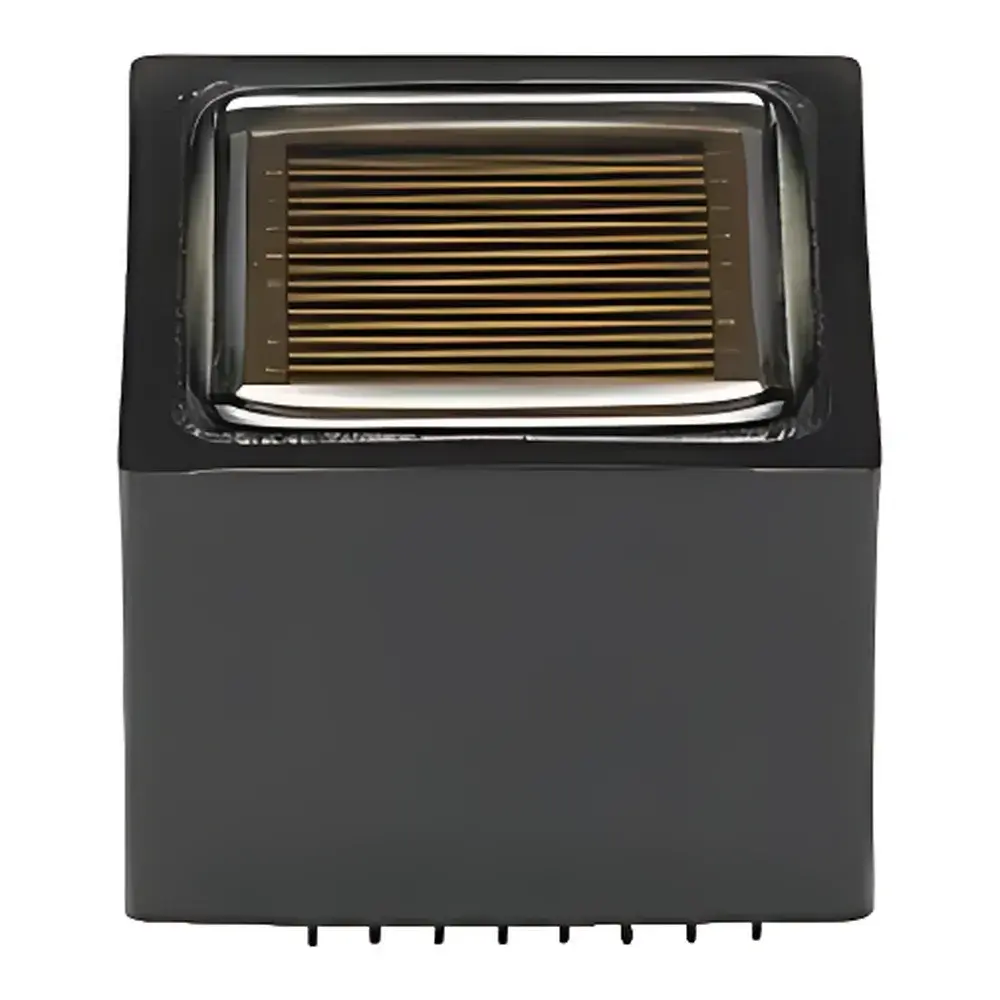
Hamamatsu Metal-Encapsulated Photomultiplier Tube (PMT) R5 Series
| Brand | Hamamatsu |
|---|---|
| Origin | Japan |
| Manufacturer | Hamamatsu Photonics K.K. |
| Type | Imported OEM Component |
| Model | R5 Series |
| Pricing | Available Upon Request |
Overview
The Hamamatsu R5 Series metal-encapsulated photomultiplier tube (PMT) is a high-performance, vacuum-sealed electron multiplier device engineered for ultra-low-light detection in demanding scientific and industrial instrumentation. Operating on the principle of secondary electron emission via a dynode chain under high-voltage bias (typically −800 V to −1500 V), the R5 series delivers exceptional signal-to-noise ratio, sub-nanosecond time response, and stable gain over extended operational lifetimes. Its hermetically sealed metal housing—constructed from Kovar or stainless steel with integrated ceramic feedthroughs—provides superior mechanical rigidity, electromagnetic shielding, and resistance to humidity and outgassing compared to glass-envelope counterparts. This architecture ensures long-term stability in vacuum-compatible environments and compatibility with bake-out procedures common in ultra-high-vacuum (UHV) spectroscopy systems and particle physics detectors. Designed and manufactured in Japan by Hamamatsu Photonics K.K., the R5 series complies with JIS C 5403 and IEC 60529 (IP54 equivalent for base-mounted configurations), supporting integration into ISO/IEC 17025-accredited analytical platforms.
Key Features
- Metal-ceramic hermetic construction for enhanced vacuum integrity and thermal stability
- Optimized dynode geometry (linear-focused or box-and-grid) enabling high collection efficiency (>85%) and pulse linearity up to 10⁶ cps
- Low dark current: typically <1 nA at 25 °C and rated voltage (model-dependent)
- High quantum efficiency (QE) across UV–NIR spectrum, with selectable photocathode materials including bialkali (Sb-Rb-Cs), multialkali (Na-K-Sb-Cs), GaAs, and solar-blind Cs-Te
- Fast rise time: 0.7–2.5 ns (depending on cathode type and gain setting)
- Timing jitter < 300 ps FWHM for time-correlated single-photon counting (TCSPC) applications
- Standard 10-pin or 14-pin base configuration compliant with ANSI C118.10 and IEC 60068-2 environmental testing protocols
Sample Compatibility & Compliance
The R5 series supports direct coupling to scintillators (e.g., NaI(Tl), LYSO, plastic), optical fibers (with tapered or lens-coupled interfaces), and monochromator exit slits in UV-Vis-NIR spectrophotometers. It is routinely deployed in ASTM E1782-compliant residual gas analyzers, ISO 15197-2013-certified blood glucose monitoring reference systems, and USP compliant fluorescence detection modules. The metal envelope meets RoHS Directive 2011/65/EU and REACH Annex XIV restrictions. All R5 variants undergo 100% burn-in and gain uniformity screening per Hamamatsu’s internal QM-1200 quality standard, ensuring batch-to-batch reproducibility required for GLP/GMP-regulated clinical chemistry analyzers and environmental emission monitors.
Software & Data Management
While the R5 PMT itself is an analog detector requiring external high-voltage supply and signal conditioning, it integrates seamlessly with industry-standard data acquisition ecosystems. Compatible HV controllers include Hamamatsu C11204-series and CAEN DT55xx modules, both supporting IEEE 11073-10201 (PHD) and Modbus TCP for remote voltage ramping and temperature compensation. Output signals interface directly with digitizers conforming to PXI Express Gen3 (e.g., Keysight M9703A) or USB-based oscilloscopes (Tektronix MSO5 Series), enabling real-time pulse height analysis (PHA) and time-of-flight (TOF) histogramming. Firmware-validated drivers are available for LabVIEW 2022 SP1, MATLAB R2023a Data Acquisition Toolbox, and Python (PyVISA + NumPy), supporting automated calibration traceability per ISO/IEC 17025 Clause 6.5.2.
Applications
- Fluorescence and phosphorescence lifetime spectroscopy in life science research
- Cherenkov radiation detection in neutrino observatories (e.g., Super-Kamiokande upgrade modules)
- Trace-level elemental analysis via inductively coupled plasma optical emission spectrometry (ICP-OES)
- Real-time plasma process monitoring in semiconductor etch chambers (OES endpoint detection)
- Laser-induced breakdown spectroscopy (LIBS) for soil and alloy composition mapping
- Positron emission tomography (PET) detector readout in preclinical imaging systems
- Radiation dosimetry and contamination survey instruments compliant with IEC 60846-1:2014
- Confocal laser scanning microscopy (CLSM) with spectral unmixing capability
FAQ
What is the typical operating voltage range for the R5 series?
Rated high-voltage supply ranges from −800 V to −1500 V DC, depending on dynode structure and desired gain; precise values are specified in the individual model’s datasheet (e.g., R5507-20: −1000 V nominal).
Can the R5 PMT be used in ultra-high-vacuum environments?
Yes—the metal-ceramic package is rated for continuous operation at pressures ≤1×10⁻⁷ Pa and withstands bake-out temperatures up to 250 °C for 24 hours without performance degradation.
Is spectral response data traceable to NIST standards?
Quantum efficiency curves are calibrated against NIST-traceable tungsten ribbon lamps (SRM 2021, SRM 2030) per Hamamatsu’s ISO/IEC 17025-accredited calibration laboratory (Registration No. APAC ILAC-MRA A001020).
Does Hamamatsu provide aging data for long-term gain stability?
Accelerated life testing reports (per MIL-STD-883H Method 1005.10) document gain drift <±3% over 10,000 hours at 20 °C and rated voltage, included with each production lot certificate.
Are custom pinouts or magnetic shielding options available?
Yes—Hamamatsu offers OEM customization including mu-metal shielding (R5xxx-MAG), non-standard bases (e.g., 20-pin D-sub), and hermetic fiber-optic feedthrough integration under NDA-supported design transfer agreements.
Related Products





