
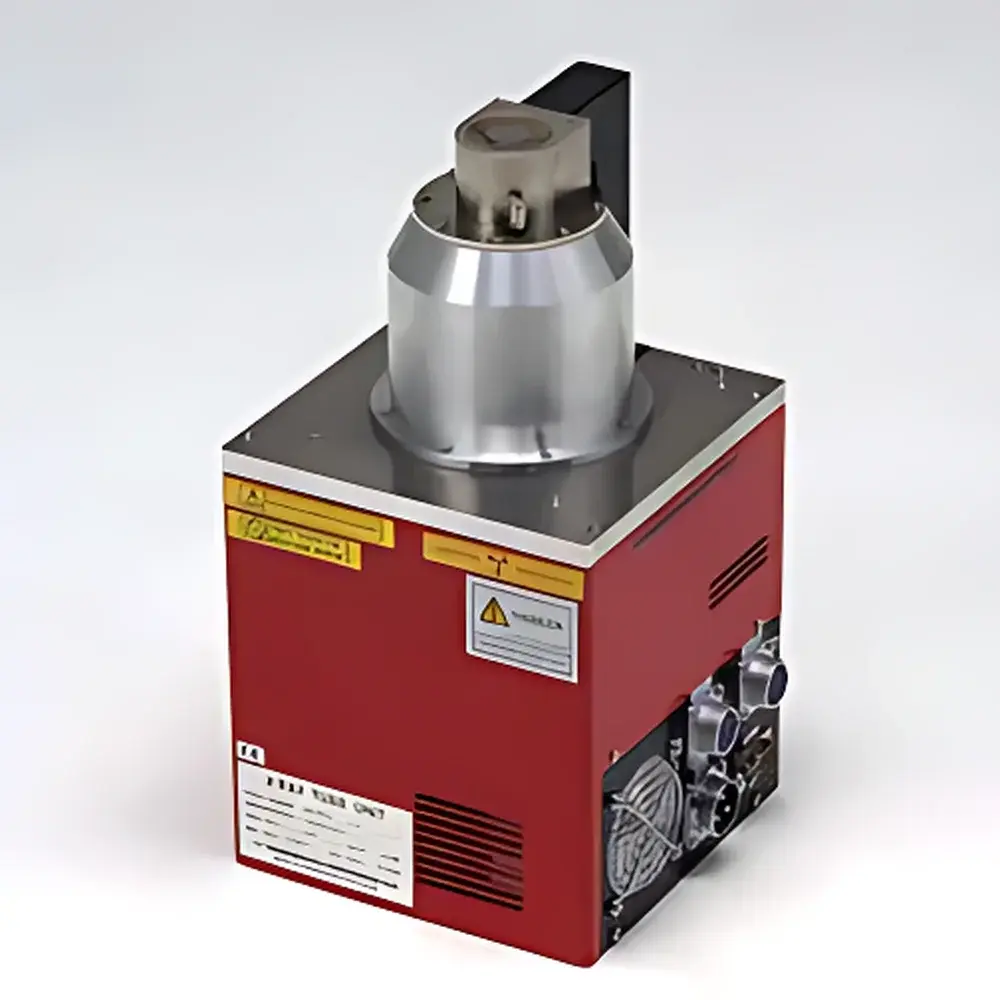
Hamamatsu Microfocus X-ray Source L9181-05
| Brand | Hamamatsu |
|---|---|
| Origin | Japan |
| Manufacturer Type | Original Equipment Manufacturer (OEM) |
| Product Category | Imported |
| Model | L9181-05 |
| Price | Upon Request |
| Tube Voltage Range | 40–130 kV |
| Maximum Output Power | 39 W |
| Focal Spot Size | 16–50 µm |
| X-ray Beam Cone Angle | 100° |
| Focus-to-Object Distance (FOD) | 13 mm |
| Tube Type | Sealed Transmission Target |
| Control Interface | RS-232C |
| Application | Non-Destructive Testing (NDT), X-ray Computed Tomography (CT) |
Overview
The Hamamatsu Microfocus X-ray Source L9181-05 is a high-performance, sealed transmission-type microfocus X-ray generator engineered for precision non-destructive evaluation (NDE) and laboratory-scale X-ray computed tomography (CT). Unlike conventional broad-beam or macrofocus sources, the L9181-05 employs electron-beam focusing onto a transmission target to generate a stable, high-brightness X-ray beam with a focal spot size controllable between 16 µm and 50 µm—enabling sub-micron spatial resolution in projection radiography and high-fidelity volumetric reconstruction in CT. Its defining optical characteristic is a wide 100° cone-angle beam geometry, which significantly increases field-of-view coverage per projection compared to standard configurations (e.g., the L9181-02 with 45° cone angle), thereby reducing scan time and improving throughput in multi-angle acquisition workflows. Operating at tube voltages from 40 kV to 130 kV and delivering up to 39 W of continuous output power, the source maintains thermal stability and long-term emission reproducibility—critical for quantitative density mapping and dimensional metrology applications.
Key Features
- Microfocus performance with adjustable focal spot size (16–50 µm), optimized for high-resolution imaging and phase-contrast compatibility
- 100° conical X-ray beam geometry—enables large-area illumination without mechanical repositioning or beam collimation loss
- Sealed transmission-target architecture eliminates need for external high-voltage cabling; simplifies system integration and improves electrical safety compliance
- RS-232C digital interface supports remote parameter control (kV, mA, exposure timing) and real-time status monitoring—compatible with custom LabVIEW, Python, or C++ acquisition frameworks
- Fixed focus-to-object distance (FOD) of 13 mm—designed for close-coupled detector configurations common in benchtop CT systems and inline inspection platforms
- Robust thermal management ensures stable output over extended duty cycles, meeting requirements for GLP-compliant serial scanning protocols
Sample Compatibility & Compliance
The L9181-05 is routinely deployed in industrial and academic laboratories for inspecting heterogeneous samples where material contrast and geometric fidelity are essential. It accommodates electronic assemblies (e.g., BGA solder joints, wire bonds), printed circuit boards (PCBs) with embedded vias and flex substrates, polymer-based components (including fiber-reinforced composites), and small metallic parts (e.g., turbine blades, additive-manufactured alloys). Its 130 kV maximum voltage provides sufficient penetration for aluminum alloys up to ~25 mm and stainless steel up to ~8 mm, while maintaining adequate signal-to-noise ratio at low-dose exposures. The device complies with IEC 61000-6-3 (EMC emission standards) and IEC 61000-6-2 (immunity), and its sealed construction satisfies ISO 9001 manufacturing traceability requirements. When integrated into automated inspection systems, it supports audit-ready operation under FDA 21 CFR Part 11 when paired with compliant software platforms featuring electronic signatures and immutable audit trails.
Software & Data Management
While the L9181-05 operates as a hardware component rather than a standalone instrument, its RS-232C interface enables seamless integration with third-party CT reconstruction suites (e.g., Octopus, VGStudio MAX, Dragonfly) and open-source frameworks (e.g., TomoPy, ASTRA Toolbox). Users may script synchronized control of tube voltage, current, and exposure duration alongside motorized rotation stages and flat-panel detector triggers—ensuring strict temporal alignment required for artifact-free reconstruction. All operational parameters—including cumulative exposure time, average kV/mA settings, and thermal history—are loggable via serial polling. For regulated environments, integration with LIMS or MES platforms is achievable using OPC UA or MQTT gateways, supporting full traceability of imaging conditions per sample ID in accordance with ISO/IEC 17025 documentation practices.
Applications
- High-resolution X-ray CT of miniature electronics for void detection, delamination analysis, and solder joint integrity assessment
- Benchtop metrology of additively manufactured metal parts—measuring internal porosity distribution, wall thickness uniformity, and lattice structure fidelity
- Non-destructive failure analysis (NDA) of encapsulated MEMS devices and hermetically sealed sensors
- Quality assurance of plastic injection-molded housings—identifying weld lines, sink marks, and embedded contaminants
- Preclinical small-animal imaging support (with appropriate shielding and dose calibration) in longitudinal studies requiring repeatable projection geometry
FAQ
What is the minimum detectable feature size achievable with the L9181-05 in CT mode?
Feature resolution depends on geometric magnification, detector pixel pitch, and reconstruction algorithm—but with optimal FOD/detector distance configuration and 16 µm focal spot, sub-20 µm structures can be resolved in high-SNR acquisitions.
Can the L9181-05 be operated continuously at maximum power (39 W)?
Yes, provided ambient temperature remains ≤25°C and airflow meets Hamamatsu’s specified cooling requirements (≥1.5 m/s across heatsink surface); derating is recommended above 30°C ambient.
Is radiation shielding included with the L9181-05?
No—shielding must be designed and validated separately per local regulatory authority (e.g., NRC, HSE, BfS) based on installed kV, workload, and occupancy factors.
Does Hamamatsu provide SDKs or driver libraries for RS-232C integration?
Yes—Hamamatsu supplies a documented ASCII command protocol manual and reference C code examples for Linux and Windows environments upon request under NDA.
How does the 100° beam angle affect CT reconstruction fidelity compared to narrower cones?
Wider cone angles introduce increased cone-beam artifacts (e.g., circle artifacts, z-distortion), necessitating use of Feldkamp-Davis-Kress (FDK) or iterative reconstruction algorithms with accurate system geometry calibration.
Related Products




