
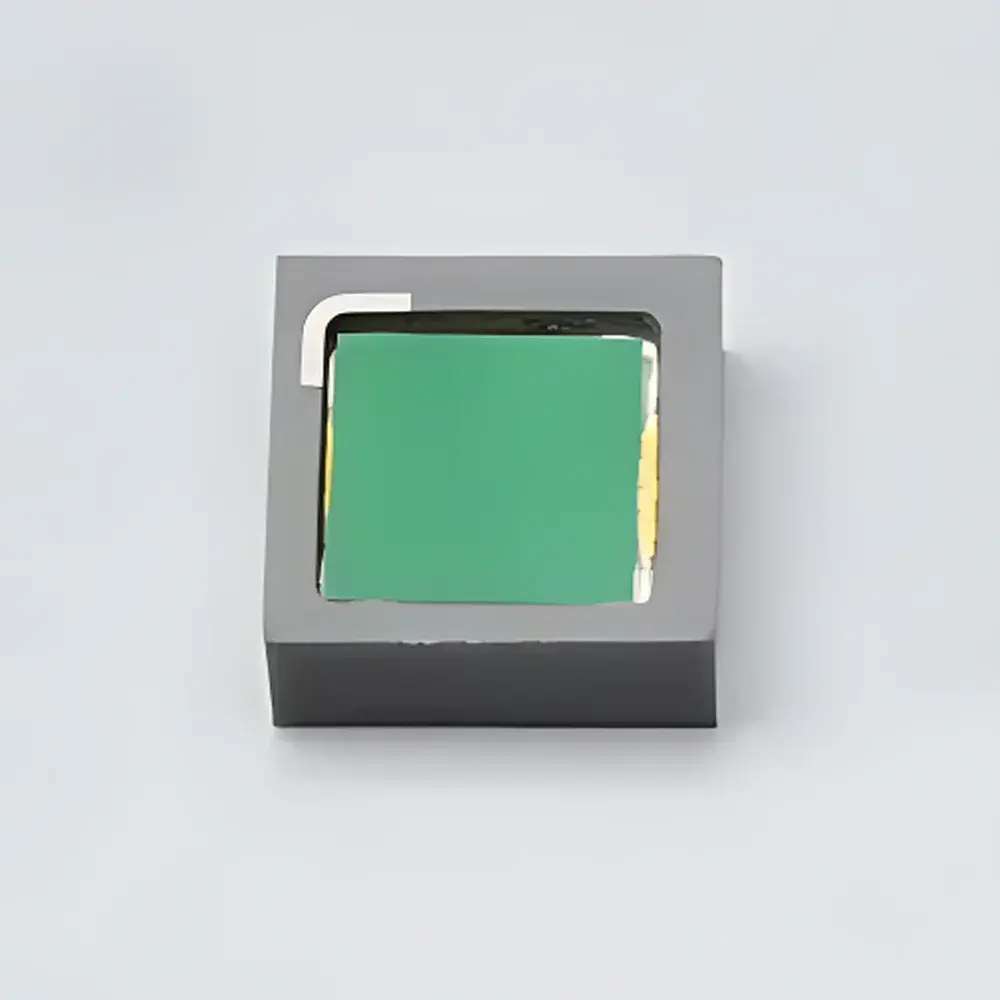
Hamamatsu Mid-Infrared LED L13454-0390C
| Brand | Hamamatsu |
|---|---|
| Origin | Japan |
| Manufacturer Type | Original Equipment Manufacturer (OEM) |
| Product Category | Imported |
| Model | L13454-0390C |
| Light Source Type | Mid-Infrared LED |
| Illumination Mode | External Illumination |
| Package | Ceramic, Surface-Mount Device (SMD) |
| Peak Emission Wavelength (min) | 3800 nm |
| Peak Emission Wavelength (typ.) | 3900 nm |
| Peak Emission Wavelength (max) | 4100 nm |
| Spectral FWHM (typ.) | 500 nm |
| Radiant Flux (typ.) | 0.2 mW |
| Forward Voltage (typ.) | 1.7 V |
| Test Condition | Ta = 25 °C, unless otherwise specified |
Overview
The Hamamatsu Mid-Infrared LED L13454-0390C is a high-performance, surface-mount ceramic-packaged light-emitting diode engineered for stable and repeatable emission in the mid-infrared spectral region. Operating on electroluminescence principles in III–V semiconductor heterostructures, this device delivers broadband thermal-like emission centered at 3900 nm with a full-width-at-half-maximum (FWHM) of approximately 500 nm—enabling coverage from ~3.8 µm to ~4.3 µm. Unlike thermal sources such as globars or silicon carbide rods, the L13454-0390C offers microsecond-scale modulation capability, eliminating thermal inertia limitations and supporting time-resolved spectroscopic applications including lock-in detection, gas-phase absorption monitoring, and non-dispersive infrared (NDIR) sensing. Its hermetically sealed ceramic SMD package ensures long-term stability under controlled ambient conditions and compatibility with automated PCB assembly processes.
Key Features
- Mid-infrared emission optimized for molecular vibrational absorption bands—particularly relevant for C–H, O–H, and N–H stretching modes in organic compounds and gases.
- Surface-mount ceramic packaging providing mechanical robustness, low thermal resistance, and high moisture resistance—critical for reliability in laboratory and embedded instrumentation environments.
- Fast electrical-to-optical response time (< 1 µs rise/fall), enabling pulse-width modulation (PWM), synchronous detection, and real-time intensity control without thermal lag.
- High radiometric reproducibility across production lots, supported by Hamamatsu’s wafer-level calibration and binning protocols traceable to NMI-Japan standards.
- No moving parts or fragile filaments; inherently immune to mechanical shock and vibration—ideal for portable or field-deployable optical systems.
Sample Compatibility & Compliance
The L13454-0390C is designed for integration into optical benches, custom spectrometer modules, and OEM gas analyzers requiring a compact, solid-state IR source. It complies with JEDEC J-STD-020D moisture sensitivity level (MSL) 3 specifications and RoHS Directive 2011/65/EU. While not certified for medical or explosion-proof use, its performance characteristics align with common requirements in analytical instrumentation governed by ISO/IEC 17025-compliant laboratories. For regulatory traceability, Hamamatsu provides lot-specific photometric test reports—including radiant flux, peak wavelength, and spectral shape—validating conformance to datasheet specifications under defined thermal and drive-current conditions.
Software & Data Management
As a passive optical component, the L13454-0390C does not incorporate onboard firmware or digital interfaces. However, it is fully compatible with industry-standard current drivers (e.g., Thorlabs LDCxx series, Keithley 2450 SMU) and temperature controllers (e.g., Lakeshore 336). When integrated into larger systems, its output can be synchronized with data acquisition hardware (NI PXI, Keysight DAQ) for time-stamped spectral acquisition. Users implementing GLP/GMP workflows may log operational parameters—including forward current, heatsink temperature, and accumulated operating hours—using external SCADA or LabVIEW-based monitoring frameworks. No FDA 21 CFR Part 11 compliance is applicable, as the device itself performs no data processing or storage.
Applications
- Non-dispersive infrared (NDIR) gas sensing for CO₂, CH₄, NH₃, and hydrocarbon vapors in environmental monitoring and industrial safety systems.
- Benchtop Fourier-transform infrared (FTIR) auxiliary sources for background normalization or reference path illumination.
- Calibration references in mid-IR photodetector characterization setups (e.g., HgCdTe, InSb, or thermopile responsivity mapping).
- Optical coherence tomography (OCT) system development targeting deeper tissue penetration in the 3–5 µm atmospheric window.
- Educational platforms demonstrating IR optics principles, including absorption spectroscopy, emissivity measurement, and thermal radiation modeling.
FAQ
What is the recommended drive current range for stable operation?
Hamamatsu specifies a maximum continuous forward current of 100 mA at Ta = 25 °C. For optimal lifetime and spectral stability, operation between 30–70 mA is advised, with active thermal management maintaining case temperature below 60 °C.
Can this LED be used in vacuum or inert-gas environments?
Yes—the ceramic SMD package is hermetically sealed and rated for operation in dry nitrogen or vacuum conditions up to 10⁻³ Pa, provided condensation and thermal cycling are controlled.
Is there a spectral calibration certificate available?
Each production lot undergoes spectral characterization; calibrated spectral radiance data (in W·sr⁻¹·nm⁻¹) can be requested directly from Hamamatsu upon order placement, subject to NDA and traceability documentation requirements.
How does temperature affect peak wavelength and output power?
Peak wavelength exhibits a redshift of ~0.3 nm/°C, while radiant flux decreases by ~0.5% per °C above 25 °C—necessitating thermal stabilization for quantitative spectroscopic applications.
What optical coupling options are recommended for collimation?
A reflective off-axis parabolic mirror (f = 15 mm, gold-coated) or molded chalcogenide glass aspheric lens (e.g., AMTIR-1, NA = 0.5) provides optimal throughput and minimal chromatic aberration across the 3.8–4.3 µm band.



