
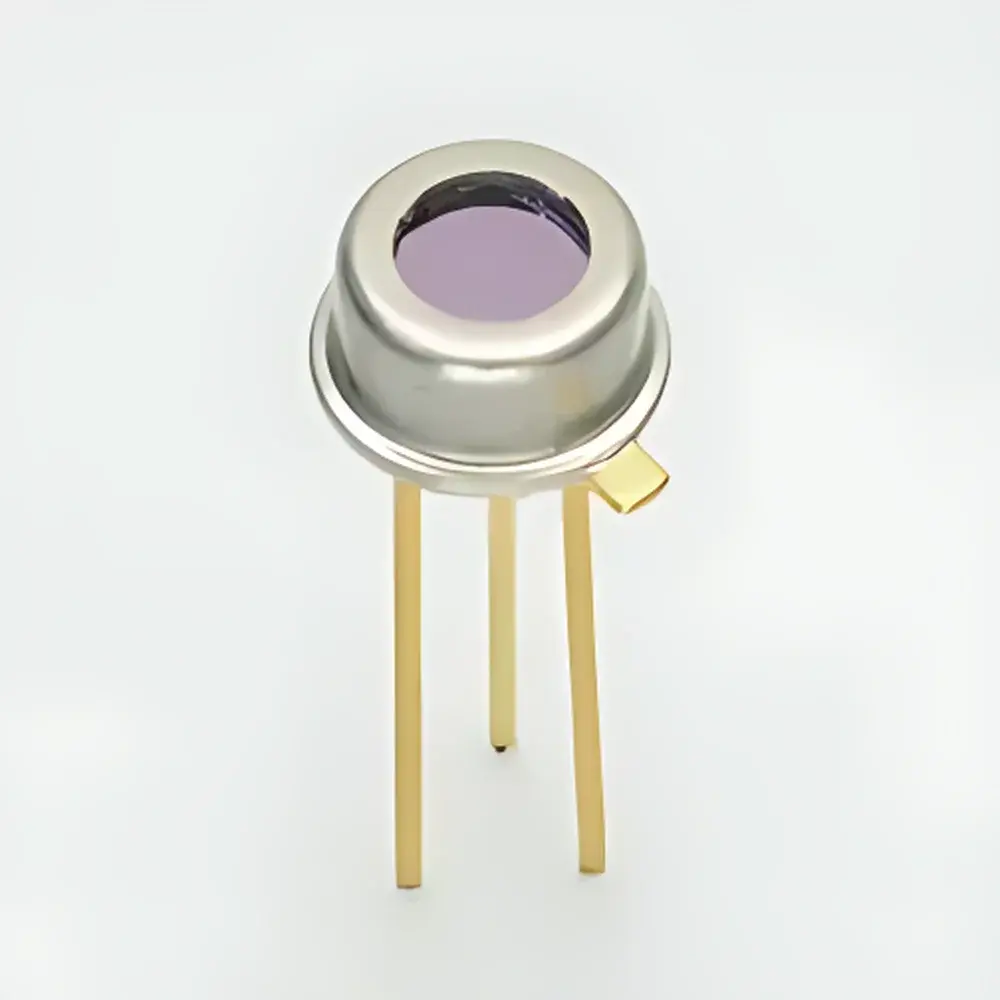
Hamamatsu Mid-Infrared LED L13454-0390M
| Brand | Hamamatsu |
|---|---|
| Origin | Japan |
| Manufacturer Type | Original Equipment Manufacturer (OEM) |
| Product Category | Imported |
| Model | L13454-0390M |
| Light Source Type | Mid-Infrared LED |
| Emission Peak Wavelength | 3.9 µm |
| Illumination Mode | External Illumination |
| Operating Temperature Range | –40 °C to +85 °C (case temperature) |
| Spectral Bandwidth (FWHM) | ~200 nm |
| Output Power | Up to 1.2 mW (typ. at 100 mA DC drive) |
| Rise/Fall Time | <100 ns |
| Package Type | TO-39 metal can with AR-coated ZnSe window |
Overview
The Hamamatsu Mid-Infrared LED L13454-0390M is a high-performance, solid-state light source engineered for precision mid-infrared (MIR) spectroscopic applications requiring stable, narrowband emission centered at 3.9 µm. Unlike thermal emitters or quantum cascade lasers (QCLs), this device leverages Hamamatsu’s proprietary epitaxial growth and chip fabrication processes on lattice-matched InAsSb-based heterostructures to achieve efficient electroluminescence in the critical 3–4 µm atmospheric transmission window. Its emission profile—characterized by a full-width-at-half-maximum (FWHM) of approximately 200 nm—aligns closely with fundamental vibrational absorption bands of key industrial and environmental gases, including CO, CO₂, CH₄, NO, and N₂O. Designed for integration into compact, low-power gas sensing platforms, the L13454-0390M operates under continuous-wave (CW) or pulsed bias conditions and exhibits exceptional thermal stability and long-term radiometric consistency—critical attributes for field-deployable optical gas analyzers and laboratory-grade FTIR reference sources.
Key Features
- High radiant output power: up to 1.2 mW (typical at 100 mA DC drive), enabling improved signal-to-noise ratio in photodetector-coupled configurations
- Ultrafast temporal response: rise and fall times under 100 ns, supporting time-resolved absorption measurements and high-frequency modulation schemes (e.g., wavelength modulation spectroscopy)
- Robust hermetic TO-39 metal package with anti-reflection (AR)-coated ZnSe output window, optimized for >90% transmittance across 3.5–4.2 µm
- Stable spectral centroid: peak wavelength shift < ±0.1 nm/°C over operational temperature range (–40 °C to +85 °C case temperature)
- Low thermal resistance package design facilitating passive or active thermal management in embedded systems
- Compliant with JEDEC J-STD-020 moisture sensitivity level (MSL) 3, ensuring reliability during reflow soldering and long-term storage
Sample Compatibility & Compliance
The L13454-0390M is compatible with standard photonic integration workflows, including free-space collimation using off-axis parabolic mirrors and fiber coupling via mid-IR-transmitting fibers (e.g., fluoride or chalcogenide). It meets RoHS Directive 2011/65/EU and REACH Regulation (EC) No. 1907/2006 requirements. While not intrinsically certified for hazardous locations, its low-voltage operation (< 1.2 V forward voltage) and absence of hazardous emissions support Class I, Division 2 (CID2) system-level certification when integrated into appropriately designed enclosures per UL 60079-0 and IEC 60079-15. The device conforms to ISO 9001:2015 manufacturing controls and undergoes 100% burn-in testing and spectral binning prior to shipment.
Software & Data Management
As a component-level emitter, the L13454-0390M does not include embedded firmware or native software drivers. However, it is routinely interfaced with industry-standard current drivers (e.g., Thorlabs LDCxx series, Wavelength Electronics QCL series) supporting analog modulation, TTL triggering, and USB/RS-232 programmability. When deployed in automated gas analyzers, its intensity and timing parameters are managed within host instrument control software compliant with IEEE 11073-10201 (medical device communication) or OPC UA (industrial automation) frameworks. Full spectral calibration data—including normalized relative intensity vs. wavelength curves and temperature-dependent drift coefficients—is provided in NIST-traceable CSV format with each production lot.
Applications
- Non-dispersive infrared (NDIR) gas sensors for industrial safety monitoring and environmental emission compliance (e.g., EPA Method 21, EN 14181)
- Portable and drone-mounted methane leak detection systems operating in the 3.3–3.5 µm C–H stretch region
- Reference sources in dual-beam Fourier-transform infrared (FTIR) spectrometers for baseline correction and detector linearity verification
- Calibration targets for uncooled microbolometer arrays used in thermal imaging systems
- Research-grade excitation sources in pump-probe spectroscopy of molecular monolayers on catalytic surfaces
- Optical coherence tomography (OCT) systems targeting deeper tissue penetration in the mid-IR biological window (3–5 µm)
FAQ
What is the recommended drive current range for optimal lifetime and output stability?
Hamamatsu specifies 50–120 mA DC for continuous operation; sustained operation above 100 mA requires active heatsinking to maintain junction temperature below 60 °C.
Can the L13454-0390M be modulated at kHz frequencies without spectral distortion?
Yes—its sub-100 ns switching speed supports square-wave modulation up to 5 MHz; however, driver impedance matching and parasitic inductance minimization are essential to preserve waveform fidelity.
Is the ZnSe window hermetically sealed against humidity ingress?
Yes—the TO-39 package employs a welded metal lid and glass-to-metal seal, achieving internal dew point < –40 °C per MIL-STD-883 Method 1004.7.
Does Hamamatsu provide spectral calibration certificates with traceability to NIST standards?
Yes—each shipment includes a factory-measured spectral radiance curve, referenced to a calibrated blackbody source traceable to NIST SRM 2252.
What is the typical failure mode under accelerated life testing?
Failure analysis per Telcordia GR-468-CORE indicates gradual output degradation (>20% lumen depreciation) after >10,000 hours at 85 °C case temperature and 80 mA drive current, primarily due to interfacial diffusion in the p-contact layer.




