
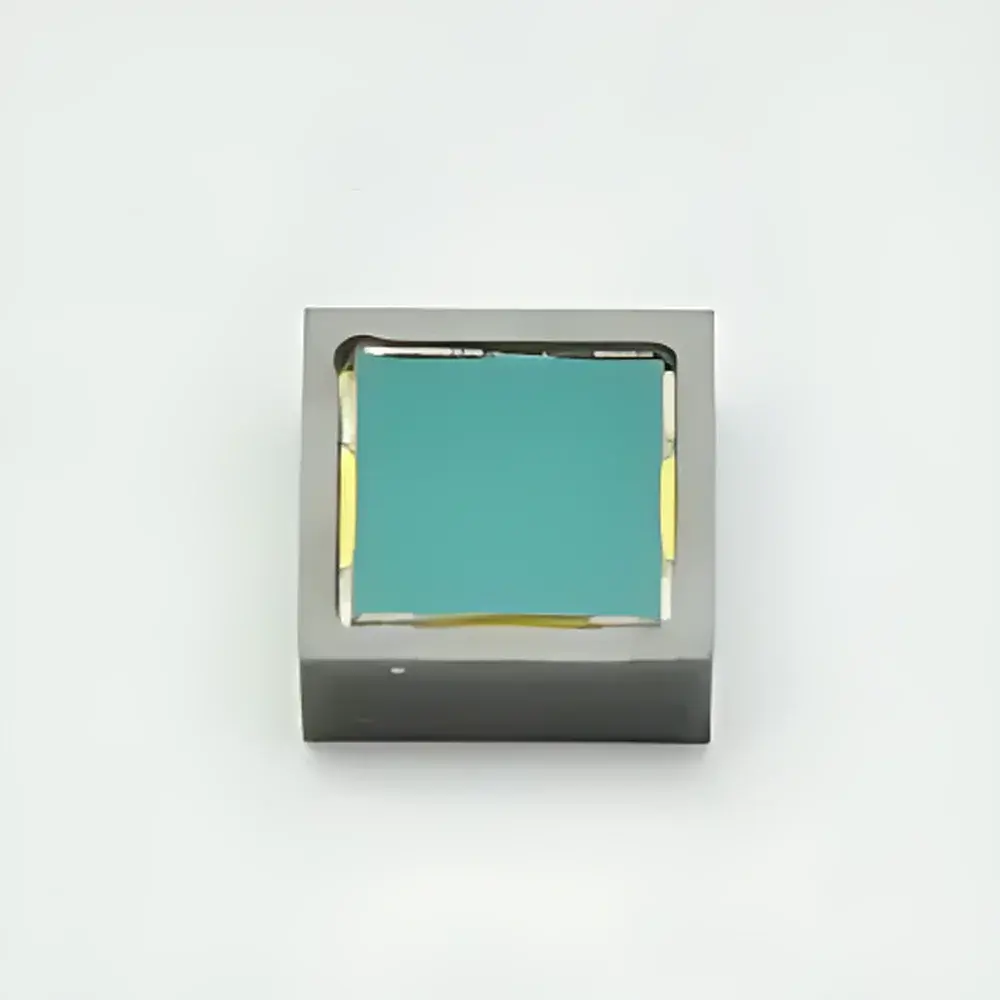
Hamamatsu Mid-Infrared LED L13771-0330C
| Brand | Hamamatsu |
|---|---|
| Origin | Japan |
| Manufacturer | Hamamatsu Photonics K.K. |
| Product Type | Mid-IR Light Source |
| Package | Ceramic Surface-Mount Device (SMD) |
| Peak Emission Wavelength (min/typ/max) | 3100 / 3300 / 3400 nm |
| Spectral FWHM (typ.) | 300 nm |
| Radiant Flux (typ.) | 0.25 mW |
| Forward Voltage (typ.) | 2.1 V |
| Operating Temperature | Ta = 25 °C (unless specified) |
Overview
The Hamamatsu Mid-Infrared LED L13771-0330C is a high-performance, surface-mount ceramic-packaged light source engineered for stable and efficient emission in the 3.1–3.4 µm spectral range. Unlike thermal emitters or quantum cascade lasers, this device operates on electroluminescence from optimized III-V semiconductor heterostructures, delivering narrow-band mid-infrared output with low power consumption and fast modulation capability. Its emission profile centers at 3300 nm (typ.), with a full width at half maximum (FWHM) of approximately 300 nm—making it particularly suitable for absorption spectroscopy targeting fundamental vibrational bands of C–H, O–H, and N–H bonds. Designed for integration into compact optical systems—including portable gas analyzers, process monitoring sensors, and laboratory-grade FTIR accessories—the L13771-0330C provides repeatable radiant flux output under controlled DC or pulsed drive conditions, with no warm-up time or spectral drift associated with filament-based sources.
Key Features
- Ceramic surface-mount package ensuring mechanical robustness and thermal stability during reflow soldering and long-term operation
- High radiometric output: 0.25 mW typical radiant flux at 2.1 V forward bias (Ta = 25 °C)
- Fast electro-optical response: sub-microsecond rise/fall times enabling kHz-range intensity modulation without waveform distortion
- Hermetically sealed construction for extended lifetime and resistance to humidity-induced degradation
- Low thermal resistance design facilitating passive heat dissipation in space-constrained modules
- Compliance with JEDEC J-STD-020 moisture sensitivity level (MSL) 3, supporting standard SMT assembly processes
Sample Compatibility & Compliance
The L13771-0330C is compatible with standard PCB layouts for 0805- and 1206-footprint components and supports both constant-current and pulse-width-modulated (PWM) drive configurations. It has been validated for use with common mid-IR photodetectors including thermopiles, pyroelectric sensors, and InSb photodiodes. From a regulatory standpoint, the device conforms to RoHS Directive 2011/65/EU and REACH Regulation (EC) No. 1907/2006. While not certified as an IEC 61000-4-x compliant subsystem, its low EMI signature and absence of high-frequency switching circuitry simplify electromagnetic compatibility (EMC) integration in analytical instrumentation. For applications requiring traceability in regulated environments (e.g., pharmaceutical QC or environmental monitoring), the component’s lot-level traceability and Hamamatsu’s ISO 9001-certified manufacturing ensure alignment with GLP documentation practices.
Software & Data Management
As a passive optical emitter, the L13771-0330C does not incorporate embedded firmware or digital interfaces. However, it is fully interoperable with industry-standard driver electronics—including analog current sources (e.g., Thorlabs LDCxx series) and programmable pulse generators (e.g., Keysight 33500B)—enabling synchronized illumination control within automated measurement sequences. When integrated into spectrometer platforms or custom optical benches, the LED’s stable output permits calibration against NIST-traceable blackbody references or certified reference materials (CRMs) per ASTM E1421–22. Data acquisition systems may log forward voltage, drive current, and detector signal simultaneously to support real-time compensation for temperature-induced wavelength shift—a feature critical for quantitative multi-component analysis.
Applications
- Non-dispersive infrared (NDIR) gas sensing for hydrocarbons (CH₄, C₂H₆), CO₂, and volatile organic compounds (VOCs)
- Portable and benchtop Fourier-transform infrared (FTIR) spectrometers used in polymer characterization and pharmaceutical raw material ID
- In-line process monitoring of moisture content in pharmaceutical granules or food products via O–H stretch absorption at ~3300 cm⁻¹
- Calibration source for mid-IR imaging systems and hyperspectral camera validation
- Research-grade setups investigating molecular fingerprinting in biological tissues and aqueous solutions
FAQ
What is the recommended drive current for optimal lifetime and output stability?
Hamamatsu specifies a maximum continuous forward current of 100 mA; operation at 70–80 mA provides optimal balance between radiant flux and thermal aging.
Can the L13771-0330C be operated in pulsed mode? If so, what are the limits?
Yes—pulse widths ≥10 µs and duty cycles ≤10% are supported; peak current must not exceed 150 mA to avoid electromigration-related failure.
Is the emission spectrum temperature-dependent?
Yes: peak wavelength exhibits a redshift of ~0.3 nm/°C, and radiant flux decreases by ~0.5%/°C above 25 °C; active temperature stabilization is advised for metrology-grade applications.
Does Hamamatsu provide spectral calibration data for individual units?
Spectral responsivity curves are supplied per batch; unit-level calibration certificates are available upon request under Hamamatsu’s Premium Calibration Service (additional lead time and cost apply).
How does this LED compare to quantum cascade lasers (QCLs) in mid-IR applications?
Unlike QCLs, the L13771-0330C offers lower cost, simpler drive electronics, and higher reliability in uncooled configurations—but lacks tunability and narrow linewidth required for high-resolution spectroscopy.




