
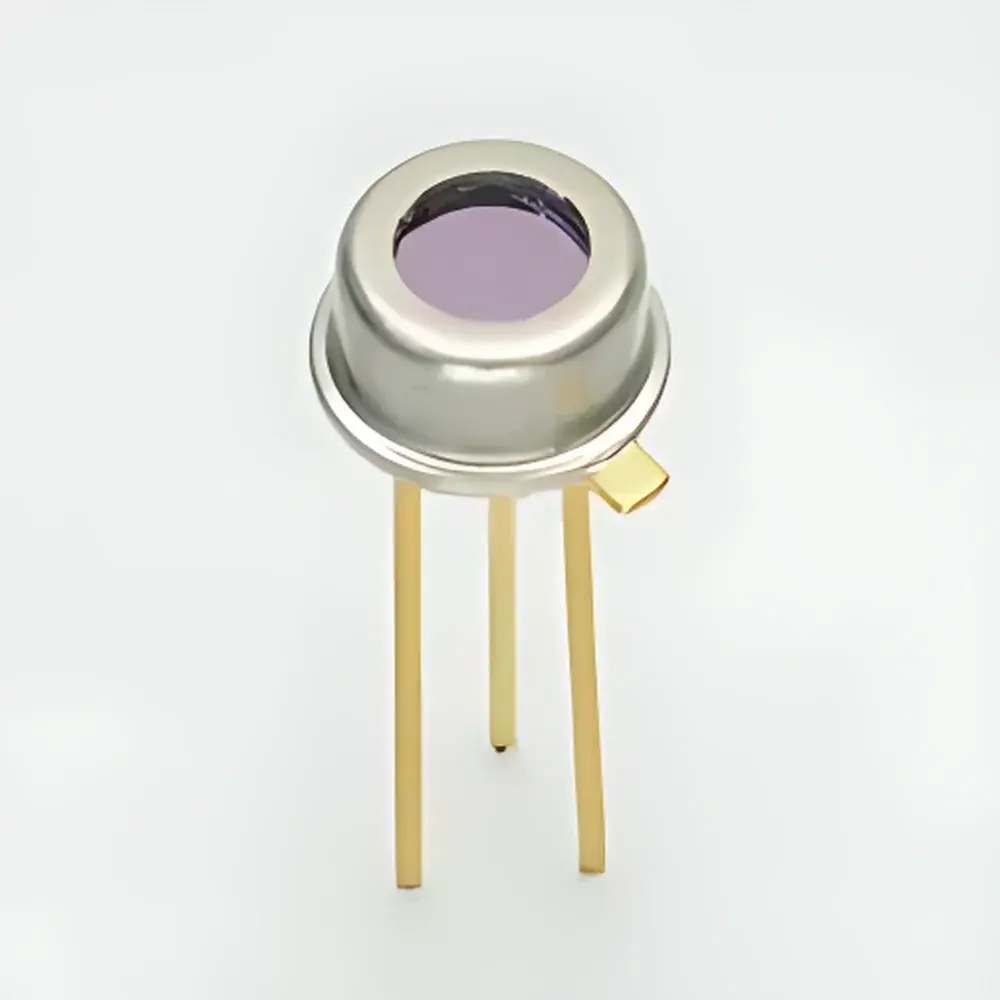
Hamamatsu Mid-IR LED L13201-0430M
| Brand | Hamamatsu |
|---|---|
| Origin | Japan |
| Manufacturer Type | Original Equipment Manufacturer (OEM) |
| Product Category | Imported |
| Model | L13201-0430M |
| Light Source Type | Mid-Infrared Light-Emitting Diode (LED) |
| Illumination Mode | External Illumination |
| Package Type | Metal Flat Cap |
| Peak Emission Wavelength (Min/Typ/Max) | 4100 / 4300 / 4400 nm |
| Spectral FWHM (Typ.) | 700 nm |
| Radiant Flux (Typ.) | 0.3 mW |
| Forward Voltage (Typ.) | 1.6 V |
| Operating Temperature | Ta = 25 °C (unless specified) |
Overview
The Hamamatsu Mid-IR LED L13201-0430M is a high-performance, solid-state light source engineered for precise mid-infrared spectral emission centered at 4.3 µm. Unlike thermal emitters or quantum cascade lasers, this device leverages Hamamatsu’s proprietary epitaxial crystal growth and heterostructure design on III–V semiconductor platforms to achieve narrow-band, room-temperature operation without active cooling. Its emission mechanism is based on interband radiative recombination in a tailored InAsSb-based heterojunction, optimized for strong absorption overlap with the fundamental asymmetric stretching vibration band of carbon dioxide (CO₂) near 2349 cm⁻¹ (4.26 µm). This makes the L13201-0430M particularly suited for non-dispersive infrared (NDIR) gas sensing architectures where stability, modulation capability, and long-term repeatability are critical under industrial or environmental monitoring conditions.
Key Features
- Peak emission wavelength precisely tuned to 4300 nm (±100 nm), matching the primary CO₂ absorption line for optimal signal-to-noise ratio in NDIR detection systems.
- Metal flat-cap hermetic package ensures mechanical robustness and long-term hermeticity—critical for maintaining optical output stability over >10,000 hours of continuous operation.
- Fast electrical-to-optical response time (<100 ns rise/fall), enabling kHz-range intensity modulation for lock-in amplification and background noise suppression.
- Low forward voltage (1.6 V typical) and minimal power dissipation support integration into battery-powered or low-power edge-sensing platforms compliant with IEC 60079-28 (optical radiation safety for hazardous areas).
- No moving parts, no warm-up delay, and immunity to mechanical shock—ideal for field-deployable analyzers and embedded OEM modules requiring high MTBF (Mean Time Between Failures).
Sample Compatibility & Compliance
The L13201-0430M is compatible with standard TO-18 and TO-46 socket interfaces and integrates seamlessly into optical benches using off-axis parabolic mirrors or ZnSe collimating optics. It meets RoHS Directive 2011/65/EU and REACH Regulation (EC) No. 1907/2006 requirements. While not intrinsically certified, its radiant flux and spectral profile comply with IEC 62471:2006 (Photobiological Safety of Lamps) for Risk Group 1 (Exempt), supporting safe integration into Class I laser product designs per IEC 60825-1:2014. The device is routinely employed in analyzers validated under ISO 8573-7 (compressed air purity—CO₂ measurement) and ASTM D6245 (indoor air quality CO₂ monitoring protocols).
Software & Data Management
As a passive optical component, the L13201-0430M does not incorporate onboard firmware or digital interfaces. However, it is fully compatible with industry-standard driver circuits—including constant-current sources with analog modulation inputs (0–5 V) and TTL-triggered pulse generators—enabling synchronization with data acquisition systems such as National Instruments DAQmx, Keysight U1282A, or open-source platforms (e.g., Arduino-compatible current drivers with PID temperature stabilization). When integrated into full-system solutions, raw detector signals from paired thermopile or pyroelectric sensors can be processed using MATLAB Signal Processing Toolbox or Python SciPy libraries for FFT-based baseline correction and peak-area quantification—supporting audit-ready traceability when aligned with GLP-compliant LabArchives or LabVantage ELN workflows.
Applications
- Non-dispersive infrared (NDIR) CO₂ gas analyzers for HVAC control, indoor air quality (IAQ) monitoring, and agricultural climate management.
- OEM modules for portable breathalyzers and medical capnographs requiring stable, low-drift IR excitation sources.
- Calibration references in FTIR spectrometer alignment procedures targeting the 4.0–4.6 µm spectral window.
- Research-grade setups for photoacoustic spectroscopy (PAS) of trace gases, where amplitude-modulated mid-IR illumination improves detection limits below 1 ppmv.
- Process analytical technology (PAT) tools deployed in pharmaceutical drying tunnels or bioreactor exhaust streams per FDA Guidance for Industry (2019) on real-time release testing.
FAQ
What is the recommended drive current for stable operation?
Hamamatsu specifies a maximum DC forward current of 100 mA; for optimal lifetime and wavelength stability, operation at 60–80 mA with heatsink-mounted PCBs is advised.
Can this LED be pulsed at frequencies above 10 kHz?
Yes—the device supports square-wave modulation up to 50 kHz with <10% duty cycle without thermal roll-off, provided transient current spikes remain within absolute maximum ratings.
Is there a datasheet revision history available?
Yes—Hamamatsu publishes controlled revision logs for all optoelectronic components; Revision D (2023) includes updated thermal resistance values and aging test data per JESD22-A108F.
Does Hamamatsu offer matched photodetectors for this wavelength?
Yes—models P11262-01R (InSb photovoltaic detector) and S120VC (thermopile sensor) are characterized for co-optimization with L13201-series emitters.
How is spectral drift managed over temperature variation?
Peak wavelength exhibits a shift of +0.45 nm/°C; system-level compensation is implemented via closed-loop TEC control or software-based baseline referencing in dual-beam configurations.





