
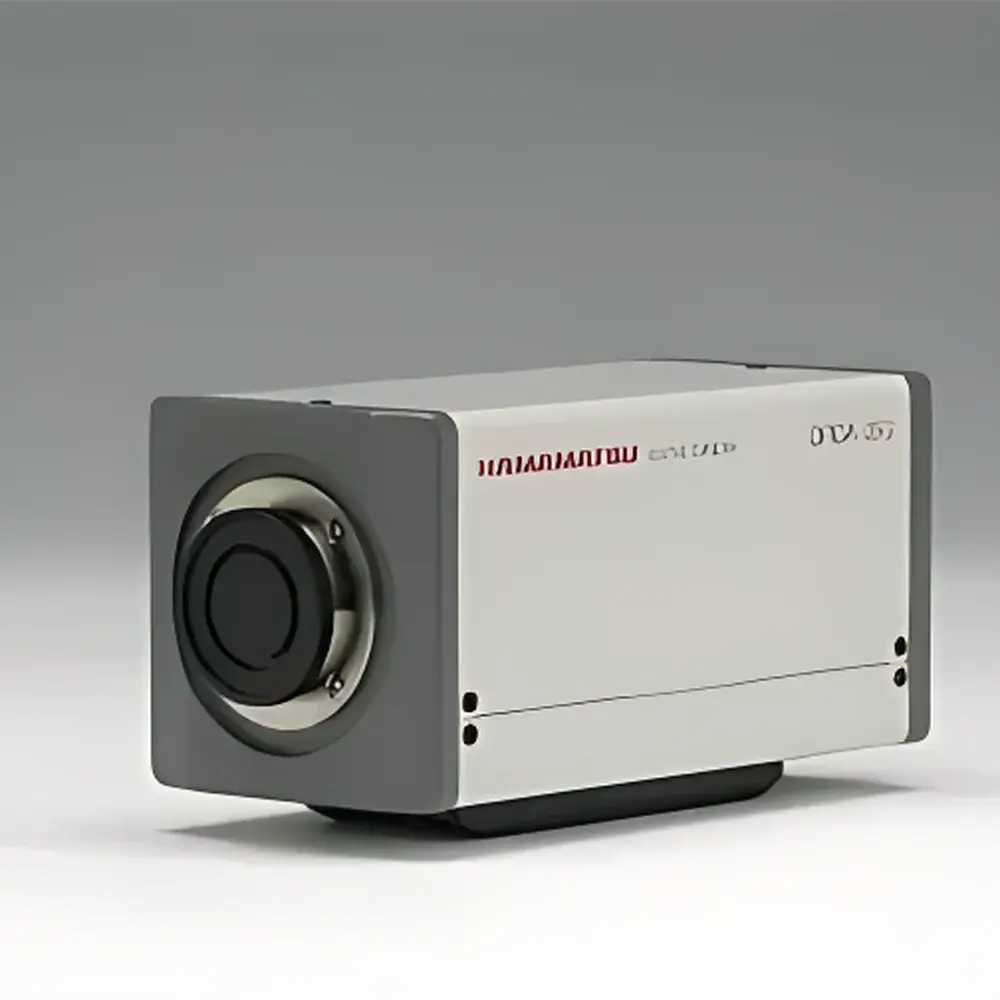
Hamamatsu ORCA-05G High-Resolution Scientific CCD Camera
| Brand | Hamamatsu |
|---|---|
| Origin | Japan |
| Manufacturer | Hamamatsu Photonics K.K. |
| Type | Interline Transfer CCD Camera |
| Model | C8484-05G02 |
| Cooling | Air-Cooled |
| Pixel Count | 1344 (H) × 1024 (V) |
| Pixel Size | 6.45 µm × 6.45 µm |
| Full Well Capacity | 15,000 e⁻ |
| Readout Noise | 10 e⁻ rms (typ.) |
| Dynamic Range | 1500:1 |
| Frame Rate | 8.9 fps (full resolution), 43 fps (8×8 binning) |
| Exposure Time | 10 µs – 1 s |
| Analog Gain | 1×, 5× |
| A/D Resolution | 12-bit |
| Interface | IEEE 1394a (FireWire), IIDC v1.30 compliant |
| Trigger Modes | Edge, Level |
| Output Signals | Integration Sync, Programmable Timing, Trigger Ready |
| Lens Mount | C-mount |
| Power Supply | DC +8 V to +30 V |
| Power Consumption | 8 VA |
| Operating Temperature | 0 °C to +40 °C |
| Storage Temperature | −10 °C to +50 °C |
| Humidity | ≤70% RH (non-condensing) |
Overview
The Hamamatsu ORCA-05G (model C8484-05G02) is a high-performance, air-cooled scientific-grade interline transfer CCD camera engineered for quantitative low-light imaging across life sciences, materials research, and industrial inspection applications. Its core architecture leverages a back-illuminated, microlens-enhanced interline CCD sensor with true progressive-scan readout—eliminating mechanical shutter artifacts and enabling precise temporal control of exposure. Unlike frame-transfer or full-frame CCDs, the interline design provides inherent anti-blooming capability and rapid charge transfer, making it especially suitable for dynamic fluorescence imaging, time-resolved microscopy, and synchronized multi-modal acquisition. The sensor delivers a native resolution of 1344 × 1024 pixels at 6.45 µm pitch, covering an active area of 8.67 mm × 6.60 mm, with spectral sensitivity spanning 350 nm to 1000 nm—optimized for visible and near-infrared (NIR) photon detection. With a full-well capacity of 15,000 electrons and a typical readout noise of 10 e⁻ rms, the ORCA-05G achieves a measured dynamic range of 1500:1, supporting both high-signal fidelity and sub-photon-level contrast recovery in demanding quantitative workflows.
Key Features
- Interline Transfer Architecture: Enables global electronic shuttering without mechanical components—critical for vibration-sensitive setups and high-repetition-rate triggering.
- Low-Noise, High-Dynamic-Range Imaging: 12-bit digitization paired with dual-gain analog amplification (1× and 5×) preserves signal integrity across intensity extremes; optimized for both bright-field and weak-fluorescence applications.
- High-Speed Readout Options: Full-resolution acquisition at 8.9 fps; region-of-interest (ROI) and on-chip 8×8 pixel binning support up to 43 fps—facilitating real-time tracking and kinetic assay monitoring.
- Robust Triggering & Synchronization: Hardware-level edge- and level-triggered input with programmable output signals (integration sync, trigger-ready, user-defined timing)—enabling seamless integration into automated stages, laser pulsed systems, and multi-camera configurations.
- C-Mount Compatibility & Compact Form Factor: Standard C-mount interface ensures universal lens compatibility; natural convection cooling eliminates fan-induced vibration—ideal for inverted microscopes and optical tables requiring mechanical stability.
- IEEE 1394a (FireWire) Interface: Compliant with IIDC 1394 digital camera specification v1.30—ensuring interoperability with major third-party acquisition software (e.g., Micro-Manager, NIS-Elements, MetaMorph) and supporting deterministic data streaming over long cable runs (up to 4.5 m).
Sample Compatibility & Compliance
The ORCA-05G is routinely deployed in regulated environments where measurement traceability and system validation are required. Its stable gain calibration, linear response across the full dynamic range (R² > 0.9999), and deterministic exposure timing support compliance with ISO/IEC 17025 for laboratory accreditation and GLP-aligned imaging protocols. While not FDA-cleared as a medical device, its performance characteristics align with ASTM E2717-19 standards for digital image sensor characterization in analytical microscopy. The camera’s non-vibrating thermal management and absence of moving parts contribute to long-term operational reliability—essential for unattended acquisition in QC labs and semiconductor metrology suites. Environmental specifications (0–40 °C operating, −10–50 °C storage, ≤70% RH non-condensing) meet IEC 60529 IP20 requirements for indoor laboratory use.
Software & Data Management
Hamamatsu provides the HCImage Live acquisition suite (Windows-based), offering real-time histogram analysis, ROI statistics, live gamma correction, and hardware-accelerated background subtraction. All parameters—including exposure time, gain, trigger mode, and binning—are controllable via ASCII command protocol over FireWire, enabling full script-driven automation using Python (via PyHamamatsu), MATLAB, or LabVIEW. Metadata embedding (exposure, gain, timestamp, temperature) follows TIFF/OME-XML conventions, ensuring compatibility with open-source platforms such as QuPath and ImageJ/Fiji for downstream quantification. Audit trail functionality—when integrated with validated LIMS or ELN systems—supports 21 CFR Part 11-compliant workflows through external logging of acquisition parameters and user authentication.
Applications
- Widefield fluorescence microscopy: GFP/RFP/NIR fluorophore imaging with minimal phototoxicity due to high quantum efficiency and low read noise.
- Chromosome ploidy analysis and DNA content quantification via Feulgen-stained nuclei or DAPI counterstaining.
- Fluorescence in situ hybridization (FISH) with multiplexed probe detection under controlled exposure conditions.
- Differential interference contrast (DIC) and phase contrast combined with epifluorescence—leveraging the camera’s wide spectral response and spatial uniformity.
- Metallurgical and semiconductor defect inspection using transmitted light or X-ray scintillator coupling (e.g., Gd₂O₂S:Tb screens).
- Dynamic cellular motility assays, including phagocytosis, migration, and ciliary beating—enabled by high frame rate and precise external synchronization.
- Low-light histopathology slide scanning and archival digitization where color fidelity and SNR preservation are critical.
FAQ
Does the ORCA-05G support hardware binning?
Yes—it supports on-chip 2×2, 4×4, and 8×8 pixel binning, delivering increased sensitivity and higher effective frame rates at reduced spatial resolution.
Is cooling active or passive?
The ORCA-05G uses natural convection (fanless) air cooling. It does not incorporate thermoelectric (TE) cooling, making it suitable for vibration-sensitive optical paths but limiting dark current suppression compared to cooled EMCCDs or sCMOS cameras.
Can the camera be triggered externally while acquiring continuously?
Yes—the external trigger input operates in “trigger-first” or “start-stop” modes, allowing precise synchronization with pulsed light sources or stage motion without interrupting continuous streaming.
What is the maximum cable length for IEEE 1394a operation?
Standard FireWire cables support reliable operation up to 4.5 meters; longer distances require active repeaters or fiber-optic FireWire extenders.
Is the sensor sensitive to near-infrared wavelengths beyond 800 nm?
Yes—the interline CCD features extended red/NIR response up to ~1000 nm, with peak QE >45% at 700 nm and measurable signal at 900 nm when paired with appropriate optics and illumination.




