
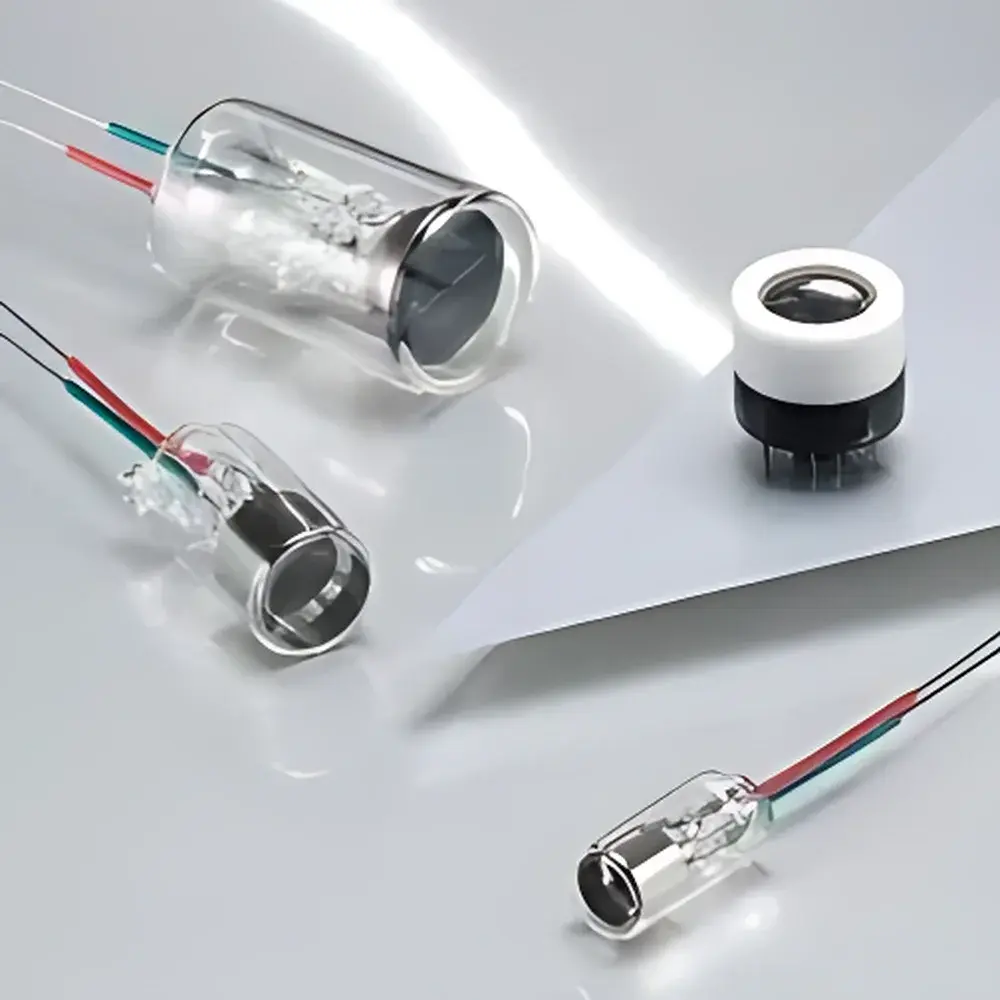
Hamamatsu Phototube R6800U-01
| Brand | Hamamatsu |
|---|---|
| Origin | Japan |
| Manufacturer Type | Original Equipment Manufacturer (OEM) |
| Product Origin | Imported |
| Model | R6800U-01 |
| Spectral Range | 185–350 nm |
| Peak Wavelength | 240 nm |
| Photocathode Material | Cesium Telluride (Cs-Te) |
| Window Material | Solar-Blind UV-Transmitting Glass |
| Photocathode Diameter | 8 mm (min.) |
| Envelope Diameter | 16 mm |
| Cathode Peak Current | 1.2 µA |
| Anode Supply Voltage (max) | 30 V |
| Avg. Cathode Current Density (max) | 5 µA/cm² |
| Avg. Cathode Current (max) | 0.4 µA |
| Operating Temperature | –80 to +50 °C |
| Radiant Sensitivity @ 254 nm (typ.) | 20 mA/W |
| Dark Current (max) | 1 pA |
| Recommended Operating Voltage | 15 V |
| Inter-Electrode Capacitance | 3 pF |
Overview
The Hamamatsu R6800U-01 is a solar-blind vacuum phototube engineered for high-fidelity ultraviolet (UV) radiation detection in demanding environmental monitoring and industrial safety applications. Based on the photoelectric effect, this device utilizes a cesium telluride (Cs-Te) photocathode deposited on a UV-transmitting fused silica window, delivering intrinsic spectral selectivity with negligible visible-light response. Its defined spectral range of 185–350 nm and peak sensitivity at 240 nm make it particularly suited for detecting low-intensity UV-C emissions from mercury-vapor lamps, arc discharges, and plasma sources—common signatures in ozone generation systems, UV sterilization validation, and flame detection subsystems. Unlike semiconductor-based UV sensors, the R6800U-01 exhibits no persistent photocurrent, zero temperature-induced gain drift, and immunity to electromagnetic interference, ensuring stable baseline performance across wide ambient temperature excursions (–80 °C to +50 °C).
Key Features
- Solar-blind spectral response: Effectively rejects visible and near-IR radiation due to Cs-Te photocathode physics and UV-grade optical window
- Ultra-low dark current: ≤1 pA maximum enables high signal-to-noise ratio (SNR) operation in low-flux UV environments
- High radiant sensitivity: 20 mA/W typical at 254 nm—optimized for mercury-line monitoring and germicidal irradiance assessment
- Robust vacuum envelope: Hermetically sealed glass tube with 16 mm outer diameter and 8 mm active photocathode area ensures long-term stability and resistance to humidity-induced degradation
- Low inter-electrode capacitance: 3 pF design supports fast pulse response (<10 ns rise time, typical) suitable for transient UV event capture
- Wide dynamic operating voltage range: Stable operation from 15 V (recommended) up to 30 V anode supply, compatible with standard industrial analog input modules and programmable logic controller (PLC) interfaces
Sample Compatibility & Compliance
The R6800U-01 is designed for integration into fixed or portable gas detection and UV monitoring platforms where regulatory compliance requires traceable, repeatable photometric response. It meets key requirements for use in Class I, Division 1 hazardous location instrumentation when embedded in certified enclosures per UL 913 and ATEX/IECEx directives. While the phototube itself is not intrinsically safe, its low power consumption (<50 mW at 15 V) and absence of thermal runaway characteristics facilitate safe integration into explosion-proof gas alarm housings. The device complies with ISO 17025 traceability principles when calibrated against NIST-traceable UV radiometers, and its spectral responsivity data supports conformity with ASTM E1318 (Standard Specification for Ultraviolet Radiometers) and IEC 62471 (Photobiological Safety of Lamps).
Software & Data Management
As a passive analog transducer, the R6800U-01 outputs a linear photocurrent proportional to incident UV irradiance. For system-level data integrity, it is recommended to pair the phototube with a precision transimpedance amplifier featuring 16-bit or higher ADC resolution and configurable gain (e.g., 10⁶–10⁸ V/A). When integrated into networked environmental monitoring systems, raw current signals are digitized, timestamped, and logged in accordance with FDA 21 CFR Part 11 requirements—including electronic signature capability, audit trail logging, and user-access controls—when deployed in pharmaceutical cleanroom UV validation or water treatment disinfection monitoring. Firmware-level calibration coefficients (e.g., responsivity vs. wavelength lookup tables) can be stored in non-volatile memory for automated compensation during real-time irradiance computation.
Applications
- UV-C intensity monitoring in municipal and industrial water/air disinfection systems
- Ozone generator output verification in HVAC and semiconductor fab exhaust abatement
- Flame detection in gas-fired industrial burners (utilizing UV emission at 185–260 nm)
- Real-time validation of UV lamp aging in pharmaceutical UV sterilization tunnels (per USP and EU GMP Annex 15)
- Background UV radiation measurement in high-altitude atmospheric research stations
- Calibration reference source for field-deployable UV spectroradiometers
FAQ
Is the R6800U-01 suitable for continuous operation in humid outdoor environments?
Yes—when housed in an IP66-rated enclosure with desiccant-filled optical port, the hermetic vacuum seal prevents moisture ingress. However, direct exposure to rain or condensation on the UV window must be avoided to prevent transmission loss.
What is the recommended load resistor value for optimal linearity at 254 nm?
For 15 V bias and typical cathode current (≤0.4 µA), a 1–10 MΩ feedback resistor in a transimpedance configuration provides optimal SNR and bandwidth trade-off.
Does Hamamatsu provide NIST-traceable calibration certificates for individual units?
Yes—calibration services include spectral responsivity mapping from 185 nm to 350 nm with ±3% uncertainty (k=2) and are available as optional add-ons upon order.
Can the R6800U-01 be used in pulsed UV laser detection?
Yes—its sub-10 ns rise time and low capacitance support single-pulse energy measurement down to ~10 nJ at 248 nm (KrF excimer), provided appropriate amplification and gated acquisition are implemented.
How does temperature affect dark current and responsivity?
Dark current increases by ~0.1 pA per 10 °C above –20 °C; responsivity remains stable within ±1% over –40 to +40 °C, making it suitable for unregulated ambient installations.
Related Products







