
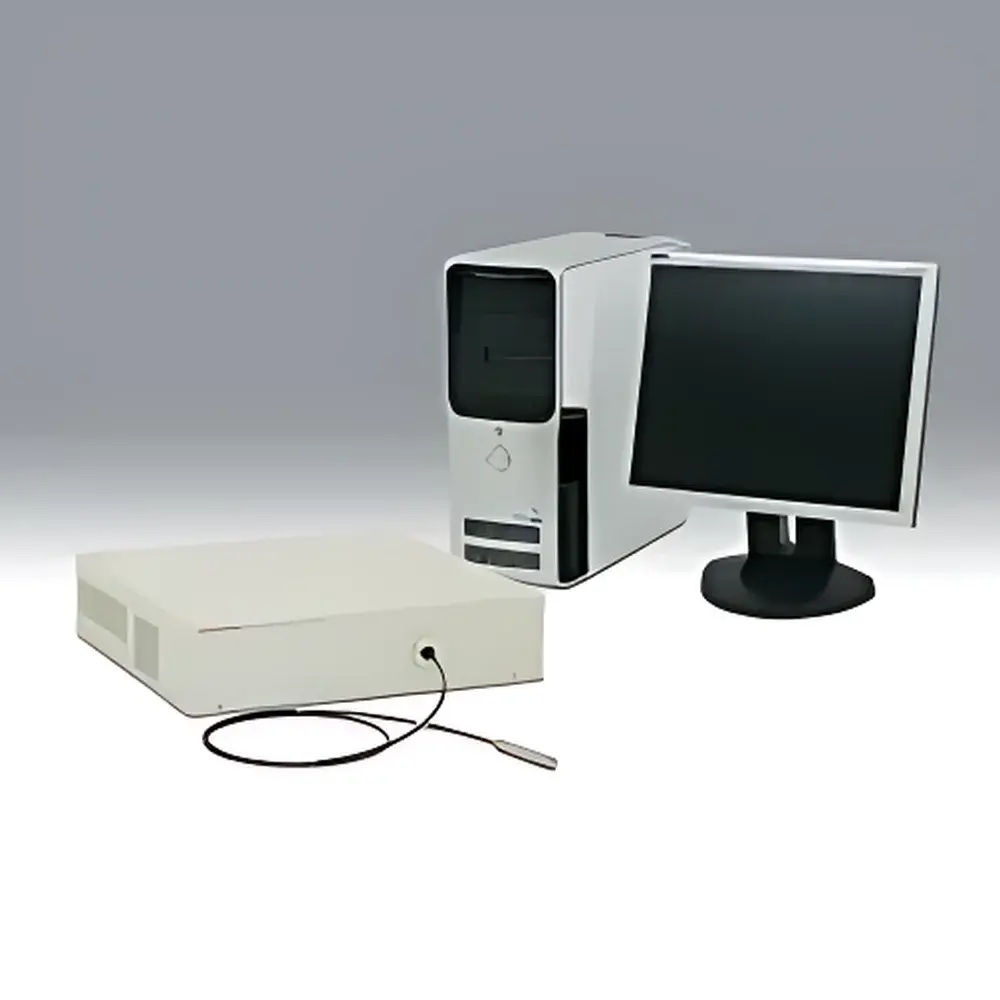
Hamamatsu PMA-20 Fiber Optic Spectrometer
| Brand | Hamamatsu |
|---|---|
| Origin | Japan |
| Manufacturer | Hamamatsu Photonics K.K. |
| Model | C10494-01 |
| Spectral Range | 200 nm to 950 nm |
| Detector Type | BT-CCD linear array sensor |
| Optical Resolution | 3 nm (FWHM) |
| Pixel Count | 2048 ch |
| Pixel Size | 12 µm × 972 µm |
| Read Noise | 100 electrons |
| Dark Current | 100 electrons/scan (at 25 °C, 100 µs integration) |
| Integration Time | 100 µs to 1 s |
| A/D Resolution | 12 bit |
| Optical Design | Czerny-Turner |
| f-number | f/4 |
| Fiber Type | Quartz optical fiber |
| Fiber Length | 1.5 m |
| Interface | Camera Link / USB 2.0 |
| Power Supply | AC 100–240 V, 50/60 Hz |
Overview
The Hamamatsu PMA-20 Fiber Optic Spectrometer is a high-speed, compact, and factory-calibrated spectroscopic measurement system engineered for time-resolved optical analysis in research and industrial quality control environments. Based on the Czerny-Turner optical architecture with an f/4 aperture, it delivers consistent spectral fidelity across a broad 200–950 nm range using a back-thinned (BT) CCD linear array sensor (2048 pixels). Its core design enables single-shot spectral acquisition at minimum integration times of 100 µs—making it suitable for transient phenomena such as pulsed laser emission, rapid chemical kinetics, and sub-millisecond photophysical processes. Unlike modular spectrometer systems requiring external calibration or alignment, the PMA-20 integrates the optical bench, detector, and power supply into a single robust housing, with wavelength and spectral responsivity pre-characterized traceably to NIST-traceable standards. This eliminates user-dependent calibration drift and ensures reproducibility across laboratories and operational cycles.
Key Features
- Sub-millisecond temporal resolution: 100 µs minimum integration time supports real-time monitoring of fast optical transients
- Pre-aligned Czerny-Turner optical path with f/4 throughput, optimized for signal-to-noise efficiency in broadband UV-VIS-NIR detection
- Back-thinned CCD detector with 2048-pixel linear array and 12-bit A/D conversion, delivering high quantum efficiency from 200 nm (deep UV) through 950 nm (near-infrared)
- Factory-wavelength-calibrated and spectrally responsivity-corrected—no user recalibration required for quantitative intensity measurements
- Integrated quartz optical fiber interface (1.5 m length, SMA 905 connector), enabling non-contact, flexible sampling in confined or hazardous environments
- Dual interface support: high-bandwidth Camera Link for synchronized multi-device acquisition and USB 2.0 for standalone operation and rapid deployment
- Compact monolithic chassis (dimensions provided in datasheet) designed for benchtop integration, OEM embedding, or portable field use
Sample Compatibility & Compliance
The PMA-20 interfaces seamlessly with diverse sample configurations via standard 400 µm core quartz optical fiber. It supports transmission, reflectance, fluorescence, and absorption measurements without hardware modification. Common applications include cuvette-based liquid-phase kinetics, gas-phase emission monitoring, solid-state luminescence mapping, and plasma diagnostics. The instrument complies with IEC 61326-1 (EMC for laboratory equipment) and meets CE marking requirements for safety and electromagnetic compatibility. While not inherently 21 CFR Part 11 compliant as a standalone device, its digital output (via Camera Link or USB) is compatible with validated LIMS or ELN platforms that implement audit trail, electronic signature, and data integrity controls per GLP/GMP and ISO/IEC 17025 guidelines. Calibration certificates are supplied with NIST-traceable reference data for wavelength and relative spectral responsivity.
Software & Data Management
Hamamatsu provides the proprietary PMA Series Control Software (Windows-compatible), which supports real-time spectrum visualization, batch acquisition scripting, dark subtraction, smoothing, peak detection, and export in CSV, TXT, and HDF5 formats. The SDK (C/C++, LabVIEW, Python) enables full low-level control of integration time, trigger mode (internal/external TTL), gain, and region-of-interest readout. All spectral data includes embedded metadata: timestamp, integration time, detector temperature (monitored internally), and calibration file version. For regulated environments, raw binary frame data can be archived alongside processed spectra to satisfy ALCOA+ (Attributable, Legible, Contemporaneous, Original, Accurate) data integrity principles. No cloud connectivity or automatic telemetry is implemented—data remains under full user control.
Applications
- Time-resolved photoluminescence decay analysis in semiconductor and phosphor materials
- Stopped-flow kinetic studies of enzyme-catalyzed reactions and protein folding dynamics
- Laser-induced breakdown spectroscopy (LIBS) and spark emission monitoring
- Real-time UV-Vis absorption tracking during photochemical synthesis or polymerization
- Plasma emission profiling in thin-film deposition and etching processes
- Quality assurance of LED and OLED spectral power distribution (SPD) under pulsed drive conditions
- Environmental sensing: dissolved organic matter (DOM) fluorescence fingerprinting in water samples
FAQ
What is the typical spectral accuracy and repeatability of the PMA-20?
Wavelength accuracy is ±0.5 nm over the full 200–950 nm range; pixel-to-pixel repeatability is better than ±0.1 nm RMS under stable thermal conditions (±1 °C).
Can the PMA-20 operate in triggered or gated acquisition mode?
Yes—it supports external TTL triggering with programmable delay (0–10 s) and gate width (100 µs–1 s), essential for pump-probe and time-gated fluorescence experiments.
Is thermoelectric cooling available for the CCD sensor?
No—the BT-CCD operates at ambient temperature (25 °C nominal); dark current is specified at this condition. For ultra-low-noise applications below 100 µs, users may employ external thermal stabilization of the housing.
Does the system include radiometric calibration?
The standard configuration includes relative spectral responsivity correction. Absolute irradiance calibration (e.g., W/m²/nm) is available as an optional service using NIST-traceable tungsten halogen and deuterium lamp sources.
What maintenance is required for long-term stability?
No routine optical alignment or recalibration is needed. Users should periodically verify wavelength calibration using a mercury-argon emission lamp (recommended annually) and maintain clean fiber connectors per IEC 61300-3-35.




